
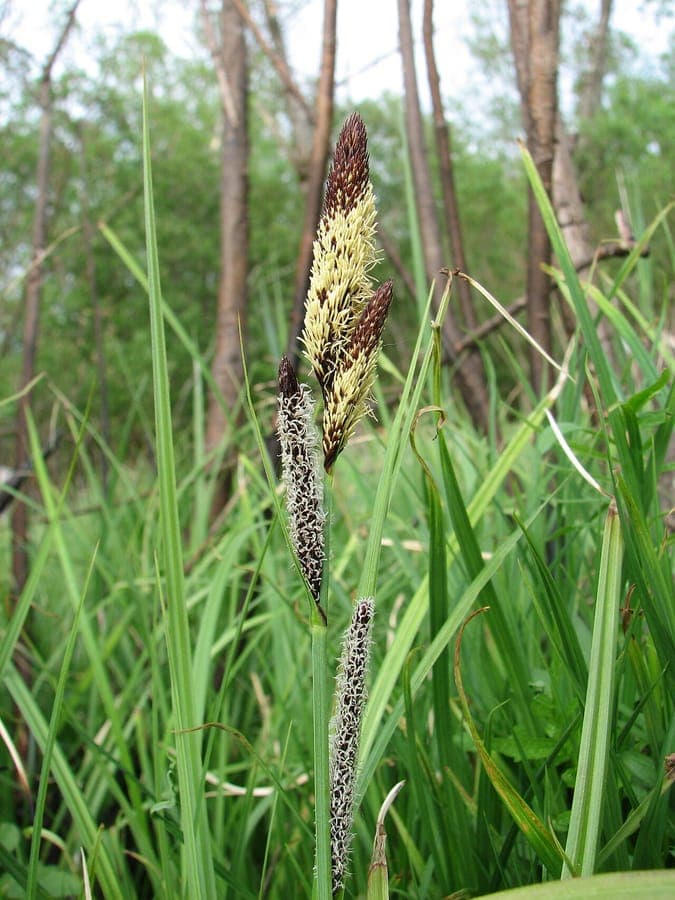
This photography was created by Artem Topchiy (user Art-top). Other photos see here This photograph was taken with a Canon PowerShot S2 IS / CC BY-SA 3.0, via Wikimedia Commons
Lesser pond sedge: complete guide
Carex acutiformis
Want to see Lesser pond sedge: complete guide in your garden?
1 minute, no credit card
Overview
Lesser pond sedge (Carex acutiformis) is a native European sedge perfect for gardens with wet areas, pond edges, and naturalistic water features. This elegant grass-like plant occurs naturally from Europe to western Asia and has been cultivated in wetland gardens for centuries.
Also called 'swamp sedge' or 'European lake sedge,' this sedge thrives in permanently wet conditions. In gardens, it provides structure, year-round interest, and a natural transition between water and dry ground.
Appearance & bloom cycle
Lesser pond sedge grows to 90-120 cm tall with fine, long-linear leaves 4-6 mm wide. Leaves emerge in dense tufts that remain green through winter, providing interest in the dormant season.
Flowers appear April-May in small, inconspicuous spikes. Male spikes are yellowish-brown at stem tips; female spikes below are greenish-brown. While not showy, they create interesting patterns.
The seed heads form small, distinctive structures that remain architecturally interesting through fall.
Ideal location
Lesser pond sedge is a true water plant and thrives only in permanently or regularly wet conditions:
- Pond edges: Submerged to 15 cm water depth
- Wetland areas: Permanently waterlogged soil
- Drainage swales: Areas where water collects naturally
- Slope bases: Where water moves slowly downslope
Full sun to half shade. Needs minimum 4 hours direct sun but tolerates shade well.
Critical point: This plant cannot survive in dry soil. Even one dry season kills it. This is absolutely a wetland plant.
Soil requirements
Lesser pond sedge demands wet to very wet soil. Ideal growing medium is silt, mud, or clay rich in organic matter.
- Moisture: Permanently wet. Cannot tolerate drought under any circumstances
- Texture: Silty, muddy soil, or heavy clay with high organic matter
- pH: Neutral to slightly alkaline
- Fertility: Moderately fertile (excessive nutrients promote algae, not growth)
In gardens, plant in aquatic baskets on pond floors or in deep planting pits with regular water supplied.
Watering
Traditional watering doesn't apply here - lesser pond sedge requires permanent inundation.
- Pond planting: Position at 10-15 cm depth; roots extend deep into muddy bottoms
- Garden planting: Position in low areas where water naturally collects or in irrigated basins
- Container culture: Place pots in water-filled saucers, maintaining constant water level
Too dry means death. This is non-negotiable.
Free design
Want to see Lesser pond sedge: complete guide in your garden? Make a free design now.
Pruning
Minimal pruning needed - the plant maintains itself naturally.
- March: Remove last year's dead leaves
- June-July: Trim tall leaves if desired for neatness
- October: Leave seed heads for winter interest
The plant is semi-evergreen and looks somewhat unkempt in late winter, but this is normal.
Maintenance calendar
March: Remove last season's dead leaves. Check water levels.
April-May: Active growth and flowering. Maintain constant water levels.
June-August: Vigorous growth. Refill water regularly during dry periods.
September-October: Growth slows. Maintain water levels.
November-February: Winter dormancy. Plant remains semi-green. May reduce water slightly in extremely wet winters.
Winter hardiness
Lesser pond sedge is very hardy to -20°C (USDA zone 5). No frost damage in Dutch winters. Risk comes from deep water freezing; ensure plant base remains submerged beneath ice.
In very wet winters, excess surface water may cause rotting; provide some drainage outlet.
Companion plants
Lesser pond sedge pairs well with:
- Other Carex species: Carex elata or other water sedges
- Iris pseudacorus (Yellow flag iris): Classic combination
- Butomus umbellatus (Flowering rush): Same habitat preference
- Phragmites australis (Common reed): Natural marginal planting
- Filipendula (Meadowsweet): For slope bases
- Mentha aquatica (Water mint): Ground cover around margins
Closing
Lesser pond sedge is essential for any water feature in the garden. It provides natural marginal planting, structure, and year-round interest. You'll find it at most garden centres in aquatic plant sections.
On gardenworld.app, design a water garden with lesser pond sedge perfectly positioned for impact. Visualize how your pond or wet area looks with sedges in place using our design tool. Plan colors and vegetation volumes before you dig.
On gardenworld.app, explore other wetland plants that pair perfectly with this sedge and discover how to create naturalistic water margins with thoughtful plant selection.
Want to see Lesser pond sedge: complete guide in your garden? Make a free design now.
Upload a photo, pick a style, and get a photorealistic design with plant list in under a minute.
No credit card required


Similar plants
Flat-stemmed club-rush: complete guide
Bolboschoenus planiculmis
Everything about Bolboschoenus planiculmis: growing conditions, watering, care, and use as a pond margin or wetland plant in garden design.
Great Plains flatsedge: complete guide
Cyperus lupulinus
Everything about Great Plains flatsedge (Cyperus lupulinus): growing conditions, care, garden uses, and ecological value. Tips for pond margins and dry sandy soils.
Golden beak sedge: complete guide
Rhynchospora corymbosa
Everything about golden beak sedge (Rhynchospora corymbosa): a dramatic tropical marginal for pond edges, bog gardens, and wet habitats.