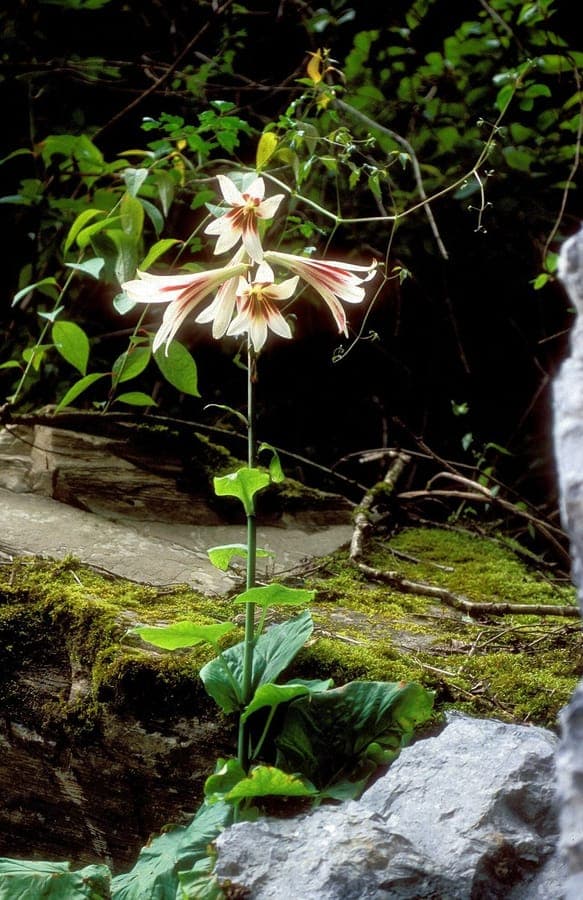
Ernst Gügel / CC BY-SA 3.0, via Wikimedia Commons
Giant Himalayan lily (Cardiocrinum giganteum): complete guide
Cardiocrinum giganteum
Want to see Giant Himalayan lily (Cardiocrinum giganteum): complete guide in your garden?
Full design in HD: €7.99
Look after your Giant Himalayan lily with the GardenWorld app
Identify plants with your camera and get a care calendar with reminders for this plant.


Overview
The giant Himalayan lily (Cardiocrinum giganteum) is the largest plant in the lily family. In the summer of its flowering year a stem of 2 to 3 metres, sometimes more, shoots up from a rosette of glossy, heart-shaped leaves. At the top hang up to twenty white trumpet flowers with a sweet, heavy scent in the evening. Anyone who has seen it in a shady woodland garden does not forget it.
In the wild the species grows in the Himalaya, from Nepal and Bhutan to Tibet and Myanmar, and on into western and central China. It grows in damp mountain forests and in clearings between the trees, at altitudes of over 3,000 metres. It was once classed among the true lilies as Lilium giganteum. The genus name Cardiocrinum refers to the heart-shaped leaves: kardia means heart and krinon means lily.
This is not a plant for impatient gardeners. A bulb takes several years to flower, and then it dies. If you understand that rhythm and plan for it at planting time, you can still count on flowers every year or every other year. A good position does half the work. On gardenworld.app you can have a garden design made in which dappled shade, shelter and bold foliage plants come together as a woodland garden where this giant belongs.
Toxicity
Whether the giant Himalayan lily is poisonous to cats has not been established with certainty. True lilies (Lilium) and daylilies (Hemerocallis), however, are extremely toxic to cats: a few bites of leaf, a little pollen or water from a vase can cause acute kidney failure. Because Cardiocrinum is closely related to those lilies, it is wise to treat it with the same caution. Do not let cats chew it, and go to the vet at once if you have the slightest suspicion, because speed is vital with lily poisoning.
No serious poisonings are known in people or dogs, but do not eat any part of the plant, and keep young children away from the bulbs and seeds.
Appearance and flowering season
The leaves are broadly heart-shaped, glossy dark green and up to 30 to 45 cm long. They often have a bronze tint as they unfurl in spring. In the years without flowers the plant forms only this rosette of leaves, which is decorative in a shady corner in its own right.
In the flowering year a thick, hollow stem grows from April and reaches its full height in June or July. Higher up the stem the leaves become smaller. Flowering usually comes in July, sometimes in late June or into August. Each stem carries ten to twenty drooping to horizontal trumpet flowers, 15 to 20 cm long. They are white to creamy white, streaked inside with reddish purple. After flowering, upright seed capsules form; they stand well into winter and look good in dried arrangements.
Flowering once and then dying
The giant Himalayan lily is monocarpic: each bulb flowers once in its life and then dies. From seed it often takes seven years or more for a plant to flower. A bought bulb of flowering size usually still needs one to three years. All that time the bulb builds reserves in a rosette of leaves until it is large enough to put everything into a flowering stem in a single season.
After flowering the mother bulb shrivels, but by then several offsets have formed around its base. These need another three to five years to flower themselves. The secret of regular flowering is therefore to plant bulbs of different sizes, or to add a few new bulbs every year. That way there is always one ready to flower.
Ideal position
Give the giant Himalayan lily a cool spot in light or dappled shade, such as beneath tall deciduous trees or on the north or east side of a group of shrubs. Morning sun is fine, but strong midday sun scorches the leaves and dries out the soil. A hot, dry site is the quickest route to failure.
Shelter from wind matters, because the tall stem with its heavy head of flowers can snap in a gale. A spot between shrubs or beside a hedge is ideal. Think about the fragrance too: plant it where you walk past in the evening.
Free preview
Want to see Giant Himalayan lily (Cardiocrinum giganteum): complete guide in your garden? Make a free preview of your design.
Soil requirements
The giant Himalayan lily is a hungry plant. It wants deep, humus-rich soil that stays moist without becoming waterlogged. Slightly acid to neutral soil is ideal. Before planting, work plenty of leaf mould, well-rotted manure or garden compost into a hole at least 50 cm wide and deep. On heavy clay add coarse grit for extra drainage; on sandy soil add plenty of organic matter to hold moisture.
Planting the bulbs
Plant the bulbs in autumn, from October into November, or in early spring once the ground is no longer frozen. Unlike most bulbs, they go in very shallow: the tip of the bulb should sit just below or level with the soil surface. Space them 75 to 90 cm apart. The bulbs have no protective tunic and dry out quickly, so plant them as soon as possible after buying.
After planting, cover the spot with a thick layer of leaf mould. Mark it with a cane so you do not tread on the young shoots in spring.
Watering and feeding
From the moment the shoots appear until after flowering, the plant needs plenty of water. Never let the soil dry out in dry spells, and give a full watering can per plant each week. This is crucial in the flowering year, when the stem grows to several metres in a few weeks.
In spring, spread compost or well-rotted manure around the plant and add an organic fertiliser if you like. Repeat every year, including the years without flowers: the better the bulb is fed, the sooner it reaches flowering size.
After flowering
No pruning is needed. Leave the flowering stem standing after flowering so the seed capsules can ripen. In autumn you can cut the hollow, dried stem off at the base. If you want to grow from seed, collect the flat seeds as the capsules split and sow them straight away in a pot outdoors. Germination often takes two winters.
In autumn, dig carefully around the dead mother bulb and detach the offsets. Replant them straight away, shallowly, in well-enriched soil.
Maintenance calendar
March–April: Shoots appear. Protect them from slugs and late frost. Apply compost or manure.
May–June: Rapid growth. Water in dry spells. Check for lily beetles, small red beetles that eat leaves and buds.
July–August: Flowering. Keep watering until flowering is over.
September–October: Seed capsules ripen. Collect seed. Plant new bulbs.
November: Remove the dead stem, detach offsets and replant them. Mulch with leaf mould.
December–February: Dormancy. A layer of leaf mould keeps the soil open and protects against hard frost.
Winter hardiness
In the ground the bulb is reliably hardy and tolerates around -15 °C, especially under a layer of leaf mould. The weak point is the young shoots in spring. A late frost in April can damage the new leaves, and a plant that was due to flower may then skip a year. When frost is forecast, lay fleece or a layer of bracken over the shoots. In Britain and the Low Countries the giant Himalayan lily overwinters outdoors without problems.
Companion plants
The giant Himalayan lily belongs in a woodland garden among plants with the same needs. Large hostas such as Hosta sieboldiana fill the ground beneath the tall stems with blue-grey foliage. Ferns are ideal partners: the shuttlecock fern (Matteuccia struthiopteris) and the male fern (Dryopteris filix-mas) give an airy backdrop. Brunnera macrophylla adds small blue flowers in spring.
As a light upper layer, a Japanese maple (Acer palmatum) and Hydrangea aspera both thrive in part shade. To see when each plant looks its best, the plant calendar on gardenworld.app shows what is flowering month by month.
Final thoughts
The giant Himalayan lily asks for patience, a cool shady spot, rich soil and plenty of water. It takes years to flower, and each bulb flowers only once, but if you plant bulbs of different sizes you can count on regular flowers. Keep cats away from the plant. In return you get, in July, the largest lily you can grow in a garden.
Frequently asked questions about Giant Himalayan lily
Is Giant Himalayan lily winter hardy?
In the ground the bulb is reliably hardy and tolerates around -15 °C, especially under a layer of leaf mould. The weak point is the young shoots in spring.
How much water does Giant Himalayan lily need?
From the moment the shoots appear until after flowering, the plant needs plenty of water. Never let the soil dry out in dry spells, and give a full watering can per plant each week.
What soil does Giant Himalayan lily need?
The giant Himalayan lily is a hungry plant. It wants deep, humus-rich soil that stays moist without becoming waterlogged.

See it in your garden
See Giant Himalayan lily in your garden
One photo of your garden and a few questions. You see the result in about a minute.
Try it with a photoIdentify this plant in your own garden. Identify a plant
Similar plants
Hosta sieboldiana: complete guide
Hosta sieboldiana
Hosta sieboldiana growing guide: large blue-green shade plant from Japan. Complete care tips, placement and maintenance for shady gardens and woodland areas.
Ostrich Fern: complete guide
Matteuccia struthiopteris
The ostrich fern (Matteuccia struthiopteris) is an elegant moisture-loving fern with distinctive feathery fronds. Learn care tips, ideal locations, and propagation methods.
Male fern: complete guide
Dryopteris filix-mas
Learn how to grow Male fern (Dryopteris filix-mas) successfully: care, soil, watering, and ideal companion plants for lush green woodland gardens.
