Wikimedia Commons / CC BY-SA 3.0, via Wikimedia Commons
Korean bellflower (Campanula takesimana): complete guide
Campanula takesimana
Want to see Korean bellflower (Campanula takesimana): complete guide in your garden?
Full design in HD: €7.99
Look after your Korean bellflower with the GardenWorld app
Identify plants with your camera and get a care calendar with reminders for this plant.


Overview
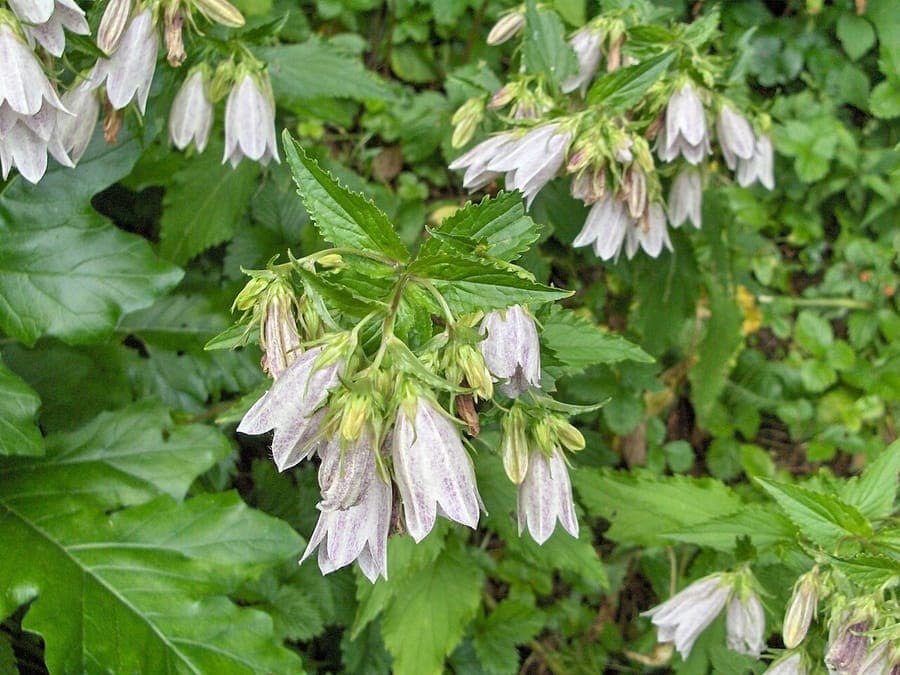
Korean bellflower (Campanula takesimana) is a hardy perennial in the bellflower family (Campanulaceae) that grows wild only on Ulleungdo, a volcanic island in the Sea of Japan off the east coast of Korea. The species name comes from Takeshima, an old Japanese name for that island. In gardens it stands out for its large, nodding tubular bells in white to pale lilac, finely speckled with purple inside. It flowers in midsummer, just as many spring perennials are fading.
Botanists do not fully agree on its status. Some floras treat it as a form of the closely related Campanula punctata, while others keep it as a separate species. For gardeners this makes little difference: sold as Campanula takesimana, it is a robust, fast-spreading perennial that performs well in borders and under light tree cover.
The plant grows 40 to 75 cm tall and spreads steadily by underground rhizomes. That is both its strength and its weakness: it fills gaps quickly, but in a small border it can swamp its neighbours. More on that below. Korean bellflower is not toxic to people or pets; in Korea the young shoots are even eaten as a vegetable. It is not listed as invasive anywhere in Europe, although it may self-seed in the garden.
Appearance and bloom cycle
At ground level the plant forms rosettes of glossy, dark green, heart-shaped leaves 8 to 12 cm long, with scalloped edges and often reddish stalks. In mild winters these rosettes stay partly green. In late spring, leafy, lightly branched flowering stems rise from them.
From June into August those stems carry clusters of broad, tubular bells 4 to 6 cm long. The outside is white to soft lilac or flushed pink, while the inside is dotted with fine purple freckles and sometimes a dark ring at the base. Because the bells hang downwards, the markings are best enjoyed up close or on a raised bed. Bumblebees love to crawl right inside to reach the nectar.
Popular cultivars include 'Elizabeth', with wine-red bells that are creamy white inside, 'Alba' with pure white flowers, and 'Beautiful Trust', a striking white form with narrow, spreading petals. 'Elizabeth' is sometimes regarded as a hybrid with Campanula punctata.
Ideal location
Campanula takesimana grows in sun or partial shade. In full sun it stays more compact, provided the soil holds enough moisture. In light shade, such as the edge of a shrub border or beneath a tree with an open canopy, it still flowers well and the bells stay fresh for longer. Deep shade gives floppy stems and few flowers.
Bear its spreading habit in mind when choosing a spot. Give it room to roam, such as a woodland edge, a wide border with sturdy neighbours or a strip along a hedge. In a small border or near delicate rock plants, sink a root barrier 25 to 30 cm deep, or grow it in a large container. Strong wind can flatten the flowering stems, so a sheltered spot or support from surrounding plants helps.
Soil requirements
It is not fussy. It grows best in humus-rich, fertile soil that does not dry out completely in summer but does not stay waterlogged either. Loam and sandy loam are ideal. On poor, sandy soil, work in a generous amount of garden compost or leaf mould at planting time. Lime is well tolerated; anything from slightly acidic to slightly alkaline is fine.
Space plants about 40 cm apart. A mulch of compost or leaf mould each spring keeps the soil open and moist and supplies enough nutrients. Extra fertiliser is rarely needed, as too much nitrogen produces long, weak stems.
Free preview
Want to see Korean bellflower (Campanula takesimana): complete guide in your garden? Make a free preview of your design.
Watering
Water new plants regularly for the first few weeks so the rhizomes establish well. After that, the plant usually copes on its own in a normal British or northern European summer. In long dry spells, especially in sunny spots and on sandy soil, give a good soaking once or twice a week. Deep and infrequent watering is better than a little every day.
A mulch of leaf mould or fine bark helps hold moisture. Containers dry out far more quickly; check them every two or three days in summer.
Pruning
After flowering, cut the spent stems back to just above the leaf rosettes. This prevents self-seeding and keeps the border tidy, while the rosettes remain as a green ground layer. A small second flush sometimes follows in September.
Clear away dead leaves in late autumn or early spring. Every three or four years, lift and divide the clump in March or April, or in September, and chop off any runners that have strayed too far. Divisions with a rosette and some root can be replanted straight away or shared with fellow gardeners.
Maintenance calendar
March and April: Remove dead foliage, mulch with compost and divide if needed. Watch out for slugs, which love the young leaves.
May: Flowering stems shoot up. Remove any runners growing outside their allotted space.
June to August: Full flower. Water during prolonged drought and cut off spent stems.
September: Possible second flush. A good month for dividing and planting.
October and November: Clear the last stems. The rosettes can stay.
December to February: Dormant season, no work needed.
For a monthly reminder covering your whole border, the plant calendar on gardenworld.app gives you an overview of what needs doing.
Winter hardiness
Korean bellflower is extremely hardy. It tolerates frost down to about -25 °C and comes through winter in Britain and the Low Countries without any protection. Most of the top growth dies back, and the rhizomes sprout again in March. Only plants in containers need a little care: in severe frost, move pots against a wall or wrap them in hessian so the root ball does not freeze solid.
It copes reasonably with heavy, wet soil in winter, but standing water leads to root rot. On very wet sites, plant slightly raised.
Companion plants
With its nodding bells and fresh colours, Campanula takesimana suits a naturalistic border or woodland edge. Good partners in partial shade include lady's mantle (Alchemilla mollis) with its lime-green sprays, Siberian bugloss (Brunnera macrophylla) for blue in spring, and great masterwort (Astrantia major), which flowers at the same time. Bigroot cranesbill (Geranium macrorrhizum) makes a tough ground cover that holds its own.
For height, plant foxgloves (Digitalis purpurea) behind it, and large hostas (Hosta sieboldiana) provide bold, calm foliage as a contrast. Pair Korean bellflower with sturdy plants that can stand their ground, not with small, delicate species.
Final thoughts
Campanula takesimana is a tough, rewarding perennial that fills the summer border with elegant, speckled bells. It is hardy, non-toxic and undemanding. The only thing to watch is its urge to spread, which is easy to manage with the right spot or a root barrier.
Not sure where it would look best? On gardenworld.app you can create a garden design that takes sun, shade and soil type into account, so your Korean bellflower gets a place where it can grow without crowding out its neighbours. Plant it in spring and enjoy its hanging bells from the very first summer.
Frequently asked questions about Korean bellflower
Is Korean bellflower winter hardy?
Korean bellflower is extremely hardy. It tolerates frost down to about -25 °C and comes through winter in Britain and the Low Countries without any protection.
When and how do you prune Korean bellflower?
After flowering, cut the spent stems back to just above the leaf rosettes. This prevents self-seeding and keeps the border tidy, while the rosettes remain as a green ground layer.
How much water does Korean bellflower need?
Water new plants regularly for the first few weeks so the rhizomes establish well. After that, the plant usually copes on its own in a normal British or northern European summer.
Where does Korean bellflower grow best?
Campanula takesimana grows in sun or partial shade. In full sun it stays more compact, provided the soil holds enough moisture.
What soil does Korean bellflower need?
It is not fussy. It grows best in humus-rich, fertile soil that does not dry out completely in summer but does not stay waterlogged either.

See it in your garden
See Korean bellflower in your garden
One photo of your garden and a few questions. You see the result in about a minute.
Try it with a photoIdentify this plant in your own garden. Identify a plant
Similar plants
Rock crane's-bill: complete guide
Geranium macrorrhizum
Rock crane's-bill (Geranium macrorrhizum) is a tough groundcover thriving in sun or partial shade. Great for rock gardens and dry spots. Grows 20-30 cm tall.
Astrantia: complete guide
Astrantia major
Complete care guide for Astrantia major: bloom time, ideal location, soil, watering and companion plants. Perfect for shady borders.
Garden lady's-mantle: complete guide
Alchemilla mollis
Alchemilla mollis, or garden lady's-mantle, is a graceful perennial perfect for borders, shade gardens, and low-maintenance landscapes. Grows 15–30 cm tall, blooms June–August.
