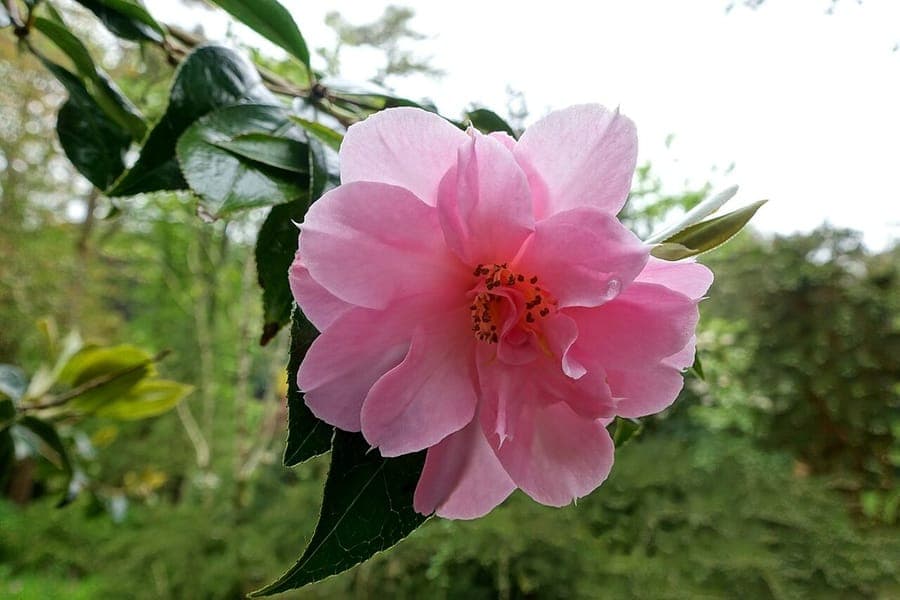
Daderot / CC0, via Wikimedia Commons
Camellia × williamsii: complete guide
Camellia × williamsii
Want to see Camellia × williamsii: complete guide in your garden?
Full design in HD: €7.99
Look after your Camellia × williamsii with the GardenWorld app
Identify plants with your camera and get a care calendar with reminders for this plant.


Overview
Camellia × williamsii is the camellia for gardeners in cooler climates who still want a shrub smothered in pink rosettes every spring. It is a cross between the familiar Japanese camellia (Camellia japonica) and the Chinese Camellia saluenensis. J.C. Williams made the cross in 1923 at Caerhays Castle in Cornwall. The seedlings first flowered in 1926 and turned out to have some real advantages: they flowered more freely, even after a cool summer, and they shed their spent blooms whole instead of holding them, brown and soggy, on the branches.
Today there is a long list of williamsii camellias. The best known is 'Donation', raised at Borde Hill in Sussex in 1941, with semi-double, orchid-pink flowers. Other classics include 'J.C. Williams' (single, soft pink), 'Debbie' (peony-form, warm pink), 'Anticipation' (deep rose red) and 'Jenefer Carlyon', with large semi-double pink flowers. The shrub is evergreen and usually reaches 2 to 4 metres in height and 1.5 to 2.5 metres across, although in a sheltered spot it can grow larger over many years.
Want to see where a camellia would get the right shade and shelter in your garden? You can have a garden design drawn up on gardenworld.app that takes your aspect and soil type into account.
Appearance and bloom cycle
The leaves are elliptic, 5 to 10 cm long, glossy dark green and finely toothed along the edge. They are slightly smaller and narrower than those of Japanese camellia, which gives the shrub a lighter look. All year round the foliage forms a fresh, shining backdrop in the garden.
Depending on the cultivar and the weather, flowering starts in February or March and continues into April, sometimes early May. In mild winters the first buds open as early as January. The flowers measure 6 to 12 cm across and may be single, semi-double or fully double. Colours range from white through soft pink and orchid pink to deep rose red. Single and semi-double forms have a boss of golden stamens at the centre. They are not really scented, but they are welcome early in the year for queen bumblebees venturing out on the first warm days.
The great selling point of this group is how it behaves after flowering. Where many Japanese camellias keep browned, faded blooms on the bush, williamsii camellias drop them, so the shrub stays tidy throughout its season. They also set plenty of buds after a cool, cloudy summer, which makes them ideal for the British and Irish climate.
Camellias are not toxic to people, dogs or cats. The related tea plant even supplies the leaves for your cup of tea, although this ornamental hybrid has no culinary use.
Ideal location
A camellia likes dappled shade with shelter from wind. A spot beneath tall trees with filtered light, against a west- or north-west-facing wall, or in a courtyard is ideal. In full sun the leaves can scorch in summer and the soil dries out too fast; in deep shade it flowers less.
The single most important point is morning sun. Frozen buds and flowers that thaw suddenly in early sunshine after a cold night turn brown and drop. For that reason, avoid an east-facing position. Protection from cold northerly and easterly winds also helps. A camellia grows well in a container on a patio, as long as the pot holds at least 40 litres and is moved against the house in winter.
Soil requirements
Camellias are lime-hating plants. They do best in a humus-rich, moisture-retentive but free-draining soil with a pH between 5 and 6.5. On chalky soil the leaves turn yellow between green veins, a sign that the plant cannot take up iron. If your garden is alkaline or heavy clay, you are better off growing it in a large pot or a raised bed of ericaceous compost than trying to change the whole border.
Dig a generous planting hole, twice the width of the root ball, and mix the soil with leaf mould, composted conifer bark or ericaceous compost. Do not plant deeper than it was in the pot: the top of the root ball should sit level with the surrounding soil. A 5 cm mulch of leaf mould or composted bark keeps the roots cool and the soil slightly acidic. For containers, use ericaceous potting compost.
Free preview
Want to see Camellia × williamsii: complete guide in your garden? Make a free preview of your design.
Watering
Water is the key to good flowering. Next spring's buds form in July, August and September. If the soil dries out during that period, the buds drop later in winter without opening. Keep the soil evenly moist through summer, but never waterlogged.
Use rainwater whenever you can. Tap water in many areas is hard and makes the soil too alkaline after a few years, especially in pots. In open ground, give 10 to 15 litres once a week during dry spells. Container plants may need watering daily in summer; in winter, place the pot so it does not sit in rainwater, but do not let the root ball dry out completely either.
Pruning
Camellia × williamsii needs little pruning. If you want to keep it in shape, prune straight after flowering, in April or May. Shorten overlong shoots to just above a leaf and remove dead or weak twigs from the centre. Pruning later in the year costs you buds.
An overgrown shrub can be cut back hard. Camellias resprout well from old wood, even after cutting back to 60 cm above the ground. Ideally spread such renovation over two or three years so that the plant keeps flowering. Give a little extra water and feed after a hard prune.
Maintenance calendar
January–February: First flowers in mild winters. Protect pots during hard frost and do not let the root ball dry out.
March–April: Peak flowering. Cover a young shrub with fleece on a frosty night. Prune immediately after flowering.
May: Apply an ericaceous fertiliser and top up the mulch. A good time to plant.
June: New growth appears. A second light feed if you wish. No feeding after July.
July–September: Bud formation. Keep the soil moist with rainwater. Check for scale insects and vine weevil.
October–December: Buds are visible. Little to do; give pots a sheltered spot against the house.
Winter hardiness
Camellia × williamsii is hardier than many people assume. Established plants in the ground tolerate temperatures down to about -15 °C, roughly USDA zone 7 (RHS H5). Across most of Britain, Ireland and the Low Countries the shrub comes through winter without trouble, especially in a sheltered spot.
The flowers and opening buds are more vulnerable and brown after a few degrees of frost. Young plants in their first winters and plants in containers also need more protection. Wrap pots in hessian or bubble wrap and move them against a wall. During a prolonged hard freeze you can loosely wrap the shrub itself in fleece. Make sure the roots do not dry out in winter: an evergreen keeps losing moisture through its leaves, even in the cold.
Companion plants
Camellias combine best with plants that enjoy the same acidic, humus-rich, lightly shaded conditions. Pieris japonica and Skimmia japonica are classic partners that keep the border green through winter. A Japanese maple (Acer palmatum) adds delicate foliage and autumn colour.
For summer, when the camellia is simply green, hydrangeas (Hydrangea macrophylla) bring colour to the same corner. At ground level, ferns such as the soft shield fern (Polystichum setiferum) cover the soil and keep the roots cool.
Final thoughts
Camellia × williamsii combines the luxurious look of a camellia with behaviour better suited to a maritime climate: generous flowering after a cool summer, spent blooms that drop on their own and good winter hardiness. Give it acidic soil, light shade, protection from morning sun and above all enough rainwater in summer, and it will be covered in pink flowers every spring for years to come.
Need a reminder for when to feed, water or prune? The plant calendar on gardenworld.app lists the monthly tasks for your camellia and the other plants in your garden.
Frequently asked questions about Camellia × williamsii
Is Camellia × williamsii winter hardy?
Camellia × williamsii is hardier than many people assume. Established plants in the ground tolerate temperatures down to about -15 °C, roughly USDA zone 7 (RHS H5).
When and how do you prune Camellia × williamsii?
Camellia × williamsii needs little pruning. If you want to keep it in shape, prune straight after flowering, in April or May.
How much water does Camellia × williamsii need?
Water is the key to good flowering. Next spring's buds form in July, August and September.
Where does Camellia × williamsii grow best?
A camellia likes dappled shade with shelter from wind. A spot beneath tall trees with filtered light, against a west- or north-west-facing wall, or in a courtyard is ideal.
What soil does Camellia × williamsii need?
Camellias are lime-hating plants. They do best in a humus-rich, moisture-retentive but free-draining soil with a pH between 5 and 6.5.

See it in your garden
See Camellia × williamsii in your garden
One photo of your garden and a few questions. You see the result in about a minute.
Try it with a photoIdentify this plant in your own garden. Identify a plant
Similar plants
Japanese pieris: complete guide
Pieris japonica
Complete care guide for Japanese pieris (Pieris japonica): ideal location, soil, watering, pruning and companion plants. Perfect for shaded, acidic gardens.
Skimmia japonica: complete guide
Skimmia japonica
Evergreen shrub with red berries and fragrant leaves that remain visible long. Winter hardy to -10C, perfect for shade.
Japanese Maple: complete guide
Acer palmatum
Everything about Japanese Maple (Acer palmatum): planting, pruning, cultivars and autumn colour. Expert tips for a spectacular ornamental tree in your garden.
