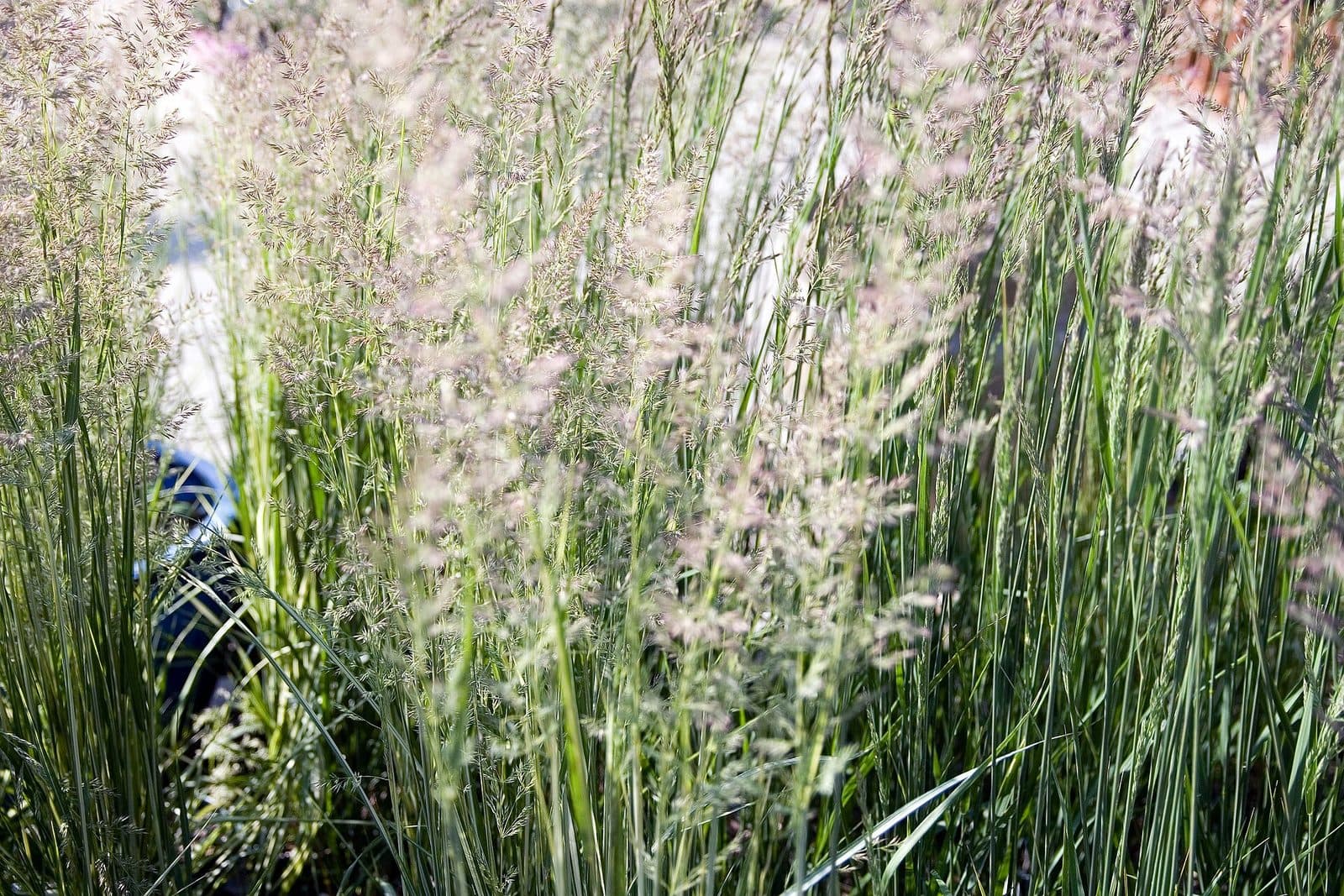
David J. Stang / CC BY-SA 4.0, via Wikimedia Commons
Feather reed grass: complete guide
Calamagrostis × acutiflora
Want to see Feather reed grass: complete guide in your garden?
Full design in HD: €7.99
Look after your Feather reed grass with the GardenWorld app
Identify plants with your camera and get a care calendar with reminders for this plant.


Overview
Feather reed grass (Calamagrostis × acutiflora) is the ornamental grass for gardeners who like clean lines. Where many grasses flop or splay outwards by autumn, 'Karl Foerster' stands bolt upright from June until March, like a row of narrow columns. It is a natural hybrid between two European species, Calamagrostis epigejos and Calamagrostis arundinacea, and belongs to the grass family (Poaceae). Its best-known selection is named after the German nurseryman Karl Foerster, who spotted it in the Hamburg botanic garden and introduced it in the middle of the twentieth century. In 2001 it was named Perennial Plant of the Year in the United States, and it holds the RHS Award of Garden Merit.
One big advantage: 'Karl Foerster' is sterile. It produces flower plumes, but the seed does not germinate, so it never self-sows and never invades. The clump widens slowly over the years to 45 to 60 cm and otherwise stays exactly where you planted it. Foliage reaches 60 to 90 cm and flower stems 150 to 180 cm. Almost every garden centre stocks 'Karl Foerster', and specialist nurseries also offer white-striped 'Overdam' and 'Avalanche' and gold-striped 'Eldorado'. With gardenworld.app you can create a garden design in which feather reed grass repeats through a border, forms a light screen or draws a vertical line along a path.
Appearance and bloom
Feather reed grass is a cool-season grass: it starts growing in March, much earlier than miscanthus. By April there is already a fresh green clump. In early June the flower stems shoot up, and in late June or July the plumes open, soft pink to purplish bronze and swaying in the breeze. During July they tighten into narrow, upright spikes that ripen to golden wheat.
In autumn and winter the whole plant turns straw yellow to pale buff. The stems stay firm, even after storms and under a coating of snow or frost. That gives feather reed grass seven to eight months of structure a year. Unlike the plumes of many other grasses, those of 'Karl Foerster' do not shatter in winter.
Ideal location
Plant feather reed grass in full sun, where the stems stay sturdiest and flowering is most generous. It also grows in light part shade, but stems may lean after heavy rain. True shade does not suit it.
It copes well with wind, including coastal gardens, and is widely used in public plantings, on roof gardens with enough soil depth and in large containers. Its narrow, upright form suits small gardens where wide-spreading grasses take up too much room. A row of five or seven clumps 50 cm apart makes an airy summer screen about 1.5 metres tall.
Soil
Feather reed grass is not fussy. It grows on clay, loam and humus-rich sand, with a pH between 5.5 and 7.5. Unlike many ornamental grasses, it also tolerates heavy, moist soil, as long as water does not stand around it in winter. On dry, poor sand it grows more slowly, so dig a generous spadeful of compost into the planting hole.
Space plants 50 to 60 cm apart, which works out at three to four per square metre. For a screen they can go slightly closer, at 40 to 50 cm. The best planting times are spring, from March to May, or early autumn, in September. Plant at the same depth as in the pot and water in well.
Watering
During its first growing season, feather reed grass needs regular water: a thorough soak once a week in dry weather so that roots establish deeply. After that it manages on its own in a normal summer. It prefers soil that does not dry out completely, so an extra watering during long hot spells is welcome, especially on sandy soil and in containers.
It needs very little feeding. A layer of compost in March is enough. Too much nitrogen makes the stems tall and soft, so they flop. The plant is almost always healthy, though rust can appear in warm, humid summers as orange-brown spots on the leaves. It is mainly cosmetic; leave enough space between clumps and water the soil, not the foliage.
Free preview
Want to see Feather reed grass: complete guide in your garden? Make a free preview of your design.
Pruning
Feather reed grass needs just one cut a year. Leave the stems standing through winter, where they look lovely in frost and shelter insects. Cut the whole clump back to 10 to 15 cm above ground in late February, or early March at the latest. Do not leave it too long: as a cool-season grass it shoots early, and if you wait until April you will clip the tips of the new green growth, which then stay blunt all season.
Tie the clump together with string first, then cut through it in one go with shears or a sharp knife and lift the trimmings away tidily. Every four or five years, or when the centre of the clump goes bare, divide it in March or April. Slice the clump into two or four pieces with a sharp spade and replant them straight away. Division is the only way to propagate 'Karl Foerster', since it sets no viable seed.
Maintenance calendar
- January: leave the stems for winter structure and insects.
- February and early March: cut the whole clump back to 10 to 15 cm before new shoots appear.
- March and April: divide and plant; spread compost around the clumps.
- May: fresh green clump; water new plantings in dry spells.
- June: flower stems shoot up; first pink plumes.
- July and August: plumes turn golden; water during long dry spells.
- September: planting time for new clumps; stems turn straw yellow.
- October to December: stems stay upright; nothing to do.
Winter hardiness
Calamagrostis × acutiflora is exceptionally hardy, surviving USDA zones 4 to 9, which means frost down to -30 °C and below. Anywhere in Britain and Ireland it needs no protection, even as a young plant in open ground. The dry stems shelter the crown in winter, another reason to wait until late February before cutting back.
Containers are a different matter, because roots freeze faster there. Use a pot of at least 40 litres, raise it on pot feet so excess water drains away, and move it against a wall in hard frost. Wet roots in winter are more dangerous to a potted plant than the cold itself.
Companion plants
Feather reed grass is the classic backbone of a prairie or naturalistic border. Its vertical lines contrast beautifully with the rounded flowers of purple coneflower and Rudbeckia fulgida, which flower from July to September just as the plumes turn gold. Perovskia atriplicifolia adds silver-grey foliage and lavender-blue spires.
At the front of the border, showy stonecrop carries flat pink heads in August and September that, like the grass, stand all winter. For lightness, let Verbena bonariensis seed between the clumps, its purple pompoms floating among the stems. Repeat feather reed grass every two to three metres along the border for a calm rhythm that holds all year.
Closing
Feather reed grass 'Karl Foerster' asks for almost no work and offers something nearly all year: fresh green leaves in spring, pink plumes in June, golden spikes in summer and straw-coloured columns in winter. It does not self-seed, stands firmly upright and tolerates heavy soil. Give it sun and cut it back in late February, and that is all. On gardenworld.app you can see how Calamagrostis × acutiflora would set the rhythm in your border or form a light screen in your garden.
Frequently asked questions about Feather reed grass
Is Feather reed grass winter hardy?
Calamagrostis × acutiflora is exceptionally hardy, surviving USDA zones 4 to 9, which means frost down to -30 °C and below. Anywhere in Britain and Ireland it needs no protection, even as a young plant in open ground.
When and how do you prune Feather reed grass?
Feather reed grass needs just one cut a year. Leave the stems standing through winter, where they look lovely in frost and shelter insects.
How much water does Feather reed grass need?
During its first growing season, feather reed grass needs regular water: a thorough soak once a week in dry weather so that roots establish deeply. After that it manages on its own in a normal summer.
Where does Feather reed grass grow best?
Plant feather reed grass in full sun, where the stems stay sturdiest and flowering is most generous. It also grows in light part shade, but stems may lean after heavy rain.
What soil does Feather reed grass need?
Feather reed grass is not fussy. It grows on clay, loam and humus-rich sand, with a pH between 5.5 and 7.5.

See it in your garden
See Feather reed grass in your garden
One photo of your garden and a few questions. You see the result in about a minute.
Try it with a photoIdentify this plant in your own garden. Identify a plant
Similar plants
Purple coneflower: complete guide
Echinacea purpurea
Everything about Purple Coneflower (Echinacea purpurea): planting, care, pruning and combinations. Expert tips for a thriving prairie-style garden.
Orange Coneflower: complete guide
Rudbeckia fulgida
Everything about Rudbeckia fulgida (orange coneflower): planting, care, combinations and bloom time. Practical tips for months of golden-yellow flowers.
Perovskia atriplicifolia: complete guide
Perovskia atriplicifolia
Russian sage is a semi-shrub with purple-blue flowers and grey-green foliage that blooms from July to October. Perfect for dry gardens and landscape design.