
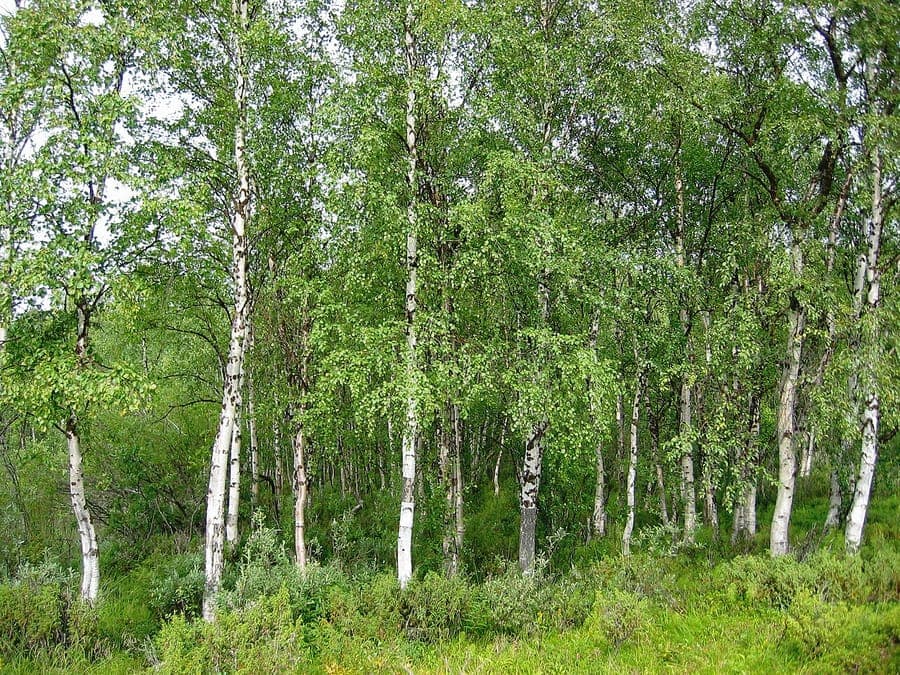
Percita at Flickr / CC BY-SA 2.0, via Wikimedia Commons
Silver Birch: complete guide
Betula pendula
Want to see Silver Birch: complete guide in your garden?
1 minute, no credit card
Overview
The Silver Birch (Betula pendula) is one of the most recognisable and beloved trees of Europe. With its striking white bark, elegant weeping branches, and trembling light-green foliage, it is an icon of the northern landscape, from the Scandinavian forests to the English countryside and the German heathlands. This deciduous tree from the birch family (Betulaceae) is a true pioneer species - often the first tree to colonise bare ground, disused building sites, or burned heathland.
In the garden, the silver birch reaches a height of 15 to 25 metres with a relatively narrow, open crown 6 to 10 metres wide. On gardenworld.app you can create a garden design in which the birch forms a graceful vertical accent - as a specimen on a lawn, in a group of three as a white trunk display, or as a light canopy tree above a shade border. The combination of white bark, gracefully weeping branches, a light canopy that admits filtered light, and spectacular golden-yellow autumn colour makes the birch a tree that offers something in every season.
Appearance through the seasons
The most striking feature of the silver birch is its bark. On young trees the bark is reddish-brown to bronze, but from the age of five to eight years the characteristic pure white, papery surface develops, peeling in horizontal strips. As the tree ages, dark, deep fissures appear at the base of the trunk, creating a handsome contrast with the white upper section. The bark is especially eye-catching in winter when the tree is bare.
In spring (April) the catkins appear: male catkins 3 to 6 cm long hang decoratively from the branches, while the smaller female catkins stand upright. The foliage unfurls simultaneously in a fresh green that appears almost translucent. The leaves are diamond-shaped to triangular, 2 to 5 cm long, with a doubly serrated margin and a long, fine tip.
In summer the birch forms a light, open canopy that admits filtered sunlight - ideal for underplanting with shade-tolerant species. The weeping (pendula) branches that give the tree its name move elegantly in the slightest breeze.
Autumn is the third highlight: the foliage turns a radiant golden yellow that bathes the entire tree in a warm glow. The autumn colour is typically brief but intense - one to two weeks in October, depending on weather and location.
Three cultivars deserve special mention. 'Youngii' (Young's Weeping Birch) is the most popular garden cultivar: a compact weeping tree of just 6 to 8 metres with an umbrella-like crown that cascades to the ground - ideal for smaller gardens. 'Fastigiata' grows narrow and columnar to 10 to 15 metres, perfect for narrow gardens or as an avenue tree. 'Dalecarlica' (Swedish Birch) has deeply cut, elegantly dissected foliage that gives the tree a particularly refined appearance. All three are widely available at garden centres.
Ideal location
The silver birch is an emphatically light-loving tree that demands full sun. In shade or partial shade it grows crookedly towards the light, develops a sparse crown, and lacks the characteristic white bark. Always plant it in the sunniest available position.
The birch is exceptionally wind-resistant thanks to its flexible branches and is therefore ideally suited to exposed coastal sites and open landscapes. It is extremely winter-hardy (USDA zones 2 to 7) and survives temperatures down to -40 degrees Celsius - cold is no problem whatsoever for a birch.
When planting, consider the ultimate size. A mature silver birch is 15 to 25 metres tall and 6 to 10 metres wide. Plant at least 8 to 10 metres from buildings and underground services - the birch's extensive shallow root system can affect foundations and drains. The cultivar 'Youngii', at a modest 6 to 8 metres, is better suited to smaller gardens.
Birches have a shallow, wide-spreading root system that extracts considerable moisture from the soil. Plants beneath a birch must be drought-tolerant: ground covers such as bluebells and periwinkle cope best with the competition.
Soil requirements
The silver birch is one of the least demanding trees regarding soil. As a true pioneer species, it grows on virtually any soil type: sand, clay, loam, peat, and even slightly impoverished ground. It tolerates both acid and mildly alkaline soils (pH 4.5 to 7.5). Its preference is for slightly moist, well-drained, sandy or loamy soil, but the birch adapts to almost anything.
On very wet, waterlogged ground the birch performs less well - it tolerates moist soil better than permanent saturation. On extremely dry, poor sand it grows more slowly and stays smaller, but it survives. In fertile garden soil, the birch grows remarkably fast: 50 to 80 cm per year in its youth.
Avoid enriching the soil at planting time with compost or manure - the birch does not need it and overly rich soil can even be counterproductive.
Planting
The best planting season is autumn (November to December) or late spring (March). Birches transplant best as young trees (trunk girth 8 to 14 cm); larger specimens establish less readily because of their extensive shallow root system.
Dig a planting hole twice as wide and the same depth as the root ball. Do not mix the excavated soil with compost - the natural soil is sufficient for a birch. Set the tree at the same depth as it stood in the nursery (check the soil mark on the trunk), backfill, firm gently, and water immediately with 20 to 30 litres.
Staking is essential: place two sturdy stakes either side of the root ball, connected by a tie around the trunk. The birch has a shallow root system and is vulnerable to wind-throw in its early years. Remove the stakes after three years. Tree staking kits are available at most garden centres.
For the cultivar 'Youngii' as a specimen on a lawn, allow at least 4 to 5 metres from paths and patios - the weeping branches reach to the ground. 'Fastigiata' can be planted closer to buildings and paths thanks to its narrow crown.
Free design
Want to see Silver Birch: complete guide in your garden? Make a free design now.
Watering
An established birch (older than three years) needs no supplementary water in a normal year - its extensive root system finds sufficient moisture. During the first two to three years after planting, regular watering is critical for good establishment: give 15 to 20 litres weekly in dry spells.
During extreme summer drought (more than three weeks without rain), even a mature birch may show signs of drought stress: premature leaf drop and twig dieback. In that case, give 50 to 100 litres at a time, applied in a ring around the drip zone of the crown.
Young birches planted as avenue trees or in paved areas are particularly susceptible to drought and may benefit from a drip irrigation system during the early years.
Pruning
The silver birch generally needs little pruning. The natural crown shape is open, elegant, and seldom requires correction. There is, however, one important caveat: never prune birches in late spring or early summer (March to June). During this period the trees are full of sap and pruning wounds bleed profusely - the sap flow can continue for days and weaken the tree.
The best time for pruning is late summer (August to September) or autumn (October to November), when sap flow is minimal. Remove dead, diseased, or crossing branches. Crown-lifting - removing the lowest branches for clearance - is the most common form of pruning on birches and can be carried out gradually to a clear trunk height of 2 to 4 metres.
For the weeping form 'Youngii', pruning may be needed to shorten trailing branches that touch the ground, so you can walk or mow beneath the tree. For 'Fastigiata', pruning is rarely needed - the columnar form is maintained without intervention.
Never top a birch - this permanently disfigures the tree and destroys its elegant natural form.
Seasonal calendar
March–April: The tree comes into leaf and flowers with catkins. No pruning - sap flow is at its peak.
May–June: Full leaf development. Check that young trees receive adequate water. Remove any weeds from around the trunk base.
July–August: Pruning season. Remove dead wood and carry out crown-lifting if desired. Check staking on young trees.
September–October: Autumn colour. Enjoy the golden-yellow foliage. Fallen leaves decompose quickly and can be used as leaf mulch.
November–December: Planting season for new birches. The white bark is now at its finest. Check staking before winter storms.
January–February: Dormancy. The white bark combined with frost or snow is a winter spectacle.
Ecological value
The silver birch is an ecological powerhouse. It is a host plant for over 300 insect species and forms an essential part of the food web. The catkins are an early food source for bees in spring, the seeds are eaten by siskins, goldfinches, and other finches, and the bark provides shelter for countless small invertebrates.
Birches form ectomycorrhizal associations with various fungi, including the famous Fly Agaric (Amanita muscaria) and the edible Birch Bolete (Leccinum scabrum). This symbiosis is essential for the tree's health and for soil biology.
The birch's light, open canopy admits sufficient light for a rich understorey - a quality that significantly increases biodiversity in a garden or park.
Pests and diseases
The most common affliction of birches is birch leaf miner, a larva that creates brown blotches and blisters in the foliage. Damage is rarely life-threatening but can reduce ornamental value. Remove and destroy affected leaves in autumn. Birch bark beetle may affect weakened trees and is recognisable by holes and galleries beneath the bark - prevent infestation by keeping the tree vigorous with adequate water during dry spells.
Birch sawfly causes defoliation in summer - healthy trees recover quickly. Witches' brooms (dense, ball-shaped growths in the crown) are caused by fungi and are harmless but aesthetically displeasing.
The most important preventive measure is avoiding injuries to the trunk and roots - birches are susceptible to fungal infections through damaged bark.
Companion plants
The silver birch combines beautifully with plants that thrive beneath its light canopy and can cope with the competition from its shallow roots. Amelanchier (Amelanchier lamarckii) is an ideal partner: its white spring blossom, edible berries, and spectacular autumn colour complement the birch in every season. Beech (Fagus sylvatica) provides a contrasting backdrop with its dense, dark green foliage.
Japanese Maple (Acer palmatum) as an underplanting creates a Japanese-inspired woodland atmosphere with contrasting leaf shapes. Underplant the root zone with drought-tolerant ground covers: bluebells (Hyacinthoides non-scripta), foxgloves (Digitalis purpurea), ferns, and hostas in the moister areas.
For a naturalistic look, plant birch clusters (three to five trunks) surrounded by heather, ornamental grasses (Molinia, Deschampsia), and wildflowers. Highlight the white bark by surrounding the trunk base with dark foliage - ivy, pachysandra, or brunnera.
Final thoughts
The silver birch is a tree that is simultaneously modest and spectacular. Modest in its demands - it grows on the poorest soil and asks for virtually no maintenance. Spectacular in its appearance - the white bark gleams in winter light, the weeping branches move like a curtain in the wind, and the golden autumn colour illuminates the garden like a torch. Choose a cultivar that matches the size of your garden - 'Youngii' for a small garden, the species itself for a larger plot.
On gardenworld.app you can create a garden design in which the birch reaches its full potential, combined with the right underplanting and companion trees for your specific situation. Plant a birch this autumn and let it grow into the white beacon that every garden deserves.
Want to see Silver Birch: complete guide in your garden? Make a free design now.
Upload a photo, pick a style, and get a photorealistic design with plant list in under a minute.
No credit card required


Similar plants
Juneberry: complete guide
Amelanchier lamarckii
Everything about the Juneberry (Amelanchier lamarckii): spring blossom, autumn colour, edible berries and care. Expert tips for this versatile four-season tree.
Beech (Fagus sylvatica): complete guide
Fagus sylvatica
Everything about beech as a hedge plant and specimen tree: planting, pruning, growth rate and winter interest. Practical tips for a dense beech hedge.
Japanese Maple: complete guide
Acer palmatum
Everything about Japanese Maple (Acer palmatum): planting, pruning, cultivars and autumn colour. Expert tips for a spectacular ornamental tree in your garden.