
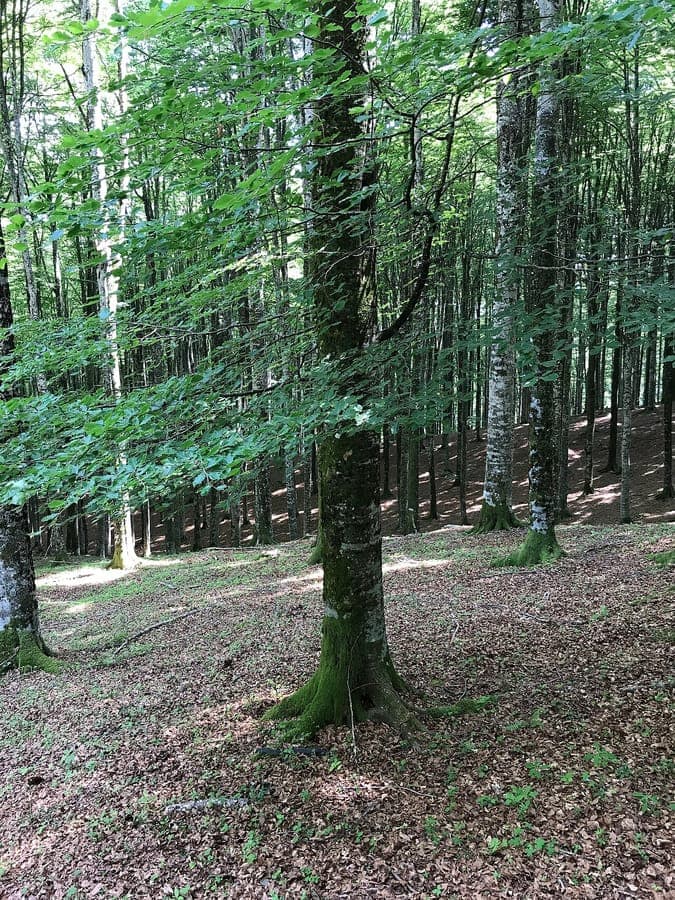
GooseCanada / CC BY-SA 4.0, via Wikimedia Commons
Beech (Fagus sylvatica): complete guide
Fagus sylvatica
Want to see Beech (Fagus sylvatica): complete guide in your garden?
1 minute, no credit card
Overview
Common Beech (Fagus sylvatica) is one of the most popular hedging plants across Europe, and for good reason. A beech hedge offers something that virtually no other deciduous hedge can: a dense leaf screen that provides privacy and shelter every month of the year. In spring and summer, beech carries fresh green foliage; in autumn, the leaves turn warm copper-brown. Then comes the remarkable part: when clipped as a hedge, beech retains its dead brown leaves until new foliage emerges in April - a phenomenon called marcescence. This means a beech hedge is effectively dense twelve months of the year.
As a free-standing tree, beech reaches a majestic 30 to 40 metres with a broad, dome-shaped crown and a smooth grey trunk. But for most garden owners, beech is primarily a hedging plant. On gardenworld.app you can create a garden design where a beech hedge provides the backbone - as a boundary, a backdrop for borders, or a windbreak. Alongside the green beech, there is Copper Beech (Fagus sylvatica f. purpurea), with deep red foliage that turns copper-bronze in autumn. Both types make superb hedges, and in practice they are often mixed in a single hedge for a playful colour effect.
Appearance and bloom
Beech leaves are oval, 5 to 10 cm long, with a gently wavy margin and prominent veins. When they emerge in April and May, they are pale green and coated with fine, silky hairs that give the young foliage a silvery sheen. Mature leaves are dark green and glossy on green beech, deep dark red on copper beech. The autumn display is spectacular: green beech turns golden-yellow to copper-brown, while copper beech shifts to orange-bronze.
Beech flowers in April and May, simultaneously with leaf emergence. The flowers are inconspicuous: male catkins hang in spherical clusters, while female flowers sit in small, spiny cups. After pollination, the triangular beechnuts develop inside bristly husks, ripening in October. Beechnuts are edible when lightly roasted and are a favourite food source for squirrels, finches, and nuthatches. A regularly clipped hedge, however, rarely flowers or sets fruit.
The bark of beech is unique: smooth, silvery-grey, and unchanged even on ancient trees. While most trees develop rough, fissured bark with age, beech retains its smooth, elephant-skin surface for its entire life. This makes beech a particularly elegant presence even in the depths of winter.
Ideal location
Beech grows best in an open to semi-shaded position. Full sun is fine for a hedge; a lightly shaded spot works too, though the hedge will be less dense. Deep shade is not tolerated - the foliage thins and the plant loses its compact character.
As a hedge plant, beech suits most temperate gardens across the UK, Europe, and the cooler parts of North America. The plant handles wind well and forms an effective windbreak. On very exposed, windy sites (coastal areas, open plains), beech hedges grow more slowly and hornbeam (Carpinus betulus) may be a better alternative - it closely resembles beech but is tougher in heavy clay and wet winters.
For a free-standing beech, you need ample space. A mature tree has a canopy 15 to 20 metres wide and roots shallowly, meaning little else grows beneath it. Plan a specimen beech only for large gardens or parkland. In the United States, Fagus sylvatica is widely planted as an ornamental in USDA zones 4 to 7, performing particularly well in the Northeast and Pacific Northwest where summers are not excessively hot.
Soil requirements
Beech is more particular about soil than many other hedging plants. The ideal ground is well-drained, moisture-retentive, and humus-rich - a loamy or sandy-loam soil is perfect beech territory. On this kind of soil, beech grows fastest and the foliage is at its finest.
Heavy clay that stays waterlogged in winter is the greatest enemy of beech. The shallow roots rot in saturated ground, and the tree or hedge loses branches and foliage. On heavy, wet clay, hornbeam (Carpinus betulus) is a safer choice. On dry sandy soil, beech performs well provided you water during dry spells in the first few years.
The ideal pH ranges from 5.5 to 7.5. Beech handles mildly acidic to mildly alkaline soil. On very chalky ground (pH above 8.0), leaf yellowing (chlorosis) may occur. Work compost into the planting hole - not so much for nutrition as to improve soil structure and moisture retention.
Free design
Want to see Beech (Fagus sylvatica): complete guide in your garden? Make a free design now.
Watering
Young beech plants and newly planted hedges need regular water during the first and second growing seasons. In dry spells, apply 10 to 15 litres per metre run of hedge twice a week. Beech has a shallow root system that dries out quickly during prolonged drought, especially on sandy soil.
Established beech hedges of five years and older manage without supplementary water in normal summers. During extreme drought (three weeks or more without rain), give even an established hedge a thorough soaking - one full watering can per metre of hedge. Always water at the base, preferably in the early morning or late evening. A 5 to 8 cm mulch layer of bark chips or leaf mould around the base of the hedge retains soil moisture and suppresses weeds.
Free-standing beech trees rarely need extra water after the third year. Their extensive root systems reach moisture reserves in deeper soil layers that are inaccessible to smaller plants.
Pruning
Pruning a beech hedge is straightforward, but timing is critical. Clip a beech hedge once a year, in August. This late timing is deliberate: growth has essentially stopped, the hedge maintains its crisp shape until the following spring, and - most importantly - late pruning promotes the retention of brown leaves through winter (marcescence).
Never prune after September and not before mid-July. Pruning too early stimulates regrowth that does not harden off before winter; pruning too late carries the same risk. Use hedge shears (manual or powered) and clip the sides into a slight taper: the base a little wider than the top. This ensures the lower portion of the hedge receives sufficient light and stays dense.
For a new hedge that has not yet reached its target height: leave it unclipped for the first two to three years (or clip only the sides). Once the desired height is reached, cut the top flat. The plant responds by producing more lateral branches and building a denser structure.
Maintenance calendar
March–April: New foliage emerges. Remove any dead wood that becomes visible. Apply a mulch layer around the base of the hedge.
May–June: Active growth. Water young hedges during dry spells. Monitor for beech leaf-mining weevil - usually cosmetic, no treatment necessary.
July: Growth slows. Begin visually assessing the hedge in preparation for the August clip.
August: The ONLY pruning month. Clip the hedge into sharp lines. Remove trimmings (suitable for the compost heap).
September–October: Spectacular autumn colour. Enjoy it - beech is at its most beautiful.
November–March: The brown foliage clings on and provides privacy. Plant new beech during frost-free weather (November or February–March is ideal).
Winter hardiness
Fagus sylvatica is fully hardy across Western Europe and much of North America, tolerating temperatures down to -25°C (USDA zones 4 to 7). The species is native from southern England to Scandinavia and from Spain to the Caucasus, and has adapted to the European climate over thousands of years.
Young beech plants (first two winters) can be sensitive to late spring frost in April, which damages the tender emerging leaves. The plant recovers fully by producing a second flush, but this costs energy. Protect young hedge plants with horticultural fleece when late frost is forecast. Established beech is untroubled by frost.
Copper Beech (f. purpurea) is precisely as winter-hardy as the green form. The difference in leaf colour has no bearing on cold tolerance.
Companion plants
A beech hedge forms a neutral, warm backdrop against which almost anything looks good. The copper-brown winter tint is particularly attractive behind winter-flowering plants: hellebores (Christmas rose), snowdrops, and winter jasmine stand out beautifully against the brown beech foliage.
In summer, the fresh green beech leaf pairs well with lavender (Lavandula angustifolia) along the base of the hedge, roses in the border, or ornamental grasses (Miscanthus sinensis) as a contrast in texture. Yew (Taxus baccata) as a dark green accent beside a lighter green beech hedge creates a strong colour contrast. Clipped box shapes (Buxus sempervirens) in front of a beech hedge provide structure through winter.
Beneath a free-standing beech, the planting palette is limited by the dense shade and shallow roots. Ivy (Hedera helix), ferns, and lesser periwinkle (Vinca minor) are the best options for green ground cover.
Closing
The beech hedge is the crowning feature of any garden that combines structure, privacy, and seasonal beauty. No other deciduous hedge offers the same year-round presence: fresh green in spring, deep green in summer, copper-brown in autumn, and that same warm brown through winter. The investment in patience - it takes three to five years for a hedge to reach full height - is repaid with a living wall that lasts decades.
Most garden centres carry beech hedging plants in various sizes and price ranges. Allow 5 to 7 plants per metre run of hedge. On gardenworld.app you can create a garden design where the beech hedge forms the backbone, combined with the right borders, paths, and planting for your situation. Start this planting season - the beech you plant today is tomorrow's boundary.
Want to see Beech (Fagus sylvatica): complete guide in your garden? Make a free design now.
Upload a photo, pick a style, and get a photorealistic design with plant list in under a minute.
No credit card required


Similar plants
English Yew: complete guide
Taxus baccata
Everything about English Yew (Taxus baccata): planting, clipping, topiary and care. Expert tips for a dense hedge or elegant sculptural form.
Common Boxwood: complete guide
Buxus sempervirens
Everything about Common Boxwood (Buxus sempervirens): planting, pruning, topiary and box moth control. Practical tips for healthy, green hedges and shapes.
Cherry Laurel: complete guide
Prunus laurocerasus
Everything about Cherry Laurel (Prunus laurocerasus): planting, pruning, cultivars and care. Expert tips for a fast-growing, dense evergreen hedge.