
Karduelis / Public domain, via Wikimedia Commons
Cherry Laurel: complete guide
Prunus laurocerasus
Want to see Cherry Laurel: complete guide in your garden?
1 minute, no credit card
Overview
Cherry Laurel (Prunus laurocerasus) is one of the most widely planted evergreen hedging plants in temperate gardens worldwide. Its combination of rapid growth, glossy dark green foliage, shade tolerance, and winter hardiness makes it the first choice for gardeners seeking a dense, impenetrable green screen in the shortest time possible. Growing at a rate of 40 to 60 centimetres per year, a bare fence or boundary can be transformed into a lush green wall within two to three seasons.
Native to southeastern Europe and southwestern Asia, cherry laurel has been cultivated as a garden plant in Western Europe since the sixteenth century. On gardenworld.app you can create a garden design where cherry laurel forms the backbone - as a hedge, a screen, or a large freestanding shrub in a spacious garden. Unpruned, the plant reaches 4 to 8 metres in height and as much in width, but regular clipping keeps it at any desired size. An important note: all parts of the plant except the fruit flesh are toxic, as with other Prunus species.
Appearance and bloom
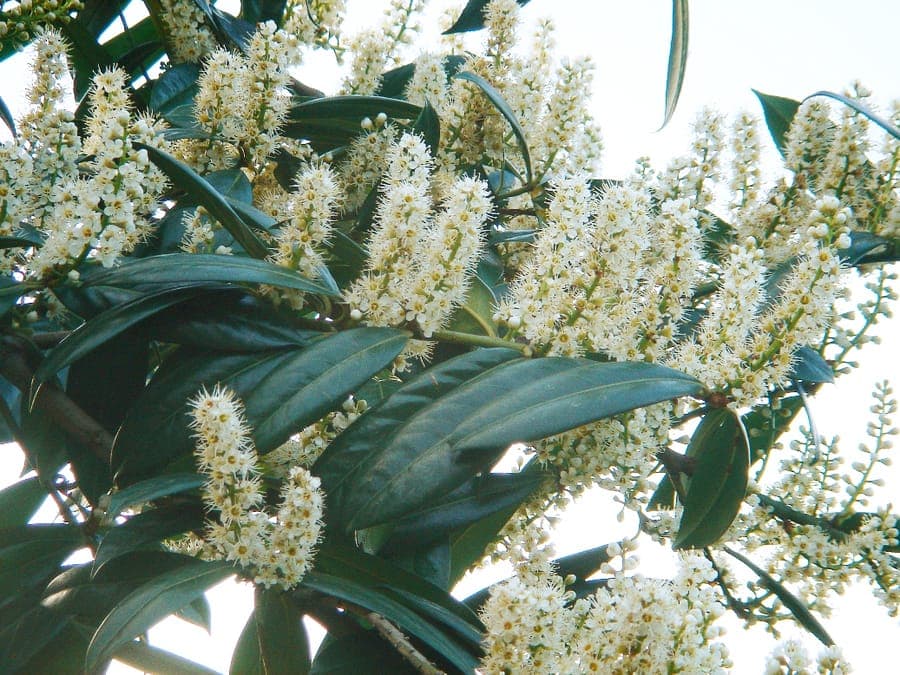
The foliage is cherry laurel's calling card: large (10–15 cm long, 4–6 cm wide), leathery, glossy dark green, and slightly undulating. The leaves superficially resemble those of true bay laurel (Laurus nobilis), hence the common name - but the two plants are unrelated. The evergreen foliage provides a dense, luxurious appearance year-round.
In April and May, eye-catching upright flower racemes 8 to 12 centimetres long appear, densely packed with small white flowers that emit a sweet fragrance. Bees and other pollinating insects visit them eagerly. After flowering, cherry-like fruits form, ripening through summer from green through red to glossy black. The fruits are eaten by blackbirds and thrushes but are toxic to humans. The combination of glossy foliage, white blossom, and black berries makes cherry laurel more visually interesting than many other hedging plants.
Ideal location
Cherry laurel is one of the most accommodating hedging plants regarding light. From full sun to fairly deep shade - it adapts. In sun it grows fastest and flowers most prolifically; in shade, growth is somewhat slower but still satisfactory. This makes cherry laurel ideal for north-facing boundaries, for hedging beneath large trees, and for shaded urban gardens.
The plant tolerates some wind but performs best in a sheltered position. In very windy coastal areas, the large leaves may develop brown margins from wind scorch. For a cherry laurel hedge, a spacing of 2.5 to 3 plants per linear metre is standard for quick coverage. Choose identical cultivars for a formal hedge; for a relaxed, natural screen you may mix varieties. Cherry laurel is widely grown across the UK, the mid-Atlantic and Pacific Northwest regions of the USA, and the cooler parts of Australia.
Soil requirements
Cherry laurel is remarkably unfussy about soil. Clay, sand, loam, chalk - it grows in virtually anything, provided the ground is not permanently waterlogged. Even in heavy clay soils it performs well, as long as surface water does not sit for extended periods.
When planting, dig a hole roughly twice the width of the rootball and slightly deeper. Mix the excavated soil with one-third compost for a strong start. The ideal soil pH ranges from 5.5 to 8.0 - a broad range that illustrates this plant's tolerance. Feeding is unnecessary in the first year; from the second year onward, a handful of organic general fertiliser per plant in spring is sufficient. Most garden centres carry cherry laurel in sizes from small pot plants to large specimens of one and a half metres.
Watering
Newly planted cherry laurel needs weekly watering during the first growing season, especially in dry, warm weather. Give 10 to 15 litres per plant per watering session and ensure the water soaks deep into the ground. Surface sprinkling leads to shallow-rooting plants that are more drought-vulnerable later.
Once established (after the first full growing season), cherry laurel is reasonably drought tolerant. Only during extended drought exceeding three weeks is supplementary watering advisable. Remember that evergreen plants lose moisture through their leaves in winter too: give young plants a thorough soak during mild winter spells. Cherry laurel in containers needs monitoring year-round - do not let it dry out, but avoid waterlogging.
Free design
Want to see Cherry Laurel: complete guide in your garden? Make a free design now.
Pruning
Here lies the most critical point of care for cherry laurel: always prune with hand secateurs or loppers, never with powered hedge trimmers. The large leaves are sliced in half by hedge trimmers, producing ugly brown, ragged edges that persist for months and create entry points for fungal infections. By pruning by hand - branch by branch - you achieve a far neater result.
The best pruning schedule is twice per year: late June and early September. The June trim catches the vigorous spring growth; the September trim brings the hedge into crisp shape for winter. When pruning, shorten protruding shoots to just above an outward-facing leaf or bud. If a hedge has become severely overgrown, cherry laurel can be cut back hard to 30 centimetres above the ground - it will regenerate fully, though recovery takes two to three years.
Popular hedging cultivars include 'Rotundifolia' (large, broad leaves, vigorous growth), 'Novita' (healthier foliage, less susceptible to shot hole disease), 'Caucasica' (narrow, upright, ideal for slender hedges), and 'Etna' (compact, bronze-tinted new growth).
Maintenance calendar
March–April: The plant begins to grow vigorously. Check for shot hole disease (brown spots with holes in the leaves). Apply a handful of organic fertiliser per plant.
May: Full bloom. The white racemes attract bees and bumblebees.
June: First pruning session. Shorten new shoots with hand secateurs. Remove any leaves affected by shot hole disease.
July–August: Fruits ripen from green to black. Check for powdery mildew in warm, humid weather.
September: Second pruning session. Shape the hedge for winter.
October–November: Planting season. Container and bare-root plants can be planted now.
December–February: Dormancy. Water young plants during frost-free weather. Remove any branches broken by snow load.
Winter hardiness
Prunus laurocerasus is hardy to approximately -15°C to -20°C (USDA zones 6–9), sufficient for most of the UK, much of the eastern USA, and comparable climates. The commonly available hedging cultivars such as 'Rotundifolia' and 'Novita' withstand typical winters without significant damage.
In severe frost (below -15°C), particularly combined with cold, dry winds, leaf scorch may occur: the foliage turns brown and curls. This looks alarming but is rarely fatal - the plant flushes with new growth in spring. Protect young plants and recently planted hedging during extreme cold snaps with a windbreak or horticultural fleece. The cultivar 'Caucasica' is slightly more frost-sensitive than 'Rotundifolia'; keep this in mind in the coldest zones.
Companion plants
Cherry laurel is a formidable neighbour in the garden: its dense canopy and surface roots leave limited space for competitors. Nevertheless, several plants thrive at the foot of or in front of a cherry laurel hedge. Box spheres (Buxus sempervirens) as low structural plants in front of the hedge create a formal, layered effect. Hydrangeas (Hydrangea macrophylla) in partial shade in front of the hedge provide months of colour.
For a natural look, combine cherry laurel with underplanting of ivy (Hedera), periwinkle (Vinca minor), or barrenwort (Epimedium). Bulbs such as daffodils and crocuses at the base bring colour in early spring before the hedge begins its growth flush. As a backdrop hedge for a flowering border, cherry laurel works superbly: the glossy dark green foliage makes every flower stand out. Yew (Taxus baccata) is a good alternative in situations where cherry laurel grows too vigorously.
Closing
Cherry laurel is the fastest route to a dense evergreen hedge in temperate gardens. Its adaptability to diverse soil types, light conditions, and climates makes it an extremely reliable choice. The single most important point of care is the pruning method: invest in a good pair of secateurs and take the time to prune by hand. The result - a hedge with intact, undamaged leaves - is well worth the extra effort.
Purchase your cherry laurel from a reputable garden centre and choose a cultivar that matches your desired hedge width and height. On gardenworld.app you can create a garden design where cherry laurel forms the green foundation - as a hedge, a screen, or a structural plant in combination with flowering species. Plant a cherry laurel hedge this autumn and enjoy a fully grown, lush green wall within just two years.
Want to see Cherry Laurel: complete guide in your garden? Make a free design now.
Upload a photo, pick a style, and get a photorealistic design with plant list in under a minute.
No credit card required


Similar plants
Common Boxwood: complete guide
Buxus sempervirens
Everything about Common Boxwood (Buxus sempervirens): planting, pruning, topiary and box moth control. Practical tips for healthy, green hedges and shapes.
English Yew: complete guide
Taxus baccata
Everything about English Yew (Taxus baccata): planting, clipping, topiary and care. Expert tips for a dense hedge or elegant sculptural form.
Bigleaf Hydrangea: complete guide
Hydrangea macrophylla
Everything about the Bigleaf Hydrangea (Hydrangea macrophylla): planting, pruning, flower colour control and winter protection. Practical tips for lush blooms.