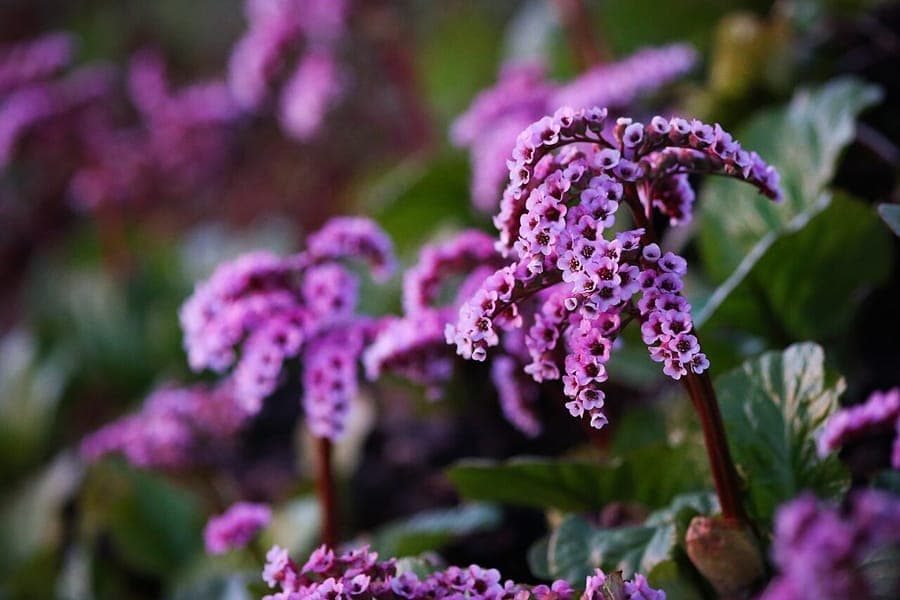
Maja Dumat from Deutschland (Germany) / CC BY 2.0, via Wikimedia Commons
Bergenia purpurascens: complete guide to this evergreen bergenia
Bergenia purpurascens
Want to see Bergenia purpurascens: complete guide to this evergreen bergenia in your garden?
Full design in HD: €7.99
Look after your Bergenia purpurascens with the GardenWorld app
Identify plants with your camera and get a care calendar with reminders for this plant.


Overview
Bergenia purpurascens is an evergreen elephant's ears that really comes into its own in the cold months. While most perennials disappear in November, the leathery leaves of this species turn a deep wine red to purple. In early spring, clusters of nodding pink to purple-red bells follow on red stems. It is a plant that shows off twice a year, and it asks surprisingly little in return.
The species is native to the Himalaya and neighbouring south-west China, from Nepal and Sikkim to Yunnan, Sichuan and Myanmar. There it grows on rocky slopes, in mountain meadows and along woodland edges at high altitude. In its homeland the rhizome has long been used in traditional medicine. In our gardens it is valued as a tough ground cover for the front of a border, beneath shrubs or along a path.
Bergenia purpurascens reaches 30 to 45 cm in height and 40 to 60 cm in spread, slowly extending by creeping rhizomes. Its leaves are narrower and more upright than those of the familiar Bergenia cordifolia, giving it a neater, more graceful outline. If you want to see where an evergreen ground cover like this would work best, you can have a garden design made on gardenworld.app that brings colour to the winter months too.
Appearance and bloom cycle
The leaves are elliptic to obovate, 10 to 20 cm long, glossy dark green and firm as leather. They sit in loose rosettes and are held at an angle, so you often glimpse their reddish undersides. From October, as nights turn cold, the foliage changes to beetroot, claret or purple. The sunnier and colder the spot, the more intense the colour. In spring the new leaves emerge green again.
Flowering starts in March and continues into May. Sturdy reddish-brown stems of 30 to 45 cm carry dense clusters of nodding, bell-shaped flowers about 2 cm long, in deep pink to purple-red. The clusters often arch over slightly, which gives the plant a more elegant look than most bergenias. Bumblebees and early bees visit the flowers eagerly, as little else is in bloom at that time.
Several selections exist, such as 'Irish Crimson', which has particularly dark red winter foliage. The variety delavayi, once treated as a separate species, has slightly rounder leaves. Bergenia purpurascens is also a parent of several well-known garden hybrids.
Ideal location
This bergenia is easy-going and grows in full sun to partial shade. For the best winter colour, choose a sunny or lightly shaded spot: in deep shade the leaves stay green and flowering is sparse. Against a very hot, dry south-facing wall the foliage may scorch in summer, so a little afternoon shade is welcome there.
It makes an ideal edging for paths and patios, a ground cover beneath shrubs or a mass planting on a bank. Plant three to five per square metre, about 40 to 50 cm apart. It also does well in a large container or a deep pocket in a rock garden. Because it keeps its leaves all year, it gives lasting structure to the front of a border.
Soil requirements
Bergenia purpurascens tolerates almost any well-drained garden soil, from slightly acidic to chalky, with a pH between 5.5 and 8. A moderately fertile, humus-rich soil is best. On very rich, wet ground the plant grows lush but floppy and colours less well in winter. On poorer, rather dry soil it stays more compact and colours more intensely.
What it dislikes is soil that sits waterlogged through winter. On heavy clay, work coarse grit and compost into the top 20 cm. Plant the rhizomes at or just below the surface, never deep. A thin layer of compost in spring is all the feeding it needs.
Free preview
Want to see Bergenia purpurascens: complete guide to this evergreen bergenia in your garden? Make a free preview of your design.
Watering
Once established, this plant is fairly drought tolerant. In the first year, water weekly during dry spells, about 5 litres per plant, so the roots can settle in. After that, extra water is only needed during prolonged drought or heat, especially on sandy soil or in a sunny position.
Water at the base rather than over the foliage: wet leaves in warm weather increase the risk of leaf spot. Container plants need watering every few days in summer. Never leave a pot standing in a full saucer, as wet roots in winter lead to rot.
Pruning
No real pruning is needed. Cut spent flower stems back to the base after flowering to keep the plant tidy. In early spring, remove damaged or brown leaves, but leave the healthy winter foliage, which remains attractive until the new leaves appear.
After a few years the centre of a clump may become bare, with long, sprawling rhizomes. Divide the plant after flowering or in early autumn. Cut the rhizomes into sections of 5 to 10 cm, each with at least one leaf rosette, and replant them in lightly improved soil. This rejuvenates the plant and gives you new stock at the same time.
Maintenance calendar
March–April: Flowering time. Remove damaged winter leaves. Apply a thin layer of compost.
May: Cut away spent stems. New leaves develop. Check for slugs and vine weevil, which leaves crescent-shaped notches in the leaf margins.
June–August: Quiet growing season. Water during long dry spells. Divide old clumps after flowering if needed.
September–October: A good time to plant new specimens or divide old ones. The foliage begins to colour.
November–February: The leaves are at their best in claret and purple. No work needed, apart from clearing fallen tree leaves that smother the rosettes.
To keep track of these jobs, use the plant calendar on gardenworld.app, which shows you what to do in your garden month by month.
Winter hardiness
Bergenia purpurascens is reliably hardy. The RHS rates the species H5, which corresponds to -10 to -15 °C, but in practice it also survives harder winters down to around -20 °C in north-west Europe, particularly on well-drained ground. It can stay outdoors without protection throughout Britain and the Low Countries. Selections such as 'Irish Crimson' are rated fully hardy.
In severe frost without snow cover, the leaves may be damaged or go limp, but they usually recover after the thaw. The real danger is prolonged wet around the rhizomes. Move pots against a wall for winter and raise them on feet so excess water can drain away.
The plant is not known to be toxic to people or pets. It can, however, suffer from leaf spot in damp weather, as well as slugs and vine weevil. Remove affected leaves and keep the area around the rosettes open and airy.
Companion plants
Bergenia purpurascens is a superb backbone plant for a winter border. It pairs beautifully with Lenten roses (Helleborus orientalis), which flower at the same time, and with the tiny blue flowers of Brunnera macrophylla in April. Lungwort (Pulmonaria officinalis), with its spotted leaves, makes a playful contrast to the large, smooth foliage.
For summer interest, add Geranium macrorrhizum, another tough ground cover with aromatic leaves. Heuchera micrantha in dark leaf colours echoes the red winter foliage nicely. Ornamental grasses and small bulbs such as snowdrops and crocuses complete the picture. Beneath shrubs such as holly or dogwood, the bergenia forms a solid, weed-suppressing understorey.
Final thoughts
Bergenia purpurascens is a plant for anyone who wants a garden with something to say in winter. Its glossy leaves turn from green to deep claret, and in March the nodding purple-pink flower clusters arrive as an early sign of spring. It is hardy, copes with drought, needs no pruning and keeps weeds at bay.
Plant a group along a path or under a shrub, let it settle for a few years, and you will have a dependable ground cover that gives structure and colour all year round.
Frequently asked questions about Bergenia purpurascens
Is Bergenia purpurascens winter hardy?
Bergenia purpurascens is reliably hardy. The RHS rates the species H5, which corresponds to -10 to -15 °C, but in practice it also survives harder winters down to around -20 °C in north-west Europe, particularly on well-drained ground.
When and how do you prune Bergenia purpurascens?
No real pruning is needed. Cut spent flower stems back to the base after flowering to keep the plant tidy.
How much water does Bergenia purpurascens need?
Once established, this plant is fairly drought tolerant. In the first year, water weekly during dry spells, about 5 litres per plant, so the roots can settle in.
Where does Bergenia purpurascens grow best?
This bergenia is easy-going and grows in full sun to partial shade. For the best winter colour, choose a sunny or lightly shaded spot: in deep shade the leaves stay green and flowering is sparse.
What soil does Bergenia purpurascens need?
Bergenia purpurascens tolerates almost any well-drained garden soil, from slightly acidic to chalky, with a pH between 5.5 and 8. A moderately fertile, humus-rich soil is best.

See it in your garden
See Bergenia purpurascens in your garden
One photo of your garden and a few questions. You see the result in about a minute.
Try it with a photoIdentify this plant in your own garden. Identify a plant
Similar plants
Lenten-rose: complete guide
Helleborus orientalis
Learn how to grow and care for Helleborus orientalis. This early-blooming perennial thrives in shady spots and flowers from February to April, adding colour when little else is blooming.
Great forget-me-not: complete guide
Brunnera macrophylla
Brunnera macrophylla, also known as Great forget-me-not, is a shade-loving perennial with heart-shaped leaves and spring blue flowers. Learn care, soil and planting tips.
Jerusalem cowslip: complete guide
Pulmonaria officinalis
Pulmonaria officinalis, or Jerusalem cowslip, is a charming spring-blooming perennial for shady gardens. Learn how to grow, where to plant, and what companions work best.
