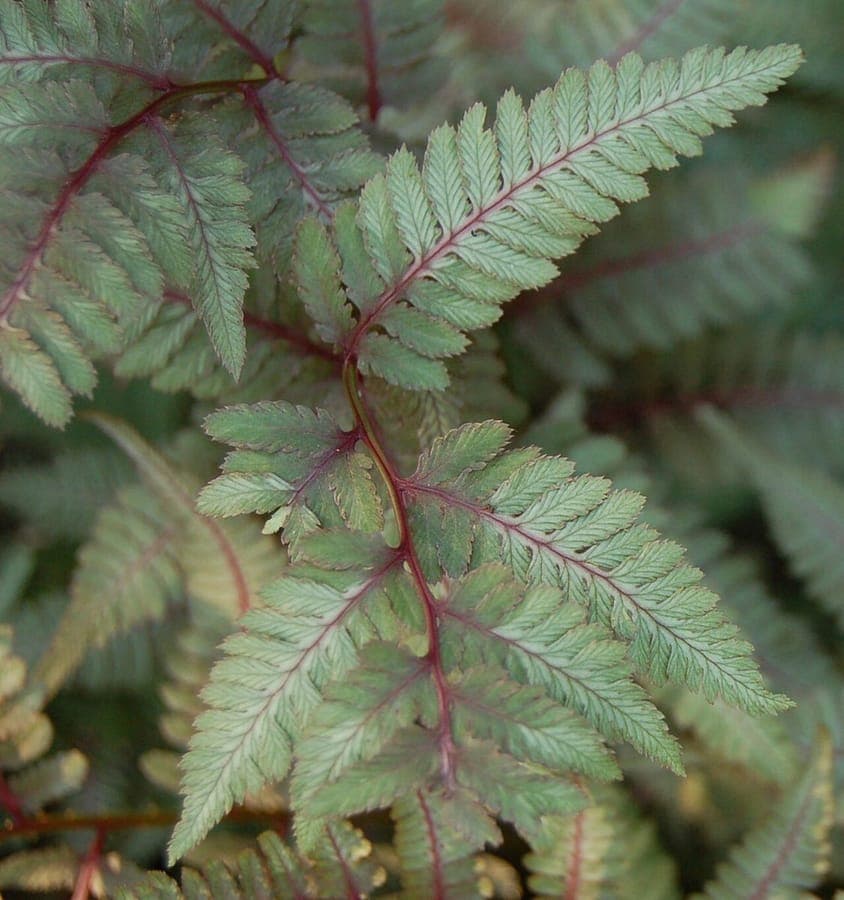
Photo (c)2006 Derek Ramsey (Ram-Man) / CC BY-SA 2.5, via Wikimedia Commons
Japanese painted fern: complete guide
Athyrium niponicum
Want to see Japanese painted fern: complete guide in your garden?
Full design in HD: €7.99
Look after your Japanese painted fern with the GardenWorld app
Identify plants with your camera and get a care calendar with reminders for this plant.


Overview
The Japanese painted fern (Athyrium niponicum) is arguably the most popular ornamental fern in gardens today, and with good reason. Where most ferns are simply green, this one is washed in silver grey with flushes of purple, burgundy and metallic green. It brings light into the darkest corners of the garden, exactly where flowering plants tend to struggle.
The species grows wild in Japan, Korea, China and Taiwan, in damp woodland, along stream banks and on shady slopes. In gardens you will mostly meet the form 'Pictum', also sold as var. pictum or 'Metallicum'. It was named Perennial Plant of the Year in the United States in 2004, which gave its popularity a real boost. Botanically, Athyrium is the lady fern genus; recent classifications give it its own family, Athyriaceae, while older references still place it in Aspleniaceae.
The Japanese painted fern is deciduous: its fronds die back in autumn and new growth appears in late spring. It forms a loose clump 30 to 45 cm tall and 45 to 60 cm wide, spreading very slowly by short, creeping rhizomes. On gardenworld.app you can have a garden design made in which this fern joins hostas, hellebores and other shade lovers in a calm, light-filled shady border.
Appearance and bloom cycle
Being a fern, Athyrium niponicum never flowers; it reproduces by spores formed on the undersides of the fronds. All of its ornamental value lies in the foliage. Each frond is twice to three times divided, 30 to 50 cm long and gently arching. The finely toothed segments are silvery grey to grey green, with a striking wine-red or purple midrib. Towards the centre of the frond the colours blend into one another, creating the characteristic painted effect.
New fronds appear only in May, later than most other ferns. Young growth shows the strongest colours: plenty of red and purple on a silver base. As summer goes on the fronds turn slightly greener, especially in deeper shade. In September and October they begin to fade, and they collapse with the first hard frost.
There are now many cultivars. 'Ursula's Red' has a bold red centre, 'Burgundy Lace' emerges deep purple, 'Silver Falls' is almost entirely silver and 'Red Beauty' has red stalks. The hybrid 'Ghost', a cross with the native lady fern (Athyrium filix-femina), is more upright and reaches about 75 cm.
Ideal location
The Japanese painted fern does best in light to partial shade. A few hours of gentle morning sun is ideal and brings out the best colour. Strong afternoon sun quickly scorches the frond edges, particularly in dry soil. It will tolerate deep shade, but there the fronds stay greener and less vividly marked.
Think of the north or east side of the house, the foot of a tree with an open canopy, the edge of a pond or a shady bed between buildings. Choose a sheltered spot out of the wind, as strong gusts damage the delicate fronds. Because the plant emerges so late, it is worth marking its position with a cane so you do not dig into it by mistake in April. Space plants 40 to 50 cm apart.
Soil requirements
The ideal soil is rich in humus, loose and moisture-retentive yet well drained. Think woodland floor: dark, crumbly and full of leaf litter. On sandy soil, dig plenty of leaf mould or well-rotted compost into the top 25 cm before planting. On clay, mix in compost and some coarse grit so winter rain can drain away. Standing water around the rhizome in winter does harm.
A slightly acidic to neutral pH between 5.5 and 7 suits it best; strongly chalky soil is less suitable. Feeding is hardly necessary: a mulch of leaf mould or fine composted bark in spring provides enough nutrients and keeps the soil cool and moist. Avoid strong synthetic fertilisers, which can burn the fine roots.
Free preview
Want to see Japanese painted fern: complete guide in your garden? Make a free preview of your design.
Watering
Keep the soil evenly moist, especially in the first year. A dry spell in summer is the biggest threat: frond edges turn brown and the plant soon looks tired. During dry weather, water generously twice a week, preferably in the morning and at the base of the plant. One thorough soak is better than a small splash every day.
Once established, the fern copes with short dry periods, particularly if the soil is mulched. In pots the compost dries out far faster, so check daily in summer. In winter no extra water is needed, except for potted plants under cover, which should get a little now and then so the root ball never dries out completely.
Pruning
Pruning is simply a matter of clearing old foliage. The fronds die back in autumn, and you can leave them in place until the end of winter: they protect the rhizome from frost and shelter beneficial insects. Cut them down close to the ground in February or early March, before the new fronds start to unfurl. Leave it too late and you can easily damage the young, curled shoots.
In summer you can snip off the odd brown or damaged frond to keep the plant looking fresh. After four or five years the clump widens and sometimes becomes a little bare in the middle. Divide it in spring, just as new growth appears. Slice the clump into two or three pieces with a sharp spade, each with a good section of rhizome, and replant straight away.
Maintenance calendar
January–February: Dormant period. Cut back the old, dead fronds at the end of February.
March–April: Apply a mulch of leaf mould. Mark the spot, as there is nothing to see yet. The best time to plant or divide.
May: New fronds unfurl. Protect them with fleece if a late frost is forecast; young growth is tender.
June–August: Colour at its peak. Water in dry spells and remove damaged fronds. Keep an eye out for slugs.
September–October: Fronds begin to fade. Planting is still possible, giving roots time to settle before winter.
November–December: Foliage dies back. Leave it as winter protection.
Winter hardiness
Athyrium niponicum is very hardy and withstands frost down to about -25 °C. In Britain and north-western Europe it needs no protection in open ground. Since the fronds die back in autumn, there is nothing above ground to be damaged by cold, and the rhizome overwinters safely under a layer of fallen leaves.
The one risk is late frost in May, just after the new fronds have emerged, which can blacken them. The plant usually reshoots, but it loses part of its season. Watch the forecast and cover plants with fleece on frosty nights. In containers the root ball is more vulnerable, so move pots against a wall in winter or sink them into the ground.
The Japanese painted fern is not known to be toxic to people or pets, and it is not invasive. Slugs generally leave it alone, although they may nibble young fronds in a wet spring.
Companion plants
Its silvery colour makes the painted fern an ideal linking plant in a shady border. Pair it with blue or golden hostas, whose large, smooth leaves contrast beautifully with the fine fern foliage. Coral bells (Heuchera micrantha) with dark red or silvery leaves pick up the red tones of the midribs.
For spring interest, Lenten roses (Helleborus orientalis) and Siberian bugloss (Brunnera macrophylla) are perfect partners: they flower while the fern is still dormant and fill the early-season gap. Another fern, the autumn fern (Dryopteris erythrosora), adds a warm coppery accent. Japanese forest grass (Hakonechloa macra), wood anemones and small bulbs such as snowdrops also work well. In a pot the painted fern looks lovely on its own, or with a small hosta and a few violas.
Final thoughts
The Japanese painted fern proves that shade need never be dull. With its silver, red-veined fronds it lights up any dark corner from May until the first frosts. Give Athyrium niponicum humus-rich, moist soil, a spot in partial shade and a little patience in spring, and it will stay handsome for years with very little effort.
The plant calendar on gardenworld.app gives you a monthly overview of jobs for your painted fern and the rest of the garden, from clearing old fronds to mulching in spring. Plant three together in a group beneath a tree and you will see a shady corner begin to shine.
Frequently asked questions about Japanese painted fern
Is Japanese painted fern winter hardy?
Athyrium niponicum is very hardy and withstands frost down to about -25 °C. In Britain and north-western Europe it needs no protection in open ground.
When and how do you prune Japanese painted fern?
Pruning is simply a matter of clearing old foliage. The fronds die back in autumn, and you can leave them in place until the end of winter: they protect the rhizome from frost and shelter beneficial insects.
How much water does Japanese painted fern need?
Keep the soil evenly moist, especially in the first year. A dry spell in summer is the biggest threat: frond edges turn brown and the plant soon looks tired.
Where does Japanese painted fern grow best?
The Japanese painted fern does best in light to partial shade. A few hours of gentle morning sun is ideal and brings out the best colour.
What soil does Japanese painted fern need?
The ideal soil is rich in humus, loose and moisture-retentive yet well drained. Think woodland floor: dark, crumbly and full of leaf litter.

See it in your garden
See Japanese painted fern in your garden
One photo of your garden and a few questions. You see the result in about a minute.
Try it with a photoIdentify this plant in your own garden. Identify a plant
Similar plants
Hosta: complete guide
Hosta
Everything about hostas (plantain lilies): varieties, planting, care and slug control. Expert tips for stunning foliage in shade gardens.
Lenten-rose: complete guide
Helleborus orientalis
Learn how to grow and care for Helleborus orientalis. This early-blooming perennial thrives in shady spots and flowers from February to April, adding colour when little else is blooming.
Great forget-me-not: complete guide
Brunnera macrophylla
Brunnera macrophylla, also known as Great forget-me-not, is a shade-loving perennial with heart-shaped leaves and spring blue flowers. Learn care, soil and planting tips.
