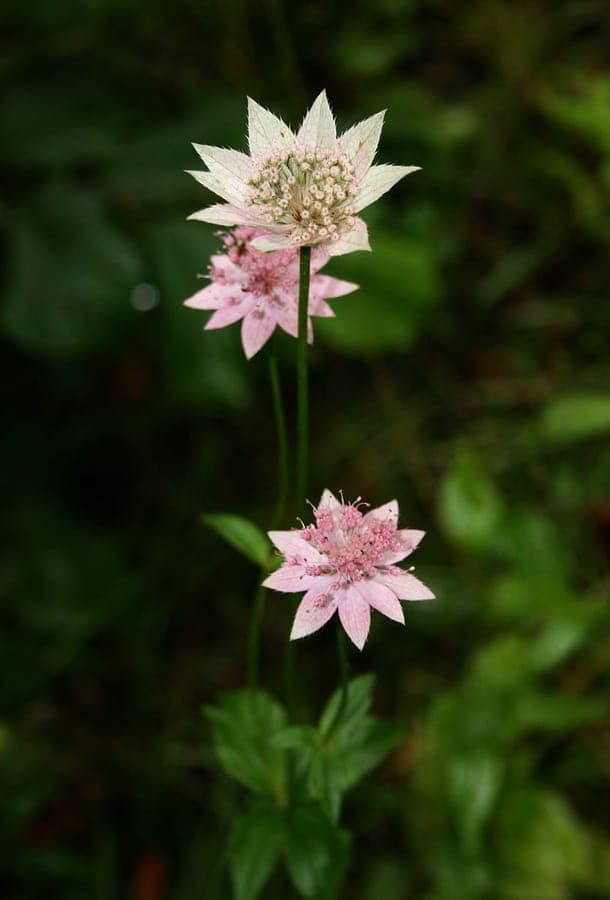
Franz Xaver / CC BY-SA 3.0, via Wikimedia Commons
Astrantia maxima: complete guide
Astrantia maxima
Want to see Astrantia maxima: complete guide in your garden?
Full design in HD: €7.99
Look after your Astrantia maxima with the GardenWorld app
Identify plants with your camera and get a care calendar with reminders for this plant.


Overview
Astrantia maxima is a masterwort from the Caucasus and north-eastern Turkey, where it grows in damp mountain meadows, along woodland edges and in open deciduous forest. Gardeners who already know the common masterwort will spot the difference straight away: the flower heads of this species sit in a ruff of broad, clear pink bracts that look as if they were cut from tissue paper. The effect is a flower that seems both sturdy and delicate, rather like an old-fashioned pincushion trimmed with ribbon.
It belongs to the carrot family (Apiaceae), alongside parsley and fennel, though you would hardly guess it. Astrantia maxima forms a low clump of deeply lobed leaves, and in summer slender, branching stems rise above it to 40 to 70 cm, depending on soil and moisture. Below ground it spreads by short rhizomes, so after a few years a single plant knits into a loose mat 40 to 60 cm across. That makes it ideal if you want a border that fills in by itself without turning into a thug.
The Royal Horticultural Society has given Astrantia maxima its Award of Garden Merit, and it deserves the honour. It is reliable, flowers for weeks, draws in insects and makes an excellent cut flower. If you are wondering where it would look best in your own plot, gardenworld.app can create a garden design for you that takes account of shade, moisture and the plants you already grow.
Appearance and bloom cycle
Flowering starts in June and carries on into August. Each head is 3 to 4 cm wide and consists of a dome of dozens of tiny florets with protruding stamens, surrounded by ten to fifteen bracts. In Astrantia maxima these bracts are noticeably broad, oval with a sharp point, and fused together at the base. Their colour ranges from soft powder pink to a deeper salmon pink. On some plants they open almost white, edged and tipped with pink, and gradually colour up as they age.
The foliage is a second reason to grow it. The leaves are deeply three-lobed with toothed margins and stay fresh green until autumn, so the clump looks tidy even when it is not in flower. Carried on long stalks, they form a dense, low layer at the front or middle of a border.
The flowers last well, on the plant and in a vase. Spent heads dry beautifully and keep some of their colour, which makes them useful in dried arrangements. Bees, hoverflies and small beetles visit in large numbers because the nectar is shallow and easy to reach for short-tongued insects. A white form, Astrantia maxima 'Alba', does turn up in nurseries, though it is much scarcer than the pink species.
Ideal location
Astrantia maxima prefers partial shade. A spot with morning sun and afternoon shade, or dappled light beneath tall trees, suits it perfectly. It will cope with full sun, but only where the soil never dries out; on a hot, dry site the leaves scorch and flowering stops early. It also tolerates deeper shade, although it flowers less freely there and the stems tend to flop.
Think of the edge of a woodland border, the north or east side of a hedge, a spot beside a pond, or a bed along a wall that casts shade in the afternoon. Plant in groups of three to five, 35 to 40 cm apart, and within a year or two they will merge into a floating haze of pink stars. Its natural look sits comfortably in a cottage garden, a modern shade-tolerant prairie scheme or a romantic town garden.
Soil requirements
The plant does best in humus-rich soil that holds moisture yet drains freely. Loam and heavier sandy loam are ideal. Improve light, sandy soil with a generous layer of leaf mould or well-rotted compost, roughly a bucketful per square metre, worked into the top 20 cm. On heavy clay, add compost and some coarse grit so the roots never sit in standing water through winter.
Slightly acidic to slightly alkaline soil is fine, roughly pH 6 to 7.5. In the wild, Astrantia maxima grows on limestone mountain soils, so lime is no problem at all. Feed sparingly: a mulch of compost in spring is plenty. Too much nitrogen produces lush leaves and weak stems that collapse in summer rain.
Free preview
Want to see Astrantia maxima: complete guide in your garden? Make a free preview of your design.
Watering
Moisture is the key to success. In the first summer after planting, give a thorough soaking once a week, around 5 to 10 litres per plant, and more often in hot spells. After that it usually manages on its own, provided the soil naturally holds some moisture.
During long dry periods in July and August, extra water is still needed. You will see it at once: the leaves droop and the edges turn brown. Water deeply at the base of the plant, preferably in the morning. A 5 cm mulch of leaf mould, bark chips or compost applied in spring makes a huge difference in keeping the root zone cool and damp. You can grow Astrantia maxima in a container, but in summer you will need to check it almost daily.
Pruning
Pruning is simple. After the first flush of flowers, usually at the end of July, cut the spent stems back to just above the foliage. A second, smaller flush often follows in August or September. If the leaves look tired or grey after a dry summer, cut those back too; fresh new growth appears within a few weeks.
If you do not want seedlings, remove the flower heads before the seed ripens. Astrantia maxima self-sows less than common masterwort, but on a damp site you may still find a few youngsters. Clear away the dead foliage in late autumn or early spring. Every four or five years you can lift and divide a large clump in March: slice it with a spade into pieces that each carry a few buds, and replant them straight away.
Maintenance calendar
March-April: Remove old leaves, spread compost or leaf mould and divide congested clumps. Plant new specimens now or in autumn.
May: Young leaves emerge. Watch out for slugs, which love the fresh shoots.
June-July: Peak flowering. Cut stems for the vase when the flowers have just fully opened. Water during dry weather.
Late July-August: Cut back the first flush to encourage a second round of flowers. Keep watering in dry weeks.
September-October: Final flowers. A good time to plant, as the soil is still warm.
November-February: Dormant season. Leave a few spent heads for winter structure if you like. If you want every task for your own garden laid out month by month, the plant calendar on gardenworld.app helps you keep on top of things.
Winter hardiness
Astrantia maxima is very hardy and survives temperatures down to around -25 to -30 °C (USDA zone 4). It comes through winter anywhere in the UK and the Low Countries without protection. The plant dies back largely in autumn and overwinters as buds at or just below soil level.
The biggest winter risk is wet, compacted ground. Rhizomes that sit in water for months on end can rot, so make sure the subsoil drains well. A layer of leaf mould in autumn protects the crowns and feeds the soil at the same time. Pots are best moved against a sheltered wall for winter so the root ball does not freeze solid.
Astrantia maxima is not known to be toxic to people or pets. As with several members of the carrot family, the sap may cause mild skin irritation in sensitive people, so wear gloves if your skin reacts easily.
Companion plants
There are plenty of good partners for partial shade. Hostas such as Hosta sieboldiana, with their large blue-grey leaves, give a calm contrast to the fine pink stars. Lady's mantle (Alchemilla mollis) with its lime-green sprays is a classic underplanting, and the two flower at the same time.
Geranium macrorrhizum is a robust ground cover that keeps weeds down beneath the astrantia. Foxgloves (Digitalis purpurea) add height behind the group in June, and ferns such as the lady fern (Athyrium filix-femina) bring a light, woodland feel. Common masterwort (Astrantia major) and dark red cultivars like 'Ruby Wedding' also combine well, giving you several shades of the same flower form.
Final thoughts
Astrantia maxima is one of those plants you would not want to be without after a single season. The broad pink ruffs, the handsome foliage, the long flowering period and the polite way it spreads make it a mainstay for partial shade. Give it a moist, humus-rich spot, cut it back after the first flush, and it will reward you year after year with hundreds of pink stars. Plant a small group at the edge of your shady border this autumn and see how well this modest native of the Caucasus blends with what you already grow.
Frequently asked questions about Astrantia maxima
Is Astrantia maxima winter hardy?
Astrantia maxima is very hardy and survives temperatures down to around -25 to -30 °C (USDA zone 4). It comes through winter anywhere in the UK and the Low Countries without protection.
When and how do you prune Astrantia maxima?
Pruning is simple. After the first flush of flowers, usually at the end of July, cut the spent stems back to just above the foliage.
How much water does Astrantia maxima need?
Moisture is the key to success. In the first summer after planting, give a thorough soaking once a week, around 5 to 10 litres per plant, and more often in hot spells.
Where does Astrantia maxima grow best?
Astrantia maxima prefers partial shade. A spot with morning sun and afternoon shade, or dappled light beneath tall trees, suits it perfectly.
What soil does Astrantia maxima need?
The plant does best in humus-rich soil that holds moisture yet drains freely. Loam and heavier sandy loam are ideal.

See it in your garden
See Astrantia maxima in your garden
One photo of your garden and a few questions. You see the result in about a minute.
Try it with a photoIdentify this plant in your own garden. Identify a plant
Similar plants
Astrantia: complete guide
Astrantia major
Complete care guide for Astrantia major: bloom time, ideal location, soil, watering and companion plants. Perfect for shady borders.
Garden lady's-mantle: complete guide
Alchemilla mollis
Alchemilla mollis, or garden lady's-mantle, is a graceful perennial perfect for borders, shade gardens, and low-maintenance landscapes. Grows 15–30 cm tall, blooms June–August.
Rock crane's-bill: complete guide
Geranium macrorrhizum
Rock crane's-bill (Geranium macrorrhizum) is a tough groundcover thriving in sun or partial shade. Great for rock gardens and dry spots. Grows 20-30 cm tall.
