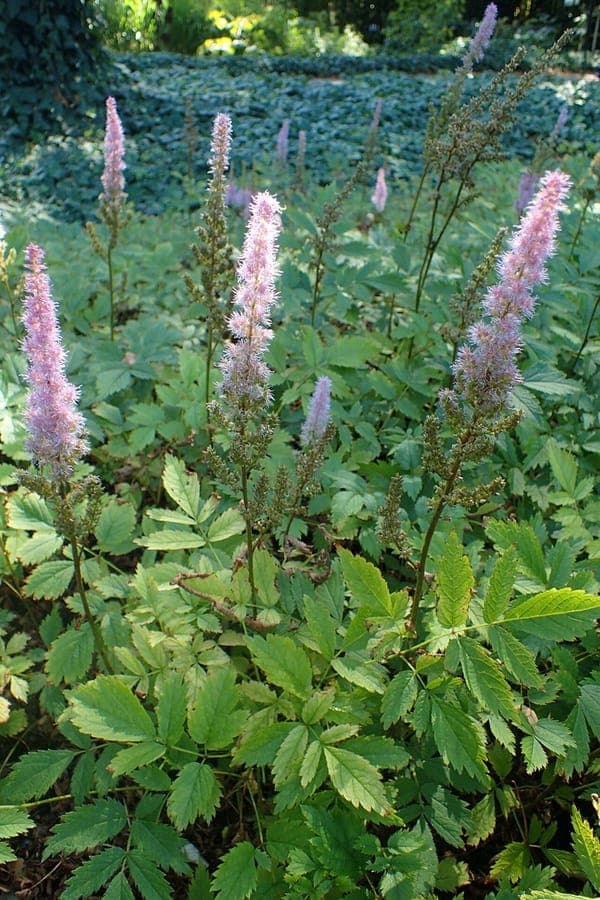
Krzysztof Ziarnek, Kenraiz / CC BY-SA 4.0, via Wikimedia Commons
Chinese Astilbe: complete guide
Astilbe chinensis
Want to see Chinese Astilbe: complete guide in your garden?
Full design in HD: €7.99
Look after your Chinese Astilbe with the GardenWorld app
Identify plants with your camera and get a care calendar with reminders for this plant.


Overview
Astilbe chinensis, the Chinese astilbe, is the one that waits longest to flower and then keeps going the longest. While the familiar garden astilbes put on their show in June and early July, this species only gets into its stride when summer is at its height. In the wild it grows in northern and eastern China, Korea and the Russian Far East, along streams, in damp woodland margins and in mountain meadows. Some botanical databases now merge it with Astilbe rubra, but in the nursery trade Astilbe chinensis remains the standard name.
It belongs to the saxifrage family (Saxifragaceae). The plant forms a clump of finely divided, toothed foliage, from which upright, narrow flower plumes appear in summer. Depending on the form, it reaches 25 to 120 cm. What sets it apart from other astilbes is its toughness: Astilbe chinensis copes with more sun and drier soil than most of its relatives. It spreads slowly by short underground rhizomes, so the low forms in particular knit together into a solid carpet.
Three main groups are widely sold. The low var. pumila grows 25 to 40 cm tall and makes an excellent ground cover. The mid-height 'Vision' series, including 'Visions' (raspberry pink), 'Vision in Pink' and 'Vision in Red', reaches 40 to 50 cm. The tall var. taquetii, with cultivars such as 'Superba' and 'Purpurlanze', shoots up to 100 or even 120 cm. Wondering which form would suit your plot? On gardenworld.app you can create a garden design in which shade, moisture and plant sizes are matched to one another.
Appearance and bloom cycle
Flowering runs from mid-July into September, and in the tall forms sometimes until the end of September. The plumes are narrower and more candle-like than the feathery heads of the Astilbe × arendsii hybrids. They are made up of thousands of tiny flowers in lilac, mauve, pink or purple-red, with a slightly fluffy look. White and cream forms exist too, but the species itself leans towards lilac-pink.
The leaves are two or three times divided, with oval, sharply toothed leaflets. They often emerge bronze in April before turning fresh green. The flower stems are sturdy and frequently covered in reddish hairs. After flowering, the plumes fade to a rusty brown. These dry heads are decorative in their own right and stand well into winter, especially when touched by frost.
The flowers are not strongly scented, yet they still draw hoverflies, small bees and beetles. They also make good cut flowers, provided you pick them when roughly half the plume is open and put them straight into water.
Ideal location
Like all astilbes, Astilbe chinensis is happiest in partial shade, with morning sun and afternoon shade being ideal. Thanks to its better drought tolerance it can also take full sun, as long as the soil holds enough moisture. In deep, dry shade under dense trees it flowers poorly.
Good spots include a border on the north or east side of the house, the edge of a pond, a bed beneath tall, light-canopied trees, or a strip along a shady path. The low var. pumila is ideal as ground cover in awkward places beneath shrubs. Plant the low forms 25 to 30 cm apart, the mid-height ones 35 to 40 cm and the tall ones 50 cm. In groups of five or more, the late flowering really comes into its own.
Soil requirements
The ideal soil is rich in humus, moisture-retentive and slightly acidic to neutral, with a pH between 5.5 and 7. Loam and humus-rich sandy soils are excellent. On poor, sandy ground, work a generous layer of compost or leaf mould into the top 25 cm when planting. On heavy clay, use compost to open up the structure: although the plant needs moisture, it dislikes ground that stays waterlogged for months in winter.
Astilbes are hungry plants. Every spring, give a layer of well-rotted compost or an organic fertiliser for perennials. Soil that is too poor results in small plumes and leaves with brown edges.
Free preview
Want to see Chinese Astilbe: complete guide in your garden? Make a free preview of your design.
Watering
Water is the main concern with any astilbe, even this relatively tough species. In the first year after planting, give 5 to 10 litres per plant twice a week in dry weather. Never let the soil dry out completely, or the leaf margins crisp and flowering fails.
Established plants of Astilbe chinensis cope with a short dry spell better than other astilbes, but regular watering in July and August is still wise, particularly in sun. Water in the morning where possible, and always at the base. A 5 cm mulch of compost, leaf mould or bark chips keeps the soil cool and damp. In a container the plant needs a large pot and water almost every day in summer.
Pruning
Astilbe chinensis needs very little pruning. You can leave the spent plumes standing until the end of winter: they look attractive and give shelter to insects. In February or early March, cut all old stems and dead leaves down to just above ground level before the new shoots appear.
Every three to five years the centre of the clump becomes woody and flowering drops off. Divide the plant then, in early spring or in September. Lift the clump, split it with a spade or sharp knife into pieces with three to five buds each, and replant straight away in improved soil. That keeps the plant young and free-flowering.
Maintenance calendar
February-March: Cut back old stems and foliage. Divide old clumps. Apply compost or organic fertiliser.
April-May: Bronze-tinted leaves emerge. Plant new specimens. Mulch once the soil has warmed up.
June: Strong growth. Water during dry spells and check young plants for slugs.
July-August: Flowering begins. Keep watering regularly, especially in sunny spots.
September: Late flowers on the tall forms. A good time to divide or plant.
October-January: Leave the brown plumes for winter structure and for insects. To see which job is due when in your own garden, check the plant calendar on gardenworld.app.
Winter hardiness
Astilbe chinensis is fully hardy and withstands temperatures down to around -30 °C (USDA zone 4). In the UK and the Low Countries it needs no winter protection at all. The top growth dies back in autumn and the plant overwinters as buds just below the soil surface.
The only winter risks are sodden ground, in which the rhizomes can rot, and late spring frost, which may damage the young leaves. The latter is purely cosmetic: the plant simply sends up new growth. For container plants, protect the root ball by placing the pot against a wall or wrapping it in hessian.
Astilbes are not known to be toxic. The American animal welfare organisation ASPCA lists them as non-toxic to cats, dogs and horses, and no cases of poisoning in people are known. That makes Astilbe chinensis a safe choice for a family garden.
Companion plants
Astilbe chinensis partners beautifully with foliage plants in partial shade. Hostas such as Hosta sieboldiana, with their broad blue-green leaves, offer a calm counterweight to the fine plumes. Ferns like the lady fern (Athyrium filix-femina) and the shuttlecock fern (Matteuccia struthiopteris) bring a woodland atmosphere.
Brunnera macrophylla flowers in spring, so the bed has something to offer from April to September. Heuchera micrantha cultivars with dark foliage pick up the lilac tones of the plumes. In damp spots, Ligularia dentata and Rodgersia podophylla look superb behind them. If you combine different astilbes, such as Astilbe japonica for June and Astilbe chinensis for August, your shade border will flower for months on end.
Final thoughts
Astilbe chinensis is the astilbe for anyone who wants more than a brief peak in June. It flowers late, tolerates more sun and drought than its relatives, spreads neatly and is non-toxic. Give it humus-rich, moist soil and a spot in partial shade, and it will fill the summer gaps in your border with lilac and pink plumes year after year. Plant a group of five beneath a light-canopied tree this spring and enjoy a shady corner that is still in full flower come August.
Frequently asked questions about Chinese Astilbe
Is Chinese Astilbe winter hardy?
Astilbe chinensis is fully hardy and withstands temperatures down to around -30 °C (USDA zone 4). In the UK and the Low Countries it needs no winter protection at all.
When and how do you prune Chinese Astilbe?
Astilbe chinensis needs very little pruning. You can leave the spent plumes standing until the end of winter: they look attractive and give shelter to insects.
How much water does Chinese Astilbe need?
Water is the main concern with any astilbe, even this relatively tough species. In the first year after planting, give 5 to 10 litres per plant twice a week in dry weather.
Where does Chinese Astilbe grow best?
Like all astilbes, Astilbe chinensis is happiest in partial shade, with morning sun and afternoon shade being ideal. Thanks to its better drought tolerance it can also take full sun, as long as the soil holds enough moisture.
What soil does Chinese Astilbe need?
The ideal soil is rich in humus, moisture-retentive and slightly acidic to neutral, with a pH between 5.5 and 7. Loam and humus-rich sandy soils are excellent.

See it in your garden
See Chinese Astilbe in your garden
One photo of your garden and a few questions. You see the result in about a minute.
Try it with a photoIdentify this plant in your own garden. Identify a plant
Similar plants
Hosta sieboldiana: complete guide
Hosta sieboldiana
Hosta sieboldiana growing guide: large blue-green shade plant from Japan. Complete care tips, placement and maintenance for shady gardens and woodland areas.
Common ladyfern: complete guide
Athyrium filix-femina
Everything you need to know about Athyrium filix-femina: care, ideal conditions, companion plants, and seasonal maintenance for UK and US gardens.
Great forget-me-not: complete guide
Brunnera macrophylla
Brunnera macrophylla, also known as Great forget-me-not, is a shade-loving perennial with heart-shaped leaves and spring blue flowers. Learn care, soil and planting tips.
