
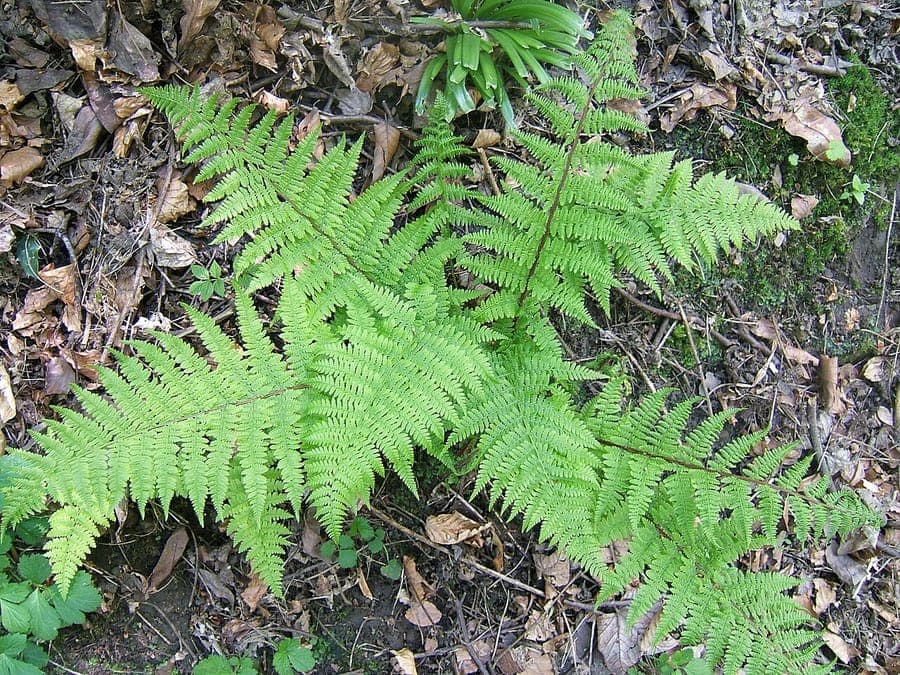
No machine-readable author provided. MPF assumed (based on copyright claims). / CC BY 2.5, via Wikimedia Commons
Common ladyfern: complete guide
Athyrium filix-femina
Want to see Common ladyfern: complete guide in your garden?
1 minute, no credit card
Overview
Athyrium filix-femina, commonly known as the common ladyfern, is a graceful perennial fern that thrives in cool, shaded environments. Native to woodlands across Europe, North Africa, and parts of North America - including regions like Arizona and the Baltic states - it's well-suited to USDA hardiness zones 4–8. In gardens, it brings a soft, elegant texture, making it a top choice for naturalistic planting schemes. Unlike flowering perennials, it doesn't bloom, but its lush fronds provide year-round interest in the right conditions.
This fern grows in loose clumps, reaching 40–60 cm in height and spreading slowly via creeping rhizomes. It's non-invasive, filling space gently without overwhelming neighbours. Its preference for shade and moisture makes it ideal for tricky spots under trees or in north-facing borders. On gardenworld.app, you can visualise how ladyferns fit into your shaded garden layout and experiment with layering textures.
Appearance & bloom cycle
The common ladyfern doesn't produce flowers. Instead, it reproduces via spores that develop in sori - clusters visible on the undersides of fronds - maturing from mid-summer to autumn. The fronds themselves are finely divided, bright green, and feathery, unfurling in spring from tight, corkscrew-like fiddleheads. These emerge in April or May, depending on local climate, and expand into arching, triangular fronds up to 60 cm long.
In summer, the foliage forms a full, airy mound. By late autumn, fronds typically turn yellow-brown and collapse, though in milder winters they may remain semi-evergreen. The plant dies back to the crown, where new growth resumes the following spring. The rhythm of unfurling and retreat gives the garden a natural, seasonal pulse.
Ideal location
Choose a spot with dappled to full shade - a light level of 3 on a 1–10 scale. Avoid hot afternoon sun, which scorches the delicate fronds. Ideal placements include under deciduous trees like beech or birch, along north-facing walls, or in woodland borders. The plant also does well in sheltered urban courtyards where light is filtered by buildings. On gardenworld.app, you can use the shade analyser tool to determine if your garden's light conditions suit ladyferns.
Avoid dry, exposed sites. If planting near evergreens, allow extra watering, as root competition can limit moisture availability.
Soil requirements
Ladyferns thrive in moist, humus-rich, well-drained soil with a pH between 4.5 and 7. They prefer loamy or sandy loam soils enriched with leaf mould or compost. Avoid heavy clay unless amended with organic matter to improve drainage. The key is consistent moisture without waterlogging - a balance that mimics their natural forest floor habitat.
If your soil is too alkaline (above pH 7), consider growing ladyferns in containers with ericaceous compost, which maintains acidity. In alkaline gardens, this small adaptation makes a big difference.
Free design
Want to see Common ladyfern: complete guide in your garden? Make a free design now.
Watering
Keep the soil consistently moist, especially during the first growing season. Water weekly during dry spells, more frequently in sandy soils. Use rainwater when possible, as tap water with high lime content can stress the plant over time. Mulching with leaf litter or bark helps retain moisture and regulate soil temperature.
In established plants, watering needs decrease, but never let the soil dry out completely. During prolonged droughts in July or August, check soil moisture every few days and supplement as needed.
Pruning
Pruning is minimal. In late winter or early spring (February–March), remove old, tattered fronds to make way for new fiddleheads. Cut close to the crown with sharp secateurs. Avoid cutting into the crown itself, as this can damage next season's growth. If the plant remains semi-evergreen, leave some foliage through winter for insulation.
Do not prune during active growth. Let the natural cycle unfold - new fronds will emerge as old ones decompose.
Maintenance calendar
- Jan: Check for winter damage; remove any collapsed fronds if needed
- Feb: Clear old growth, apply thin layer of leaf mulch
- Mar: Monitor for emerging fiddleheads; protect from slugs
- Apr: Ensure soil stays moist; watch for pests
- May: Fronds fully expand; no intervention required
- Jun: Maintain moisture under tree canopies
- Jul: Watch for dry spells; water during heatwaves
- Aug: Continue monitoring soil; avoid fertilisers
- Sep: Let plant prepare for dormancy
- Oct: Leave fallen fronds as mulch
- Nov: Final check for debris; minimal watering
- Dec: Dormant; protect from extreme freeze-thaw cycles
Winter hardiness
Hardy in USDA zones 4–8, the ladyfern tolerates winter lows down to -30°C. In the UK and northern US, it typically survives without protection. In zone 4, a light mulch of leaves helps insulate the crown. Avoid heavy mulches like straw, which can trap excess moisture and lead to rot.
Companion plants
Pair with hostas, hellebores, tiarella, and epimedium for a layered woodland effect. Early spring bulbs like snowdrops and bluebells bloom before the ferns fully leaf out, creating seasonal contrast. Ferns also contrast beautifully with bold-leaved plants like rodgersia or ligularia in damper areas.
Avoid aggressive spreaders like mint or bindweed. Stick to slow, clump-forming plants that won't compete for moisture and space.
Closing
The common ladyfern is a reliable, elegant solution for shaded, moist areas where few other plants thrive. It asks little - just consistent moisture and protection from harsh sun - and rewards with lush texture year after year. Buy healthy plants from local garden centres or reputable online suppliers, and give them time to settle. With the right start, Athyrium filix-femina becomes a quiet backbone in your garden's ecosystem.
Want to see Common ladyfern: complete guide in your garden? Make a free design now.
Upload a photo, pick a style, and get a photorealistic design with plant list in under a minute.
No credit card required


Similar plants
Mountain spleenwort: complete guide
Asplenium montanum
Everything about mountain spleenwort fern: cultivation, care, growing conditions and proper maintenance for your garden
Western spleenwort: complete guide
Asplenium vespertinum
The Western spleenwort (Asplenium vespertinum) is a delicate fern from California with fine, feathery fronds. Learn about care, location, and overwintering in this comprehensive guide.
Asplenium cirrhatum: complete guide
Asplenium cirrhatum
Discover the chestnut scale spleenwort, a tropical fern full of elegance. Learn how to care for this exotic plant at home.