
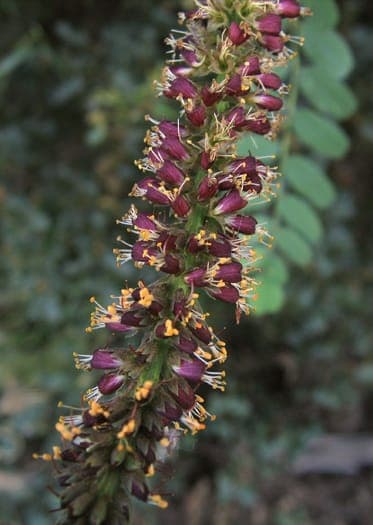
Anthony Valois and the National Park Service / Public domain, via Wikimedia Commons
California false indigo: complete guide
Amorpha californica
Want to see California false indigo: complete guide in your garden?
1 minute, no credit card
Overview
California false indigo (Amorpha californica), also known as California indigobush or mock locust, is a deciduous multi-stemmed shrub in the pea family (Fabaceae). It was first described botanically in 1838 by Torrey and Gray, and is native to California, Arizona, New Mexico, and the northern reaches of Baja California in Mexico. In its natural chaparral and dry woodland habitat it endures long, hot, rainless summers followed by mild, wet winters - a climate profile that makes it well suited to Mediterranean gardens, xeriscaping projects, and any situation where a drought-adapted flowering shrub is needed.
The common name "false indigo" refers to a superficial resemblance to the true indigo plant (Indigofera tinctoria) and to the leadplants of the American prairies. Amorpha californica is closely related to the better-known Amorpha fruticosa but is better adapted to dry, alkaline, or sandy soils and has a somewhat more compact form. It is a nitrogen-fixing plant, able to enrich poor soils through symbiotic root bacteria - a practical advantage in low-nutrient garden situations.
At gardenworld.app you can browse design ideas for combining California false indigo with other Mediterranean-climate shrubs and perennials in a cohesive planting plan.
Appearance and bloom cycle
California false indigo typically grows between 1 and 2 metres tall with a similar spread. Its multi-stemmed base gives it an open, loose silhouette that suits informal and naturalistic garden styles. Over time, the clump spreads modestly from the root crown but rarely becomes invasive.
The leaves are finely pinnate, composed of 15 to 25 small elliptic leaflets arranged along a central stalk. Their texture is fine and light, giving the plant an airy, graceful appearance even when not in flower. The foliage turns yellow in autumn before falling.
Flowering occurs in May and June, when slender spikes up to 15 cm long emerge from the tips of the current season's shoots. Each flower on the spike has a single standard petal in rich purple-blue, surrounded by prominent orange-yellow stamens - a striking bicolour combination. Because there are no wing or keel petals, the anthers are unusually visible, which makes the spikes especially attractive to bees and butterflies. After flowering, small oblong seed pods develop.
Ideal location
California false indigo requires full sun and performs best in warm, sheltered positions. It evolved in the intense sunshine of Californian chaparral and coastal scrub, and in shadier conditions it becomes lax and flowers sparsely.
In European gardens, a south- or south-west-facing position is ideal, particularly against a wall or fence that stores and reflects heat. The plant thrives in a dry border, on a sunny slope, in a Mediterranean-themed planting, or as a container specimen that can be moved to a sheltered spot in cold winters.
Avoid positions where water pools in winter, as root rot in wet cold conditions is the main threat to this plant's survival. Good air circulation also helps prevent fungal issues on the dense foliage.
Soil
This species is notably tolerant of poor, dry, and freely draining soils. As a legume it fixes atmospheric nitrogen in partnership with root bacteria, meaning it actually does better on lean soils than on rich, heavily fertilised ground. Overfeeding with nitrogen produces lush, soft growth that flowers poorly and is more prone to pests and disease.
The preferred pH range is broad - from 5 to 8.5 - which is unusual and useful in gardens where soil conditions vary. Sandy loam or gritty loam soils are ideal. Heavy clay that stays wet in winter is problematic and should be improved with coarse grit before planting.
A light mulch of 3 to 5 cm can help regulate moisture without making the soil too rich. Keep the mulch clear of the base of the stems to avoid collar rot.
Free design
Want to see California false indigo: complete guide in your garden? Make a free design now.
Watering
Once established, California false indigo is one of the more drought-tolerant flowering shrubs you can grow in a temperate garden. It survives extended dry periods with minimal supplemental water, provided the root system has had time to penetrate deeply into the soil.
In the first year, water deeply and thoroughly once a week, allowing the soil to dry out between sessions. Deep, infrequent watering encourages the roots to go down rather than spread horizontally near the surface. From the second year onward, watering can be reduced sharply. Established plants in average European summers rarely need more than an occasional deep soak during prolonged drought.
Overwatering - especially in combination with cold temperatures - is far more damaging than drought. In winter, ensure the drainage is adequate to prevent the roots from sitting in water.
Pruning
California false indigo responds well to pruning in early spring, just before new growth begins. Cut back the previous year's stems by up to one-third to keep the plant compact and encourage vigorous flowering shoots. Remove any dead, damaged, or crossing stems cleanly at their origin.
After flowering in June, the spent spikes can be removed for a tidier appearance, but this is optional - the developing seed pods have their own modest ornamental value and feed birds.
If the plant becomes overgrown or suffers severe winter damage, it can be cut back hard to near ground level. It usually regenerates strongly from the root crown, sending up vigorous new shoots in spring.
Maintenance calendar
February - March: Check for frost damage. Remove dead or blackened stems. Carry out shaping cuts before growth begins.
April - May: First leaves emerge. Water young plants weekly in dry spells. Watch for aphids on new shoots.
June - July: Flowering period. Enjoy the purple spikes. Remove spent spikes after bloom if desired.
August - September: Seed pods ripen. Reduce watering. No further feeding needed.
October - November: Leaves fall. Apply a protective mulch around the base in exposed gardens. Shelter young plants from the first hard frosts.
December - January: Dormant period. Protect the root collar with straw or fleece in areas with hard winters.
Winter hardiness
California false indigo is rated for USDA zones 7 to 10, tolerating minimum temperatures of around -15 degrees Celsius. In the UK, the Netherlands, and Belgium, it will survive most winters in sheltered positions but may suffer damage in severe cold snaps below -12 degrees Celsius.
Young plants are more vulnerable than established ones. In the first two winters, mulch the root zone generously with dry leaves or bark to insulate against freezing. In colder inland areas of central Europe, growing the plant in a large container and overwintering it in a frost-free but cool greenhouse or garage is the most reliable approach.
A sunny, sheltered microclimate - for example, against a south-facing wall - can make the difference between a plant that survives and one that does not in borderline-hardy situations. gardenworld.app can help you identify the best planting spots in your garden to give heat-loving plants the best possible start.
Companion plants
California false indigo is well suited to dry, sunny Mediterranean-style plantings. Good partners include:
- Ceanothus thyrsiflorus (blue blossom): complementary blue flowers and similar drought tolerance
- Salvia officinalis and Salvia nemorosa: purple-flowered companions at a smaller scale
- Perovskia atriplicifolia (Russian sage): similar airy texture and lavender-blue summer flowers
- Yucca filamentosa: bold structural accent with equal drought tolerance
- Eschscholzia californica (California poppy): warm orange annual flowers at ground level between the taller shrubs
Closing thoughts
California false indigo (Amorpha californica) is an underused but rewarding plant for dry, sunny gardens. Its tolerance for poor soil, its value to pollinators, and its striking purple flower spikes in late spring make it a genuinely distinctive addition to any Mediterranean or prairie-style planting.
It is not commonly stocked at mainstream garden centres but is available from specialist online nurseries and dry-land plant specialists. Once established, it is a long-lived, largely self-sufficient plant that earns its place in a thoughtfully designed low-maintenance garden.
Want to see California false indigo: complete guide in your garden? Make a free design now.
Upload a photo, pick a style, and get a photorealistic design with plant list in under a minute.
10,000+ gardens designed already
No credit card required


Similar plants
Bastard indigo-bush: complete guide
Amorpha fruticosa
Complete care guide for Amorpha fruticosa: ideal conditions, pruning tips, watering needs and companion plants. Great for wet areas and wildlife gardens.
Ceanothus americanus: complete guide
Ceanothus americanus
Discover New Jersey tea, a North American deciduous shrub with showy white flower clusters. Low-maintenance, drought-tolerant, and wildlife-friendly for gardens.
Bush lupine: complete guide
Lupinus arboreus
A full guide to growing Lupinus arboreus: ideal light, soil pH, watering, pruning and companion plants. Perfect for dry, sunny gardens in USDA zones 8+.