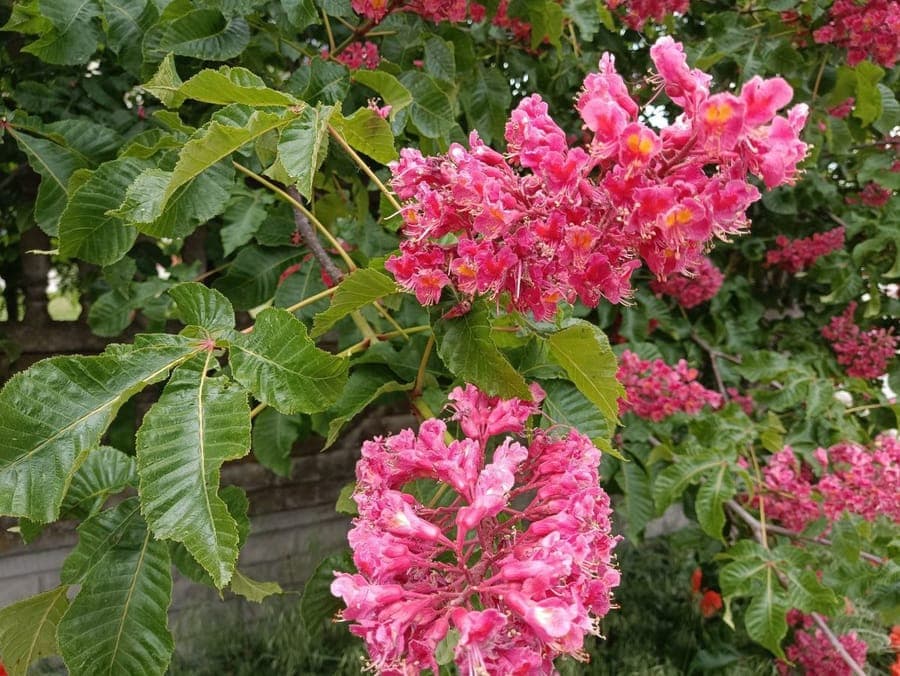
Svetit / CC BY-SA 4.0, via Wikimedia Commons
Red horse chestnut: a flowering tree for large gardens
Aesculus × carnea
Want to see Red horse chestnut: a flowering tree for large gardens in your garden?
Full design in HD: €7.99
Look after your Red horse chestnut with the GardenWorld app
Identify plants with your camera and get a care calendar with reminders for this plant.


Overview
The red horse chestnut (Aesculus × carnea) is a cross between the common white horse chestnut (Aesculus hippocastanum) and the American red buckeye (Aesculus pavia). The hybrid arose in Europe in the early nineteenth century and soon became a favourite tree for parks, avenues and village greens. From the horse chestnut it inherits its sturdy build and large flower spikes, and from the red buckeye its pink to red flower colour. It belongs to the soapberry family, Sapindaceae, which also includes the maples.
Compared with the white horse chestnut, the red form stays smaller and grows more slowly. In a garden or park it reaches 10 to 15 m after several decades, with a dense, rounded crown 8 to 12 m across. That is still a substantial tree, suited only to a large garden, a paddock edge or a generous lawn. If you want to know whether you have space for one and what to plant beneath it, you can have a garden design made on gardenworld.app tailored to your plot.
The best-known cultivar is 'Briotii', selected in France around 1858. It flowers a deeper red than the ordinary hybrid and has a more compact crown, and it is the red horse chestnut you see most often lining streets.
Appearance and flowering
The leaves are palmately compound, with five or sometimes seven leaflets. These are dark green, slightly glossy and often a little wavy or puckered, and smaller than those of the white horse chestnut. In autumn the foliage turns yellowish brown; the autumn colour is pleasant but not spectacular.
Flowering takes place in May. Upright panicles 15 to 20 cm tall cover the crown like candles on a Christmas tree. The individual flowers are pink to carmine red with a yellow blotch in the throat, which turns red after pollination. This tells bees and bumblebees which flowers still offer nectar. The tree is an important source of nectar and pollen in late spring. The photo shows those flower spikes close up, among the dark green leaves.
After flowering, rounded fruits develop with a fairly smooth husk carrying few spines. They are smaller and fewer than on the white horse chestnut. In September and October they split open and drop glossy brown seeds, the familiar conkers.
Be aware that the seeds are poisonous. They contain saponins such as aescin, as well as a compound called aesculin. The leaves, bark and husks are toxic too. In people, eating conkers causes vomiting, diarrhoea and stomach cramps. For dogs they are especially dangerous: besides poisoning, a swallowed conker can block the intestine. Teach children that these nuts are not edible, and keep your dog away from fallen conkers in autumn. Do not confuse them with sweet chestnuts (Castanea sativa), which are edible.
Ideal position
The red horse chestnut flowers best in full sun but also tolerates light shade. Give it room: plant it at least 8 m from the house, drains and paving. The roots are vigorous, and the dense crown casts deep shade. Avoid planting it over a patio or drive, where fallen flowers and husks can stain or make the surface slippery.
The tree copes well with wind and urban conditions, which is why it is so popular for avenues. On an open, windy site it grows a little lower and broader, but that barely affects flowering.
Soil requirements
The red horse chestnut is not fussy. It grows in any fertile, moisture-retentive and well-drained garden soil, from slightly acidic to chalky. Loam and clay are ideal, as long as water does not lie on the surface. On poor, dry sand it grows more slowly and suffers more in drought.
When planting, dig a generous hole and mix the excavated soil with compost. Set the tree at the same depth as it grew in the nursery and support it with a sturdy stake or a tripod, angled into the prevailing wind. A mulch of wood chips in a 1 m circle around the trunk keeps grass and weeds away during the first years.
Free preview
Want to see Red horse chestnut: a flowering tree for large gardens in your garden? Make a free preview of your design.
Watering
A young tree needs regular watering for its first three years. In dry weather give it 30 to 50 litres every fortnight in one go, slowly, so it soaks down to the roots. A ridge of soil or a watering bag around the trunk helps.
A mature red horse chestnut looks after itself in most summers. During long droughts it may develop brown leaf margins and drop leaves early in August. On a dry site, an extra deep soak in July and August can help.
Pruning
The red horse chestnut naturally forms a handsome, regular crown and needs little pruning. Young trees benefit from formative pruning: keep a single central leader, remove competing tops and, after a few years, gradually take off the lowest branches if you want a clear trunk.
Prune in late winter in dry weather, or in summer. Restrict yourself to dead, diseased or crossing wood and avoid large saw cuts, as fungi and bacteria can enter through them. Leave heavy work on large trees to a qualified tree surgeon.
Pests and diseases
The red horse chestnut suffers less from horse chestnut leaf miner than the white species, although its leaves can look a little brown by late summer. It is, however, susceptible to bleeding canker, a bacterial infection in which dark fluid oozes from cracks in the bark. Older trees also often develop knobbly, fissured bark on the trunk. If you notice bleeding patches, have the tree inspected by an arborist.
Care calendar
January–February: Formative pruning of young trees in dry weather. Check the stake and tie.
March: Give young trees a layer of compost and top up the mulch.
April: Leaves emerge. Keep young trees moist in a dry spring.
May: Full bloom. Enjoy the bees and bumblebees in the crown.
June–August: Water young trees in drought. Check the trunk for bleeding patches.
September–October: Conkers fall. Gather them up if children or dogs use the garden.
November–December: Leaf fall. Plant new trees while the ground is not frozen.
So that you do not forget these jobs, use the plant calendar on gardenworld.app, which shows month by month what your trees and plants need.
Hardiness
Aesculus × carnea is fully hardy throughout Britain and the Low Countries. It withstands frost of -25 °C and below without damage. Late frosts rarely do real harm either, because the leaves do not open until April. No winter protection is needed, even for young trees.
Companion plants
Under a dense chestnut crown it is dark and often dry. Choose shade-tolerant ground cover such as bigroot cranesbill (Geranium macrorrhizum), lesser periwinkle (Vinca minor), ivy or barrenwort. Spring bulbs such as wood anemone, snowdrops and bluebells flower before the tree is in full leaf.
As an evergreen backdrop or boundary, laurustinus (Viburnum tinus) works well. In a large garden or avenue you can combine the red horse chestnut with small-leaved lime (Tilia cordata), which flowers later, in June, and keeps feeding the bees once the chestnut blossom is over.
Final thoughts
The red horse chestnut is an impressive tree for anyone with space. In May it is covered in pinkish-red candles that draw in bees and bumblebees, and in summer its crown gives deep shade. It is hardy, undemanding about soil and needs hardly any pruning. Do keep the poisonous seeds in mind if you have children or a dog, and give it plenty of distance from the house. Then you have a tree that will last for generations.
Frequently asked questions about Red horse chestnut
Is Red horse chestnut winter hardy?
Aesculus × carnea is fully hardy throughout Britain and the Low Countries. It withstands frost of -25 °C and below without damage.
When and how do you prune Red horse chestnut?
The red horse chestnut naturally forms a handsome, regular crown and needs little pruning. Young trees benefit from formative pruning: keep a single central leader, remove competing tops and, after a few years, gradually take off the lowest branches if you want a clear trunk.
How much water does Red horse chestnut need?
A young tree needs regular watering for its first three years. In dry weather give it 30 to 50 litres every fortnight in one go, slowly, so it soaks down to the roots.
What soil does Red horse chestnut need?
The red horse chestnut is not fussy. It grows in any fertile, moisture-retentive and well-drained garden soil, from slightly acidic to chalky.

See it in your garden
See Red horse chestnut in your garden
One photo of your garden and a few questions. You see the result in about a minute.
Try it with a photoIdentify this plant in your own garden. Identify a plant
Similar plants
Linden: complete guide
Tilia cordata
A full guide to Tilia cordata: ideal growing conditions, care, pruning, and companion planting. Perfect for UK and North American gardens.
Rock crane's-bill: complete guide
Geranium macrorrhizum
Rock crane's-bill (Geranium macrorrhizum) is a tough groundcover thriving in sun or partial shade. Great for rock gardens and dry spots. Grows 20-30 cm tall.
Common periwinkle: complete guide
Vinca minor
Blue flowers, spreads to 15 cm, shade to partial shade. Moisture-tolerant soil, hardy to -15°C. Garden centres year-round.
