
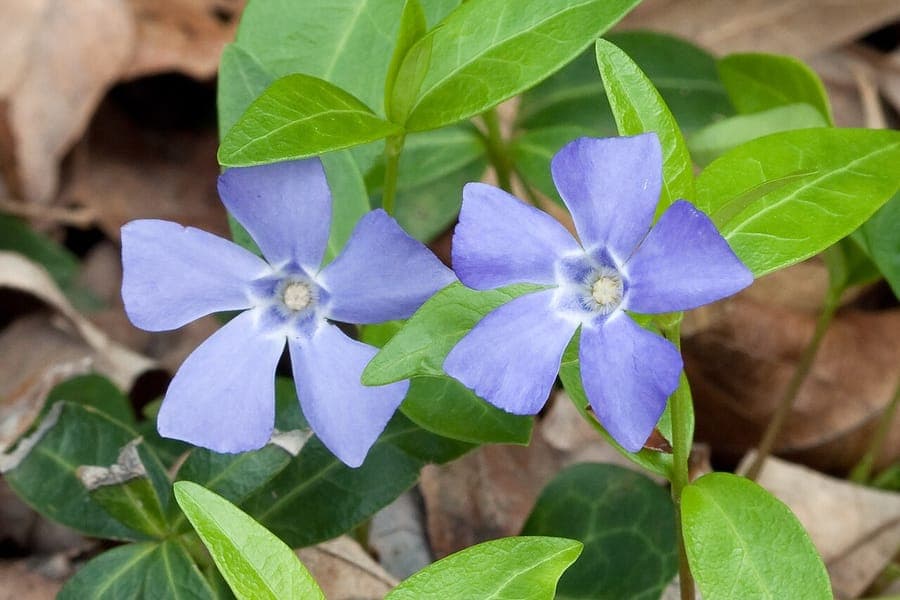
Ryan Kaldari / Public domain, via Wikimedia Commons
Common periwinkle: complete guide
Vinca minor
Want to see Common periwinkle: complete guide in your garden?
Full design in HD: €7.99
Overview
Common periwinkle (Vinca minor), also called lesser periwinkle or wintergreen, solves the shade groundcover problem that stumps many gardeners. This European native spreads reliably in conditions where most plants struggle: under trees, against north-facing walls, in deep shade. Every garden centre stocks it.
What makes Vinca minor invaluable is that it actually thrives where rivals fail. It grows dense enough to suppress weeds, stays evergreen through hard winters, produces bright blue flowers, and asks almost nothing in return. Once established, it's maintenance-free.
Appearance & bloom cycle
Common periwinkle forms a low spreading mat, rarely exceeding 15 centimetres tall. Stems are smooth and glossy, carrying opposite leaves just 2-3 centimetres long. Foliage is dark green and semi-evergreen to evergreen depending on winter severity.
Blue-violet flowers appear from April to May, often with a lighter blue centre. Each flower measures roughly 2 centimetres across with five petals. Blooms are scattered but numerous along stems, creating an overall blue effect. A second, lighter flush often reappears in September. Small seed pods form occasionally but rarely mature to viable seed.
Ideal location
Vinca minor genuinely prefers dappled shade to part shade. Place it where 2-4 hours of soft light reaches it daily - morning sun filtered through tree canopy, or north-facing spots. It actually blooms better in light shade than in scorching sun, where leaf colour can fade to yellow.
This is the go-to plant under deciduous trees, against north walls, under evergreen hedges, and in woodland settings. It tolerates foot traffic near pathways if the soil isn't compacted. Full sun is acceptable but not ideal.
Soil requirements
Vinca minor is remarkably soil-tolerant. It establishes in clay, loam, or sandy soils, acidic or neutral. No special preparation needed. Unlike many groundcovers, it actually prefers slightly moist soil and handles periodic wetness well - making it ideal for areas that stay damp.
Workable soil is worth creating by digging in compost before planting, but established plants thrive even without amendment. Drainage is less critical than with other spreaders; areas that would rot ivy actually suit Vinca minor fine.
Watering
During the first season after planting, maintain consistent moisture to establish roots. Once settled (by the second growing season), Vinca minor needs minimal watering. Rainfall usually suffices across the UK and northern Europe.
During drought, brief wilting is tolerable, though watering improves vigour. Overwatering is more harmful than underwatering. Waterlogged conditions encourage root rot, but Vinca minor tolerates temporary flooding better than alternatives.
Free preview
Want to see Common periwinkle: complete guide in your garden? Make a free preview of your design.
Pruning
Vinca minor barely needs pruning. The plant grows naturally restrained and spreads slowly. In early spring, tidy any frost-damaged or wayward shoots. Light pruning after flowering in June can encourage bushier growth, but it's optional.
Severe pruning actually reduces flowering and should be avoided. The plant looks best with minimal intervention. If it spreads beyond boundaries, simply pull back the outer runners - they root shallowly and come away easily.
Maintenance calendar
March: Inspect for winter damage. Tidy straggly stems. Refresh mulch layer.
April-May: Peak flowering period. Water young plants during dry spells. Enjoy flowers.
June-July: Flowering fades. Optional light trim for bushier form. Water during dry periods.
August-September: Second flush of flowers common. No maintenance needed. Plant establishes deeper roots.
October-November: Foliage may colour slightly in cold autumn. Plant slows. Minimal watering.
December-February: Winter dormancy (though evergreen). No pruning needed. No feeding.
Winter hardiness
Vinca minor is hardy to around -15°C, which covers the entire UK, northern Europe, and much of North America. In USDA zones 4-9, it's a permanent solution. Hard winters cause minor leaf damage, but recovery is always complete by late spring.
Snow actually protects the plant against extreme cold swings. In continental winters, the shallow root system is insulated by frozen soil, which paradoxically provides protection.
Companion plants
Underplant Vinca minor beneath deciduous trees and large shrubs. Combine with Hedera helix (ivy) for textural contrast. It nestles under rhododendrons and azaleas, provided soil moisture matches. Hostas, hakonechloa, and sedges pair beautifully.
Use Vinca minor as the base layer in shade gardens, topped with taller ferns and shade-loving perennials. Its uniformity provides visual calm beneath busy plant combinations.
Closing
For reliable, carefree shade groundcover, Vinca minor is the standard. Once established, it needs almost no attention and solves shady areas that otherwise remain bare. Design your garden including periwinkle placement on gardenworld.app, visualising how it spreads beneath your trees and fills dark corners. Use gardenworld.app to see how your shade garden matures season by season, watching Vinca minor establish groundcover.

See it in your garden
See Common periwinkle in your garden
One photo of your garden and a few questions. You see the result in about a minute.
Try it with a photoIdentify this plant in your own garden. Identify a plant
Similar plants
Asclepias speciosa: complete guide
Asclepias speciosa
Showy milkweed: striking pink-white flowers, fragrant blooms. Essential monarch butterfly host plant.
Plumeria obtusa: complete guide
Plumeria obtusa
Discover the Singapore graveyard flower: an exotic evergreen with mesmerizing white blooms and exquisite fragrance. Expert cultivation, care, and maintenance tips.
Wrightia arborea: complete guide
Wrightia arborea
Wrightia arborea, known as doodhi, is an elegant tree from South Asia with delicate white flowers. Discover how to cultivate this exotic plant.
