
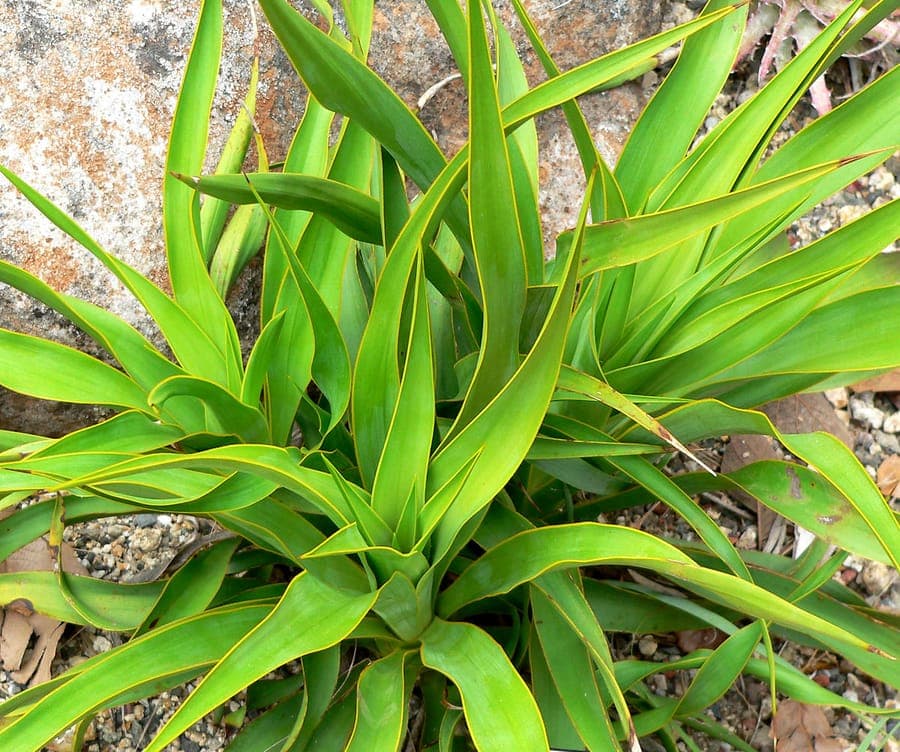
Stan Shebs / CC BY-SA 3.0, via Wikimedia Commons
Yucca rupicola: complete guide
Yucca rupicola
Want to see Yucca rupicola: complete guide in your garden?
1 minute, no credit card
Overview
Yucca rupicola, known as Twist-leaf yucca or Texas yucca, is a stunning compact species from the Edwards Plateau in southeast Texas and adjacent Mexico. The name reveals its essence: this yucca features twisted leaves creating distinctive textural interest.
The plant reaches approximately 60-80 centimeters and forms a compact rosette. It excels in rocky, lean soil and drought conditions. This makes it an excellent choice for front yard designs where you want something wilder than standard clipped hedging.
Appearance and Bloom
Twist-leaf yucca's most striking feature is the twisted foliage: leaves don't grow straight upward but exhibit characteristic spiraling (twist). Leaves are narrow, 20-30 centimeters long, with blue-green coloration.
From May through June, cream-white to yellow flowers appear on short flowering stems. Blooms are small, tubular, and emerge in clusters. The plant grows slowly and requires years to reach maturity.
Ideal Location
Position Twist-leaf yucca in full sun. Minimum six hours of direct sunlight is necessary for optimal growth and flowering. Partial shade produces leggy, weaker plants.
The name 'rupicola' (rock-lover) speaks volumes: this yucca thrives in rocky, well-draining locations. Much prefer elevated ground to low, wet areas.
Soil Requirements
Extremely good drainage is crucial. Use 70% grit/gravel and only 30% potting soil in containers. In front yards: position on raised beds, preferably surrounded by rocks.
The plant tolerates calcareous and acidic soil. pH 6.0-8.0 is suitable. It grows readily in relatively lean soil without difficulty.
Free design
Want to see Yucca rupicola: complete guide in your garden? Make a free design now.
Watering
Twist-leaf yucca is extremely drought-tolerant. Water it only during genuine droughts. Container plants receive water during extended dry spells only.
In front yards, supplemental watering is typically unnecessary. Natural rainfall provides sufficient moisture.
Pruning
Not necessary. The plant grows naturally tidy and compact. Remove only dead leaves.
Maintenance Calendar
May through June: Possible flowering. Ensure soil doesn't stay wet. July through September: Growth period during heat. No interventions. October through April: Complete dormancy. No water.
Winter Hardiness
Yucca rupicola is extremely winter hardy. Temperatures to -15 degrees Celsius are not problematic. Snow on foliage can be damaging, so gently shake it off.
Companion Plants
Combine with Sedum, Sempervivum, Festuca, Phlox subulata, and other rock garden plants. This creates a coherent, low-maintenance planting.
Closing
Twist-leaf yucca is for gardeners wanting character. Those twisted leaves give it completely different presence than straighter yucca species. Extremely drought-tolerant, winter-hardy, and compact. Purchase from garden retailers. Position on elevated, well-draining ground in full sun. Gardenworld.app shows how to integrate this exceptional specimen into your front yard. Gardenworld.app helps you create complete plant designs featuring these characterful plants.
Want to see Yucca rupicola: complete guide in your garden? Make a free design now.
Upload a photo, pick a style, and get a photorealistic design with plant list in under a minute.
No credit card required


Similar plants
Narrow-leaved dracaena: complete guide
Dracaena angustifolia
Everything about Dracaena angustifolia - the narrow-leaved dracaena: location, care, overwintering and use as a houseplant or patio plant.
Chaparral yucca: complete guide to Hesperoyucca whipplei
Hesperoyucca whipplei
Hesperoyucca whipplei (Our Lord's candle) is a dramatic rosette-forming plant from California that produces a towering flower spike, ideal for dry and gravel gardens.
False lily-of-the-valley: complete guide
Maianthemum dilatatum
Everything about Maianthemum dilatatum, the false lily-of-the-valley. Care, shade location, propagation and garden combinations for this popular shade ground cover.