
Rebou / CC BY-SA 3.0, via Wikimedia Commons
Yucca constricta: complete guide
Yucca constricta
Want to see Yucca constricta: complete guide in your garden?
1 minute, no credit card
Overview
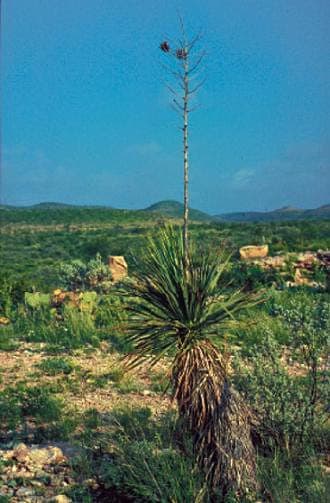
Yucca constricta, known as Buckley's yucca, is an exceptionally compact species from Texas and northeastern Mexico. This dwarf yucca forms a perfect sphere and typically reaches only 50 centimeters in height. This makes it ideal for tiny front yards, containers, and as an accent in borders.
Buckley's yucca's charm lies in its compactness and fine, almost delicate foliage relative to larger species. Yet it matches the drought tolerance and frost hardiness (-15 degrees Celsius) of its larger relatives.
Appearance and Bloom
Buckley's yucca creates a dense, spherical rosette of blue-green leaves reaching merely 20-25 centimeters in length. This produces a very tidy, understated appearance. Leaves feel rigid and pointed but remain relatively narrow.
From June through July, cream to pale yellow flowers emerge on a short, sturdy stalk. The flowers are small, tubular, and appear in considerable quantities. Following bloom, long, thin seed capsules form.
Ideal Location
Position this yucca in full sun: minimum six hours of direct sunlight daily. Complete shade produces leggy, weakened plants. A sunny spot in the front yard maintains compactness and regular flowering.
Frost protection is unnecessary down to -15 degrees Celsius, but in regions with heavy wet snow, light protection helps. The compact form makes snow load less problematic than in larger varieties.
Soil Requirements
Excellent drainage is essential. In containers, use 50% potting soil mixed with 50% sand or grit. In front yards, position on slightly elevated ground with constructed drainage.
The plant accepts acidic and alkaline soil. pH 6.0-7.5 is ideal. Nutrition is not critical; this yucca demands minimal feeding.
Free design
Want to see Yucca constricta: complete guide in your garden? Make a free design now.
Watering
Once established, Buckley's yucca requires virtually no water. During dry, hot summers, occasional watering every two weeks is beneficial. Much prefer drier than wetter conditions.
For containers, regularly check that soil is completely dry (outside winter). Cease watering entirely in winter.
Pruning
Pruning is essentially unnecessary. The plant naturally maintains its tidy, compact form. Remove only dead leaves.
Maintenance Calendar
May through July: Monitor growth. Optional watering during dry spells. August: Flowering period. No special care needed. September through October: Discontinue watering. November through February: Complete dormancy; no water. March through April: Prepare for the season.
Winter Hardiness
Buckley's yucca is extremely winter hardy. Temperatures to -15 degrees Celsius are no concern. During extreme winters (-20 degrees) with heavy wet snow, light protection proves helpful.
Companion Plants
Combine with other compact drought-tolerant species: Sedum cultivars, dwarf Sempervivum, Festuca grasses. This creates a cohesive, low-maintenance planting.
Closing
Buckley's yucca is the perfect choice for gardeners wanting a compact, elegant succulent. Small, tidy, drought-tolerant, and extremely cold-hardy. Purchase from garden retailers. Plant in full sun with good drainage. Maintenance is minimal. Gardenworld.app offers further inspiration for incorporating this small jewel into your front yard design. Gardenworld.app helps you create complete planting schemes as low-maintenance as this plant itself.
Want to see Yucca constricta: complete guide in your garden? Make a free design now.
Upload a photo, pick a style, and get a photorealistic design with plant list in under a minute.
No credit card required


Similar plants
Narrow-leaved dracaena: complete guide
Dracaena angustifolia
Everything about Dracaena angustifolia - the narrow-leaved dracaena: location, care, overwintering and use as a houseplant or patio plant.
Chaparral yucca: complete guide to Hesperoyucca whipplei
Hesperoyucca whipplei
Hesperoyucca whipplei (Our Lord's candle) is a dramatic rosette-forming plant from California that produces a towering flower spike, ideal for dry and gravel gardens.
False lily-of-the-valley: complete guide
Maianthemum dilatatum
Everything about Maianthemum dilatatum, the false lily-of-the-valley. Care, shade location, propagation and garden combinations for this popular shade ground cover.