Osnat Ravid Amir / CC BY-SA 4.0, via Wikimedia Commons
Garden pansy (Viola × wittrockiana): complete guide
Viola × wittrockiana
Want to see Garden pansy (Viola × wittrockiana): complete guide in your garden?
Full design in HD: €7.99
Look after your Garden pansy with the GardenWorld app
Identify plants with your camera and get a care calendar with reminders for this plant.


Overview
The garden pansy (Viola × wittrockiana) is the plant that brings colour to pots and borders just when everything else gives up. Planted in autumn, it flowers until the first hard frost, hangs on stubbornly through winter and bursts into bloom again in March and April. With its rounded flowers and the familiar "face" at the centre, it is one of Europe's most recognisable garden plants.
The botanical name honours the Swedish botanist Veit Wittrock, who researched the history of the plant at the end of the nineteenth century. The garden pansy is not a wild species but a complex hybrid, mainly of heartsease (Viola tricolor), mountain pansy (Viola lutea) and Viola altaica. English gardeners began breeding these species in the early nineteenth century, and thousands of cultivars have followed since.
The plant stays low, 15 to 25 cm, and is botanically a short-lived perennial. In practice it is grown as a biennial: sown in summer, planted in autumn and replaced after its spring display. Want to know where pansies will stand out most in your garden during the cold season? On gardenworld.app you can have a garden design made that gives winter and spring flowers a permanent place too.
Appearance and bloom cycle
The pansy forms a compact rosette of oval to heart-shaped leaves with scalloped edges. The stems are slightly angular and often sprawl a little on older plants.
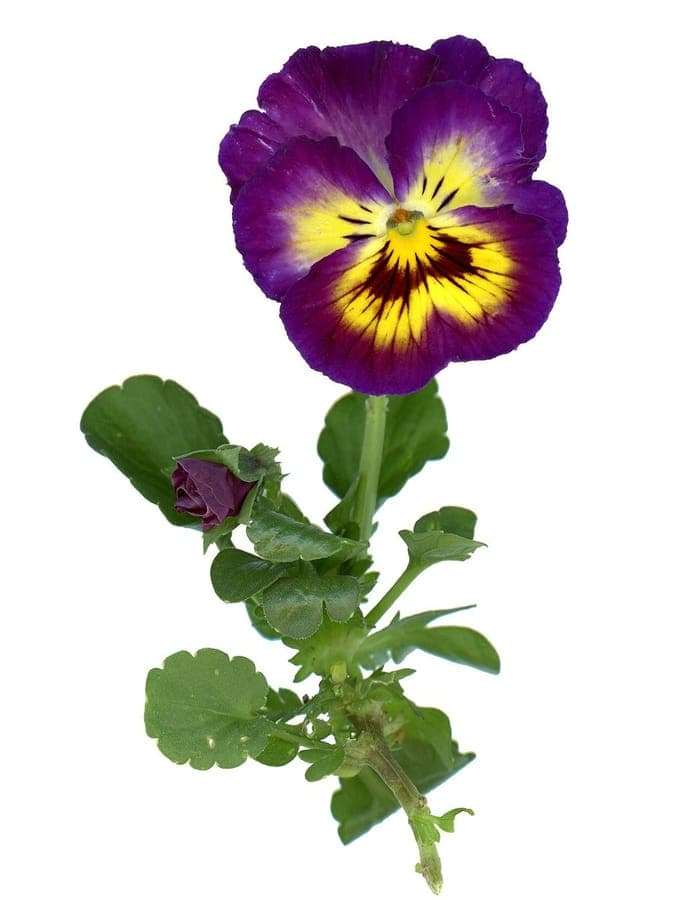
The flowers are 5 to 10 cm across, much larger than those of wild violets. They have five petals: two at the top, two at the sides and one large lower petal with a short spur. Many cultivars have a dark blotch or fine lines at the centre that form the well-known face, while others are plain. The colour range is enormous: white, yellow, orange, red, pink, purple, blue and almost black, often in combination. The flower in the photo is a classic purple pansy with a yellow centre and dark rays, beside a closed bud.
Pansies planted in autumn flower from September to December, produce the odd bloom during mild winter spells and peak from March to May. In warm weather in June they run out of steam. The flowers are edible and look lovely in salads or on cakes, provided you grew them yourself or know they have not been sprayed. Pansies are not considered toxic to cats or dogs either.
Ideal location
Pansies like light but not heat. A position in sun or partial shade is ideal. In autumn, winter and spring you can give them as much sun as possible, as the sun is low and the days are short. For spring plantings that need to last into June, a spot with afternoon shade is better.
They look their best in pots, troughs, window boxes and along the front of borders. Plant them 15 to 20 cm apart, or closer in a container for a full effect. On a windy, exposed site, cold drying winds combined with frost can damage the leaves, so a sheltered corner near the house helps.
Soil requirements
Garden pansies grow best in humus-rich, loose soil that stays moist but drains well. Work some compost into the ground at planting time. In containers, use a multi-purpose compost with a little extra perlite or grit. A slightly acidic to neutral pH, between 5.5 and 6.5, is ideal.
Try not to plant pansies in the same spot every year. Soil-borne fungi that cause root rot, often called pansy sickness, can build up in the ground. Rotate positions or replace the compost in containers.
Feed moderately. A granular fertiliser at planting time is enough for autumn. From March, when growth resumes, you can give a liquid feed for flowering plants every two weeks.
Free preview
Want to see Garden pansy (Viola × wittrockiana): complete guide in your garden? Make a free preview of your design.
Watering
Keep the soil evenly moist but never waterlogged. In autumn and spring, rain is usually enough for plants in the ground. Check pots and window boxes weekly, and more often on sunny, windy days.
In winter, water only when the compost is genuinely dry and it is not freezing. Frost can also cause drought stress: when the soil is frozen, the plant cannot take up water while sun and wind dry out its leaves. So water containers on a mild day if they are dry. Always water the soil rather than the flowers to limit fungal problems.
Pruning
Pansies need no real pruning, but they do need regular attention. Pinch or snip off faded flowers along with their stalks. The plant then stops making seed pods and keeps producing new buds. This is the single most important task for a long flowering season.
If plants become leggy and untidy in late spring, cut the stems back by half. They will regrow compactly and often flower for several more weeks. Remove yellow leaves and damaged parts as well, and keep an eye out for aphids, slugs and mildew.
Sow in June or July. The seed germinates best when cool, below 20 °C, and in darkness, so cover it lightly with seed compost. Prick out the seedlings and plant them out in September or October. If you let a few flowers set seed, pansies sometimes self-sow, but the seedlings usually have smaller flowers than the parent plant.
Maintenance calendar
June-July: Sow in a cool, shaded place and keep the seed compost moist.
August: Prick out seedlings into small pots.
September-October: Plant pansies in borders, window boxes and pots. Add spring bulbs at the same time.
November-February: Deadhead on mild days. Water containers during dry spells when it is not freezing and protect them in severe frost.
March-May: Peak flowering. Start feeding, deadhead and keep the soil moist. You can still add new plants now.
June: When plants are exhausted, clear them away to make room for summer bedding.
The planting calendar on gardenworld.app shows month by month when to sow, plant and clear, so your containers stay full all year round.
Winter hardiness
Viola × wittrockiana is fully hardy and tolerates temperatures down to about -15 °C in the ground. In hard frost the leaves and flowers may look limp and wilted, but once it thaws the plant usually recovers completely. Snow is more of a blanket than a problem.
In pots and troughs the roots freeze more quickly. In winter, move containers against a house wall, raise them on pot feet so excess water can drain, and wrap them in hessian or bubble wrap during severe frost. During long spells of frost without snow cover below -10 °C, you can cover plants in the ground with conifer branches or horticultural fleece.
The garden pansy is not invasive anywhere in Europe. Seedlings may pop up here and there in your own garden, but they are easy to remove.
Companion plants
Pansies are ideal partners for spring bulbs. In autumn, plant tulips (Tulipa gesneriana), daffodils (Narcissus pseudonarcissus) or grape hyacinths (Muscari armeniacum) between and beneath the pansies. The pansies provide colour in winter, and in spring the bulbs grow straight through them.
Other classic partners are forget-me-nots (Myosotis sylvatica) and double daisies (Bellis perennis), which like pansies are planted in autumn and flower in spring. For structure in containers, add heucheras, ivy or ornamental grasses such as Carex. Small-flowered horned violets (Viola cornuta) also make a lovely match.
Final thoughts
The garden pansy is one of the few plants that provide colour from autumn right through to late spring. Plant it in September or October, combine it with spring bulbs and deadhead regularly, and you will have a cheerful container or border for months.
Sow your own in summer or choose young plants at the garden centre, change the planting spot each year to avoid soil diseases, and enjoy the flowers in the garden and even on your plate.
Frequently asked questions about Garden pansy
Is Garden pansy winter hardy?
Viola × wittrockiana is fully hardy and tolerates temperatures down to about -15 °C in the ground. In hard frost the leaves and flowers may look limp and wilted, but once it thaws the plant usually recovers completely.
When and how do you prune Garden pansy?
Pansies need no real pruning, but they do need regular attention. Pinch or snip off faded flowers along with their stalks.
How much water does Garden pansy need?
Keep the soil evenly moist but never waterlogged. In autumn and spring, rain is usually enough for plants in the ground.
Where does Garden pansy grow best?
Pansies like light but not heat. A position in sun or partial shade is ideal.
What soil does Garden pansy need?
Garden pansies grow best in humus-rich, loose soil that stays moist but drains well. Work some compost into the ground at planting time.

See it in your garden
See Garden pansy in your garden
One photo of your garden and a few questions. You see the result in about a minute.
Try it with a photoIdentify this plant in your own garden. Identify a plant
Similar plants
Tulip: complete guide
Tulipa gesneriana
Everything about the tulip (Tulipa gesneriana): planting, care, the finest groups and cultivars. Practical tips for a colourful spring full of tulips.
Daffodil: complete guide
Narcissus pseudonarcissus
Everything about the daffodil (Narcissus pseudonarcissus): planting, care, naturalising and the best cultivars. Practical tips for a radiant spring garden.
Wood forget-me-not: complete guide
Myosotis sylvatica
Learn how to grow and care for Forget-me-not (Myosotis sylvatica) in your garden. Full details on light, soil, watering, and companion plants for borders.
