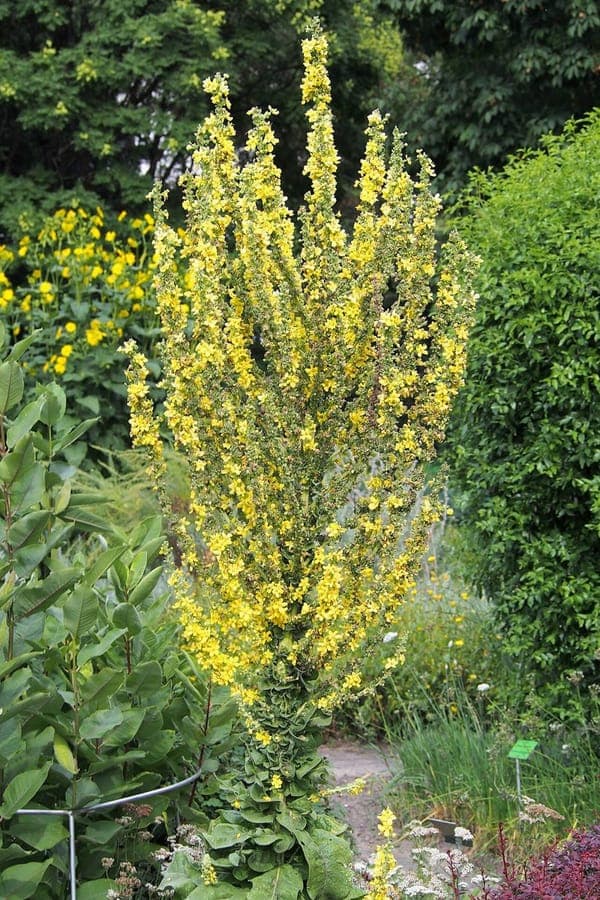
Agnieszka Kwiecień, Nova / CC BY-SA 4.0, via Wikimedia Commons
Olympic Mullein (Verbascum olympicum): complete guide
Verbascum olympicum
Want to see Olympic Mullein (Verbascum olympicum): complete guide in your garden?
Full design in HD: €7.99
Look after your Olympic Mullein with the GardenWorld app
Identify plants with your camera and get a care calendar with reminders for this plant.


Overview
Olympic mullein (Verbascum olympicum) is the largest and most branched mullein you can grow. From a broad rosette of grey, felted leaves rises a stem that divides like a giant candelabra, reaching 2 m and sometimes more. Every branch is clothed from bottom to top in golden-yellow flowers. From a distance it looks as though a yellow fountain has sprung up in the middle of the border.
The name does not refer to the Greek Mount Olympus but to the Bithynian Olympus, the mountain now called Uludağ, near Bursa in north-western Turkey. There it grows on dry, sunny slopes with stony soil. It is sometimes sold as Greek mullein as well.
Verbascum olympicum is a short-lived perennial. For the first two, sometimes three, years it forms only a rosette. Then it flowers once, lavishly, and usually dies after ripening its seed. That may sound like a drawback, but the plant self-seeds readily, so there are always new rosettes waiting in the wings. If you want a gravel garden or a dry, sunny border with a striking vertical feature, this is your plant. On gardenworld.app you can have a garden design made that puts a giant like this exactly where it belongs, with enough space around it.
Appearance and bloom cycle
The rosette is made up of large, oval to lance-shaped leaves 30 to 50 cm long, covered in greyish white felt. It is less snowy and less woolly than that of its relative Verbascum bombyciferum, but broader: a mature rosette can measure 60 cm to almost 1 m across. It stays visible through winter.
In its flowering year a thick, felted stem appears in May and, from about 50 cm up, branches into dozens of side arms. From June to August, sometimes into September, the flowers open in succession. They are 2 to 3 cm across, golden yellow, with orange, hairy stamens. Each flower lasts only a day, but the sheer number of buds keeps the show going for weeks. Bees, bumblebees and hoverflies work it from morning till evening.
The plant is not known to be poisonous to people or pets. The felted hairs can irritate sensitive skin, and as with other mulleins the seeds contain saponins, so they should not be eaten.
Ideal location
Full sun is essential. The warmer and sunnier the spot, the sturdier the candelabra. A south-facing gravel garden, a dry bank, the edge of a terrace or a border against a warm wall are all excellent. In partial shade the stem stretches towards the light and topples easily.
Give it room: allow about a square metre per plant, as both the rosette and the branched flower head take up a lot of space. Place it in the middle or towards the back of a border, or as a specimen in gravel where its silhouette can be seen. On an open, windy site a heavy candelabra can blow over; a sturdy stake pushed in beside the base early in the season prevents that.
Soil requirements
The best soil is lean and free-draining: sand, gravel, rubble or chalk. The pH can be neutral to distinctly alkaline. On rich soil the plant grows too fast, the stem goes soft and it falls over.
On heavy clay, improve the ground thoroughly with coarse grit and gravel, or build a raised bed. Wet feet in winter are the biggest threat, as the rosette can rot before it ever gets the chance to flower. Spread gravel or grit around the rosette so the leaves do not lie on damp soil.
Watering
Water for a few weeks after planting out to help the taproot establish. After that the plant is genuinely drought tolerant: its long taproot draws moisture from deep down. In a normal summer watering is unnecessary. Only during a prolonged heatwave in its flowering year can a deep soak extend the display.
Always water at the base, never over the rosette. This giant is not suited to containers, because the taproot needs depth.
Free preview
Want to see Olympic Mullein (Verbascum olympicum): complete guide in your garden? Make a free preview of your design.
Pruning
During the rosette years there is nothing to prune, apart from removing dead lower leaves in spring. While it flowers you can snip off spent side branches if you like things tidy, but most gardeners simply leave the candelabra be.
After flowering you have a choice. Leave the stem until the seed is ripe and you will get a carpet of seedlings the following year. Cut it off in good time, before the seed ripens, and the plant sometimes produces new rosettes at its base and lives for another season. The dry brown candelabra is decorative in autumn too, especially on a frosty morning.
In late spring and summer, watch out for the pale caterpillars, spotted with yellow and black, of the mullein moth (Cucullia verbasci). They eat leaves and buds. Pick them off by hand as soon as you see them.
Sowing and propagation
Because the plant disappears after flowering, propagation matters. Usually nature does the work and seedlings appear around the parent. Move them while they are young and have only a few leaves, as an older rosette with a long taproot transplants badly.
You can also sow from April to June in a tray of gritty seed compost. The seed is fine and needs light to germinate, so press it onto the surface without covering it. At 15 to 20 °C it comes up in two to three weeks.
Maintenance calendar
March–April: Remove dead leaves from the rosettes. Stake plants that will flower this year.
May–June: Stems shoot up. Check for caterpillars. Sow, or move young seedlings.
June–August: Peak flowering. Water only during prolonged drought.
September: Let seed ripen or cut the stem. Collect seed in a paper bag if you wish.
October–November: Thin seedlings to one per square metre. Clear fallen leaves from the rosettes.
December–February: Rest. The rosettes stay silvery grey through winter.
The plant calendar on gardenworld.app helps you see, month by month, what needs doing in your garden.
Winter hardiness
Verbascum olympicum is hardy. The RHS rates it H6, which covers frosts down to around -15 to -20 °C. Throughout Britain the rosette survives in open ground without protection.
Once again, wet is more dangerous than cold. A rosette sitting in a damp hollow or under a layer of rotting leaves can rot away in winter. Free-draining soil and a layer of gravel are the best winter protection you can give it.
Companion plants
A 2 m yellow candelabra needs partners that keep the picture in balance. Blue tones work beautifully: flat sea holly (Eryngium planum) and the airy purpletop vervain (Verbena bonariensis) create a blue-violet haze beneath the yellow. For a warmer mood, choose red hot poker (Kniphofia uvaria), whose orange spikes echo the shape of the mullein.
Early in the season, before the mullein flowers, oriental poppy (Papaver orientale) provides colour. Mediterranean spurge (Euphorbia characias) adds blue-green structure all year round. Leave a little space between plants so the mullein seedlings have a chance.
Final thoughts
Verbascum olympicum is a plant for anyone who loves a spectacle. A couple of years of patience with a silver-grey rosette, then a whole summer of golden candelabra humming with bees, followed by a new generation that comes up on its own. With full sun, lean soil and dry feet, it asks almost nothing of you.
Frequently asked questions about Olympic Mullein
Is Olympic Mullein winter hardy?
Verbascum olympicum is hardy. The RHS rates it H6, which covers frosts down to around -15 to -20 °C.
When and how do you prune Olympic Mullein?
During the rosette years there is nothing to prune, apart from removing dead lower leaves in spring. While it flowers you can snip off spent side branches if you like things tidy, but most gardeners simply leave the candelabra be.
How much water does Olympic Mullein need?
Water for a few weeks after planting out to help the taproot establish. After that the plant is genuinely drought tolerant: its long taproot draws moisture from deep down.
Where does Olympic Mullein grow best?
Full sun is essential. The warmer and sunnier the spot, the sturdier the candelabra.
What soil does Olympic Mullein need?
The best soil is lean and free-draining: sand, gravel, rubble or chalk. The pH can be neutral to distinctly alkaline.

See it in your garden
See Olympic Mullein in your garden
One photo of your garden and a few questions. You see the result in about a minute.
Try it with a photoIdentify this plant in your own garden. Identify a plant
Similar plants
Blue eryngo: complete guide
Eryngium planum
Everything you need to know about Blue eryngo (Eryngium planum): growing conditions, soil, pruning and hardiness. Perfect for dry gardens.
Kniphofia uvaria: complete guide
Kniphofia uvaria
Learn about red-hot poker (pokerplant) - exotic summer bloomer, full sun requirements, drainage, frost protection, and vibrant color.
Argentine vervain: complete guide
Verbena bonariensis
Discover how to grow Verbena bonariensis: ideal conditions, pruning tips, hardiness and plant partners. Perfect for wildlife gardens in USDA zones 7-11.
