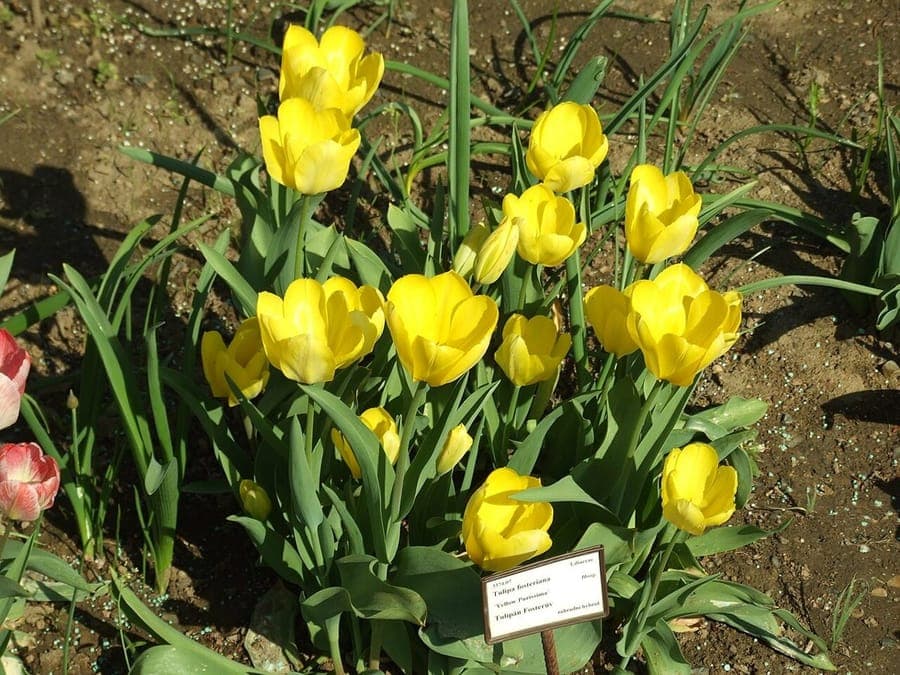
I would appreciate being notified if you use my work outside Wikimedia. More of my work can be found in my personal gallery. / CC BY 3.0, via Wikimedia Commons
Tulipa fosteriana: complete guide
Tulipa fosteriana
Want to see Tulipa fosteriana: complete guide in your garden?
Full design in HD: €7.99
Look after your Tulipa fosteriana with the GardenWorld app
Identify plants with your camera and get a care calendar with reminders for this plant.


Overview
Tulipa fosteriana is a wild tulip from the mountains of Central Asia and the ancestor of a whole group of garden tulips with the largest flowers of the early spring season. When you see broad, bowl-shaped tulips in white, yellow, orange or red opening almost flat in the April sunshine, you are often looking at a Fosteriana tulip such as 'Purissima' or 'Red Emperor'.
The wild species grows in the Pamir-Alay range, including the mountains around Samarkand in Uzbekistan and in Tajikistan, on stony slopes at around 1,500 metres. It reached Europe in the early twentieth century and was named after the British physiologist and bulb enthusiast Michael Foster. Breeders soon saw the potential of its enormous flowers and developed a garden group of its own.
Fosteriana tulips grow 30 to 50 cm tall, flower earlier than most garden tulips and return for several years in a good spot. They suit borders, containers and cutting beds. On gardenworld.app you can have a garden design made that gives these early tulips a place alongside other spring flowers to suit your garden.
Toxicity
All tulips are poisonous, and Fosteriana tulips are no exception. The bulb contains the highest levels of toxic compounds (tulipalin and tuliposides). Eating it causes vomiting, diarrhoea and drooling in people as well as in cats, dogs and horses. Dogs that dig up bulbs are most at risk. In cats, tulips do not cause the acute kidney failure that true lilies do, but they do make them ill. Handling lots of bulbs can cause a skin irritation known among bulb workers as tulip fingers. Wear gloves, keep bulbs out of reach of children and animals, and do not place a vase of tulips where the cat can reach it.
Appearance and flowering season
The wild Tulipa fosteriana has three to five broad, grey-green to green leaves and a sturdy stem with one large flower. In the wild the flower is bright scarlet, with a black basal blotch edged in yellow inside. The petals are broad and rounded, and the flower opens wide in the sun.
The garden forms have flowers up to about 12 cm across, larger than almost any other early tulip. They bloom from late March to mid-April, a few weeks before the classic Triumph and Darwin hybrid tulips. In a cool spring a flower stays looking good for up to two weeks.
From wild species to Emperor tulips
In the official tulip classification, Fosteriana tulips form a group of their own. They are selections and hybrids based on the wild species. The best-known series is the Emperor tulips. 'Red Emperor', also known as 'Madame Lefeber', is an old scarlet classic. 'Orange Emperor' is warm orange. 'Purissima', also sold as 'White Emperor', is creamy white and one of the most widely planted white tulips. It gave rise to 'Yellow Purissima', soft yellow as in the photo above, and 'Flaming Purissima', white with pink flames.
Tulipa fosteriana is also a parent of the Darwin hybrid tulips, which arose from crosses with Darwin tulips. Their large flowers and good perennial performance owe a great deal to this species.
Ideal position
Fosteriana tulips need full sun. Only then do the flowers open fully and the bulb ripen properly after flowering. Choose a spot sheltered from strong wind, because the big flowers catch a lot of wind and can be damaged in a gale. They look their best at the front of a border, along a path, in a front garden or in large pots by the door.
If you want them to come back, choose a place that is not watered often in summer. Among summer bedding that is watered daily, the bulbs are more likely to become exhausted or rot.
Free preview
Want to see Tulipa fosteriana: complete guide in your garden? Make a free preview of your design.
Soil requirements
A well-drained, moderately fertile soil is ideal. Sandy loam is perfect. On heavy clay, work coarse grit and some compost into the top 25 cm. Neutral to slightly alkaline soil is best. Before planting you can work a handful of bonemeal or a bulb fertiliser into the soil, but avoid fresh manure, which encourages rot.
Planting the bulbs
Plant the bulbs from mid-October to late November, once the soil has cooled. That limits the risk of tulip fire. For tulips you want to return over several years, plant deeper than usual: 15 to 20 cm to the base of the bulb. Deeply planted bulbs are less likely to split into small, non-flowering bulblets. Space them 10 to 12 cm apart and plant in groups of at least ten.
In containers you can set the bulbs closer, almost touching, and layer them with smaller bulbs. Use a pot with drainage holes and a layer of gravel at the bottom.
Watering
Water thoroughly once after planting. In winter, rainfall is enough. During growth and flowering the plant needs moisture, so water weekly in a dry spring. Stop once the leaves turn yellow, because the bulb wants to stay dry in summer. Pots should not become sodden in winter: move them under cover during prolonged rain.
After flowering
Snap off the faded flower with its seed pod so the plant does not waste energy on seed. Leave the stem and leaves until they turn yellow, at least six weeks after flowering. Meanwhile, give a high-potash feed. This lets the bulb build reserves for next year's flowers.
For the vase, cut tulips when the bud shows colour but is still closed. Leave as much foliage on the plant as possible.
Maintenance calendar
March: Leaves emerge. Check for slugs and scatter some high-potash bulb feed if you like.
Late March–April: Flowering. Remove any flowers with grey spots (tulip fire) straight away.
April–May: Remove faded flowers. Water in dry spells.
June: The foliage turns yellow. Cut it off once it has withered.
July–September: Summer dormancy. Bulbs in pots can be lifted and stored dry.
October–November: Plant new bulbs 15 to 20 cm deep.
Winter hardiness
Tulipa fosteriana comes from a region with cold winters and is fully hardy. In the ground the bulbs easily tolerate -20 °C and below. A cold period of several months is actually needed for the flower stem to extend. In pots the compost can freeze solid; in a severe winter move containers against the house wall or wrap them in hessian.
Companion plants
Forget-me-nots (Myosotis sylvatica) are the classic underplanting: their sky-blue haze makes yellow and white look even fresher. Muscari latifolium, in two shades of blue, fills the ground beneath. Wallflowers (Erysimum cheiri) are scented at the same time and their warm colours suit 'Orange Emperor' and 'Red Emperor'. Wild daffodils (Narcissus pseudonarcissus) partly overlap and extend the yellow display of 'Yellow Purissima'.
If you plan your bulbs in successive waves, the plant calendar on gardenworld.app shows what is in flower each month, so the early Fosterianas lead neatly into later tulips.
Final thoughts
Tulipa fosteriana is the wild parent of some of the finest early tulips you can plant. 'Purissima', 'Red Emperor' and their relatives flower large, early and reliably. Plant the bulbs deep, in sun and in well-drained soil, let the foliage ripen after flowering and keep the bulbs away from pets. Then you will see them again year after year.
Frequently asked questions about Tulipa fosteriana
Is Tulipa fosteriana winter hardy?
Tulipa fosteriana comes from a region with cold winters and is fully hardy. In the ground the bulbs easily tolerate -20 °C and below.
How much water does Tulipa fosteriana need?
Water thoroughly once after planting. In winter, rainfall is enough.
What soil does Tulipa fosteriana need?
A well-drained, moderately fertile soil is ideal. Sandy loam is perfect.

See it in your garden
See Tulipa fosteriana in your garden
One photo of your garden and a few questions. You see the result in about a minute.
Try it with a photoIdentify this plant in your own garden. Identify a plant
Similar plants
Wood forget-me-not: complete guide
Myosotis sylvatica
Learn how to grow and care for Forget-me-not (Myosotis sylvatica) in your garden. Full details on light, soil, watering, and companion plants for borders.
Broad-leaved grape hyacinth (Muscari latifolium): complete guide
Muscari latifolium
Discover broad-leaved grape hyacinth with distinctive two-toned flowers. Growing guide, care tips, and spring garden design.
Erysimum cheiri: complete guide
Erysimum cheiri
Learn about the Wallflower (Erysimum cheiri), a classic spring-blooming plant. Care, cultivation, flowering, and maintenance of this popular garden plant.
