
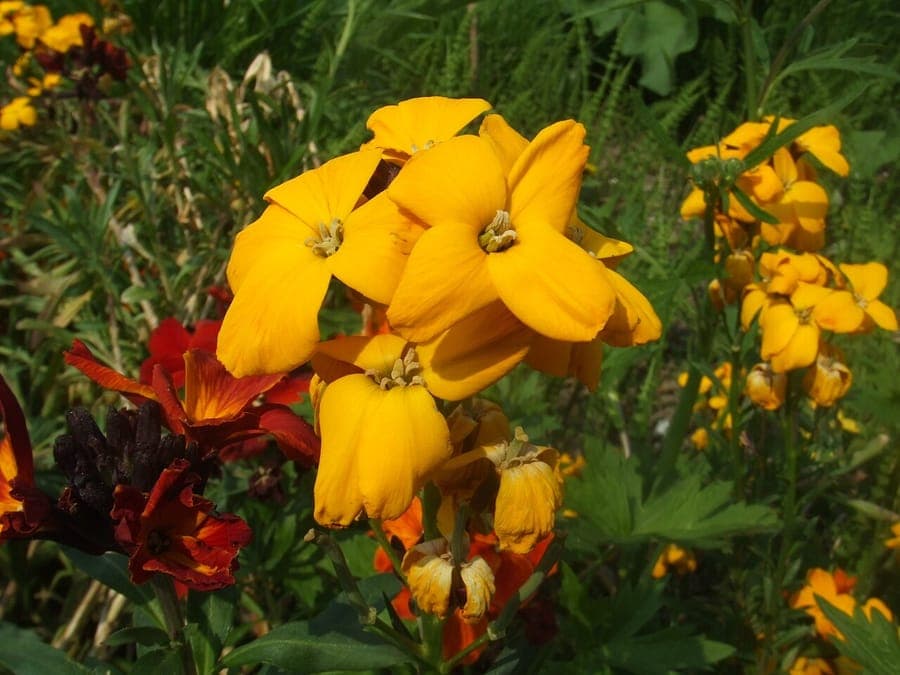
No machine-readable author provided. Hans B.~commonswiki assumed (based on copyright claims). / Public domain, via Wikimedia Commons
Erysimum cheiri: complete guide
Erysimum cheiri
Want to see Erysimum cheiri: complete guide in your garden?
1 minute, no credit card
Erysimum cheiri, commonly known as the Wallflower, is a classic garden plant that has been growing in gardens for centuries. This plant is renowned for its vibrant colors, pleasant fragrance, and easy cultivation. It is a popular choice for spring and early summer flowering.
Overview
The Wallflower is a short-lived plant that usually lives for two years. In the first year, it forms a rosette-like group of leaves. In the second year, it blooms with brilliant flowers in various colors. The plant is native to the Mediterranean region and grows wild on walls and rocky outcrops. It is a very versatile plant that can grow both in gardens and in containers.
Appearance and Bloom
The plant first forms a compact leafy rosette with elongated, dark green leaves. As it matures, it grows into strongly upright stems that can reach 30-60 centimeters high. The flowers are small, four-petaled, and grow in dense clusters at the end of the stems. The flowers can be yellow, orange, red, pink, or brown, depending on the variety. Many varieties are bicolored. Fragrance is subtle but pleasant.
Ideal Location
Place your Wallflower in a sunny to partially shaded location. The plant blooms best with at least 4-5 hours of direct sunlight. A south or west-facing aspect is ideal, but the plant can also thrive in east-facing locations. The plant tolerates half-shade to moderate shade.
Soil
The Wallflower grows well in well-draining soil. The plant is not particularly fussy about soil quality but feels most at home in neutral to slightly chalky soil. Ensure good drainage; wet feet can be harmful. Fertilize moderately; too much feeding can result in green, non-flowering plants.
Watering
Water regularly during the growing and blooming periods. In the first year, you should water regularly to promote good root establishment. In the second year (bloom), water when the soil feels dry. Avoid heavy rainfall or excessive dampness in winter.
Pruning
Pruning is not really necessary, but you can remove dead flowers (deadheading) to extend the blooming period. If the plant becomes very large after blooming, you can lightly cut it back, but this will likely make little difference since it naturally decays after flowering.
Maintenance Calendar
Spring (Year 1): Plant seedlings after frost. Water regularly. Give moderate feeding. Summer (Year 1): Plant builds up. Continue watering. No more feeding needed. Autumn (Year 1): Plant prepares for blooming. Minimal care. Spring (Year 2): Blooming begins. Moderate watering. Deadhead spent flowers. Summer (Year 2): Peak of blooming. Water regularly. Plant may decline.
Winter Hardiness
The Wallflower is fairly winter-hardy and can tolerate temperatures down to approximately -10 degrees Celsius in the ground. In containers, winter protection is advisable. Ensure good drainage to prevent rot. In areas with heavy snow, you can carefully remove snow from heavy snowfall.
Companion Plants
The Wallflower grows well with other spring and early summer bloomers such as Pansy, Snapdragon, Daisy, and Forget-me-not. This combination creates a beautiful spring-like scene. You can also group it with other Brassicaceae family members.
Closing
Erysimum cheiri is a classic, low-maintenance garden plant with a long tradition in European gardens. With its vibrant colors and pleasant fragrance, it brings joy to the garden. Most garden centres stock seeds or plants of wallflower in many varieties. Sow in the preceding summer and enjoy a brilliant bloom next spring. This is really a plant every gardener should try. Discover more plants on gardenworld.app.
Want to see Erysimum cheiri: complete guide in your garden? Make a free design now.
Upload a photo, pick a style, and get a photorealistic design with plant list in under a minute.
No credit card required


Similar plants
Brassica cretica: complete guide
Brassica cretica
Brassica cretica, the Cretan cabbage, grows wild on Aegean cliffs. Discover how to grow this drought-tolerant, yellow-flowered Mediterranean perennial.
Corsican cabbage: complete guide
Brassica insularis
Corsican cabbage is a rare Mediterranean rock cabbage with white flowers and blue-green leaves. Location, soil and winter protection.
Prostrate cabbage: complete guide
Brassica procumbens
Prostrate cabbage is a creeping North African cliff plant with yellow flowers. Discover location, soil type and winter protection.