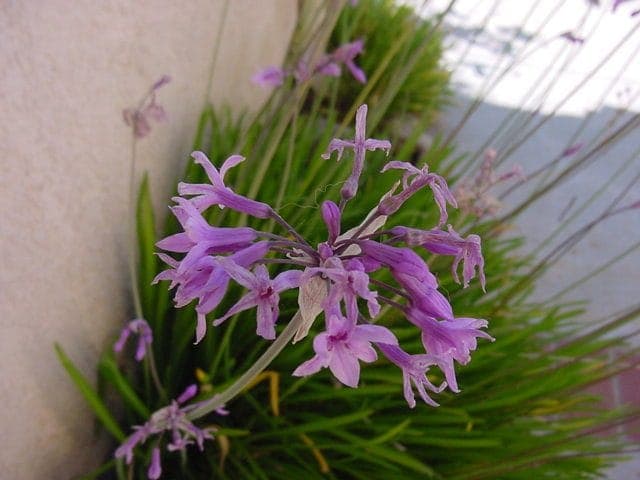
No machine-readable author provided. CatherineMunro assumed (based on copyright claims). / CC BY-SA 3.0, via Wikimedia Commons
Society garlic: growing Tulbaghia violacea
Tulbaghia violacea
Want to see Society garlic: growing Tulbaghia violacea in your garden?
Full design in HD: €7.99
Look after your Society garlic with the GardenWorld app
Identify plants with your camera and get a care calendar with reminders for this plant.


Overview
Tulbaghia violacea, widely known as society garlic, is a South African perennial that keeps flowering for most of the summer. Above clumps of narrow, grey-green leaves, slender stems carrying clusters of lilac, star-shaped flowers appear from June to October. Crush a leaf and you will immediately understand the common name: the whole plant smells strongly of garlic. It belongs to the Amaryllidaceae, the same family as onions, garlic and the larger Agapanthus.
In the wild it grows in the Eastern Cape and KwaZulu-Natal on grassy slopes and rocky outcrops, where hot, dry spells alternate with summer rain. That makes it a good choice for a warm, sunny spot in the garden and above all for pots on a patio. It is not fully hardy, but in the right position it often survives several winters in the open ground.
After a few years it forms dense clumps 30 to 40 cm across, with flower stems 40 to 60 cm tall. It makes an ideal filler among low Mediterranean herbs, at the front of a border or in a gravel garden. If you want to know where it would look best in your own plot, gardenworld.app can create a garden design that takes account of sun, soil and the size of every plant.
Appearance and bloom cycle
The leaves are strap-shaped, 20 to 30 cm long, about half a centimetre wide and grey-green. They grow from fleshy rhizomes in loose fans. In mild winters the foliage stays put; in frost it dies back and the plant reshoots in April. There is also a variegated form, 'Silver Lace', with a creamy white leaf margin, which is slightly less vigorous.
From June onwards, smooth, round flower stems rise well clear of the foliage. Each carries a loose umbel of eight to twenty flowers. Every flower is tubular with six spreading lobes, about 2 cm across, in lilac to mauve, with a darker stripe down each lobe. At the centre sits a small corona, typical of the genus. The flowers themselves have a sweetish scent, especially in the evening, while the leaves and stems smell of garlic.
Flowering carries on and on: new stems appear from June into October, with the main flush in July and August. Bees, bumblebees and hoverflies visit them readily. Small three-chambered seed capsules follow.
Ideal location
Society garlic needs full sun. The warmer and sunnier the spot, the better it flowers. A south-facing wall, a sunny terrace, a raised bed or a gravel garden is ideal. It will grow in light shade, but flowering drops off sharply and the stems lean towards the light.
Because the leaves smell strongly of garlic when brushed, avoid planting it right beside a bench where you will keep knocking into it. A little further away, at the edge of a path or in a pot on the steps, you can enjoy the flowers without releasing too much of the scent. Plant 25 to 30 cm apart; after two seasons the clumps form a continuous edge.
It is at its best in a container. A terracotta pot 25 to 30 cm across with a single plant will fill out within a year, and a pot is easy to move to a frost-free place in winter.
Soil requirements
Well-drained, moderately fertile soil is essential. In its native range it grows in sandy or gritty ground with a little humus. Heavy clay that stays wet in winter is its worst enemy, because the fleshy rhizomes rot. On clay, work plenty of coarse sand or fine gravel into the top 25 cm, or plant on a slightly raised bed.
A pH from slightly acidic to slightly alkaline, roughly 6 to 7.5, suits it. For containers use two parts multi-purpose compost to one part coarse sand or fine grit. A little compost or organic granular feed in spring is enough; too much nitrogen gives lots of leaf and fewer flowers.
Watering
Tulbaghia violacea copes well with drought but flowers more freely with regular summer watering. In open ground you only need to water during longer dry spells: give a thorough soak once a week. In pots, check every two or three days in summer and water when the top few centimetres feel dry. Never leave the pot standing in a saucer of water.
In winter keep the plant as dry as possible. In the ground that means a free-draining site; in a pot, give just an occasional splash while it is overwintering, enough to stop the roots drying out completely.
Free preview
Want to see Society garlic: growing Tulbaghia violacea in your garden? Make a free preview of your design.
Pruning
There is little pruning to do. Cut spent flower stems off at the base; this keeps the clump tidy and sends the plant's energy into new flowers rather than seed. In spring, trim frosted or withered leaves to just above the ground. New growth soon follows.
Every three or four years a clump becomes congested and flowers less in the middle. Lift it in April, divide it with a spade or knife into pieces with a few shoots each and replant. Divisions often flower the same year.
Harvesting and uses
The leaves and flowers of society garlic are edible and have long been used in South African cooking. The leaves taste like a milder garlic with a green note, somewhere between chives and garlic. Snip them over potatoes, eggs, soups or salads. The flowers make a pretty edible garnish with a gently peppery, garlicky flavour. Pick leaves as you need them, never more than a third of a clump at a time.
Use it in moderation: in large quantities it can upset the stomach, as ordinary garlic can. Take care with dogs and cats. There are no reliable studies on poisoning by this species, but its relatives onion and garlic are toxic to pets, and the plant contains similar sulphur compounds. Do not let your dog or cat chew it.
Society garlic is also said to deter mice, moles and some insects. That is mostly folklore and has not been properly tested.
Maintenance calendar
March–April: Cut away frost-damaged leaves. Move pots outside once the last hard frosts have passed. Divide congested clumps.
May: Plant new specimens in open ground. Give a little compost or organic feed.
June–September: Full flower. Remove spent stems. Water pots regularly. Harvest leaves and flowers.
October: Last flowers. Reduce watering of container plants.
November–February: Move pots to a bright, frost-free place at 3 to 10 °C, or against a wall under an overhang. Protect plants in the ground with a thick layer of dry mulch.
Winter hardiness
Tulbaghia violacea is not fully hardy. The leaves tolerate about -5 °C before dying back. In dry, free-draining soil the rhizomes usually survive frost down to roughly -8 to -10 °C, particularly under a 10 cm mulch of straw, bark or dry leaves. Wet soil combined with frost is what really kills it.
In southern and western Britain, in town gardens and in sheltered spots against a south wall, it often comes through winter in the ground. In colder areas, or if you would rather not take the risk, grow it in a pot. From November move it to a cold greenhouse, a garage with a window or a bright porch at 3 to 10 °C, and water sparingly. Put it back outside in March or April once the worst frost is over.
In southern Europe, including Italy, it has naturalised here and there, but it is not regarded as invasive anywhere in Europe.
Companion plants
Society garlic is excellent in a Mediterranean or sunny border. Combine it with lavender (Lavandula angustifolia), rosemary (Rosmarinus officinalis) and thyme for a fragrant edging. The grey-green leaves pick up the tones of blue fescue (Festuca glauca), and the lilac flowers sit beautifully with the blue of Agapanthus praecox, a larger relative that thrives in the same conditions.
In pots on steps or a terrace, Mexican fleabane (Erigeron karvinskianus) is a lovely companion: its little white and pink daisies spill over the rim while the lilac umbels float above. In a kitchen garden or herb box it sits well beside other edible herbs, as long as they also like sun and good drainage.
Final thoughts
Tulbaghia violacea is an easy, long-flowering plant for sunny spots and containers: months of lilac flowers, edible garlic-flavoured leaves and very little work. Give it good drainage, full sun and a dry winter, and it will flower year after year.
The plant calendar on gardenworld.app shows the jobs for each month, so you know when the pots should come in and when they can go back out. Put a pot of society garlic by the kitchen door this spring and snip from it all summer.
Frequently asked questions about Society garlic
Is Society garlic winter hardy?
Tulbaghia violacea is not fully hardy. The leaves tolerate about -5 °C before dying back.
When and how do you prune Society garlic?
There is little pruning to do. Cut spent flower stems off at the base; this keeps the clump tidy and sends the plant's energy into new flowers rather than seed.
How much water does Society garlic need?
Tulbaghia violacea copes well with drought but flowers more freely with regular summer watering. In open ground you only need to water during longer dry spells: give a thorough soak once a week.
Where does Society garlic grow best?
Society garlic needs full sun. The warmer and sunnier the spot, the better it flowers.
What soil does Society garlic need?
Well-drained, moderately fertile soil is essential. In its native range it grows in sandy or gritty ground with a little humus.

See it in your garden
See Society garlic in your garden
One photo of your garden and a few questions. You see the result in about a minute.
Try it with a photoIdentify this plant in your own garden. Identify a plant
Similar plants
Agapanthus praecox: complete guide
Agapanthus praecox
Agapanthus praecox or African lily is an elegant ornamental plant with striking purple-blue flower heads. Master cultivation, care and design tips here.
English Lavender: complete guide
Lavandula angustifolia
Everything about English Lavender (Lavandula angustifolia): planting, pruning, care and overwintering. Practical tips for lush purple blooms.
Rosemary: complete guide
Rosmarinus officinalis
Everything about Rosemary (Rosmarinus officinalis): planting, care, overwintering and culinary use. Practical tips for a healthy, aromatic shrub.
