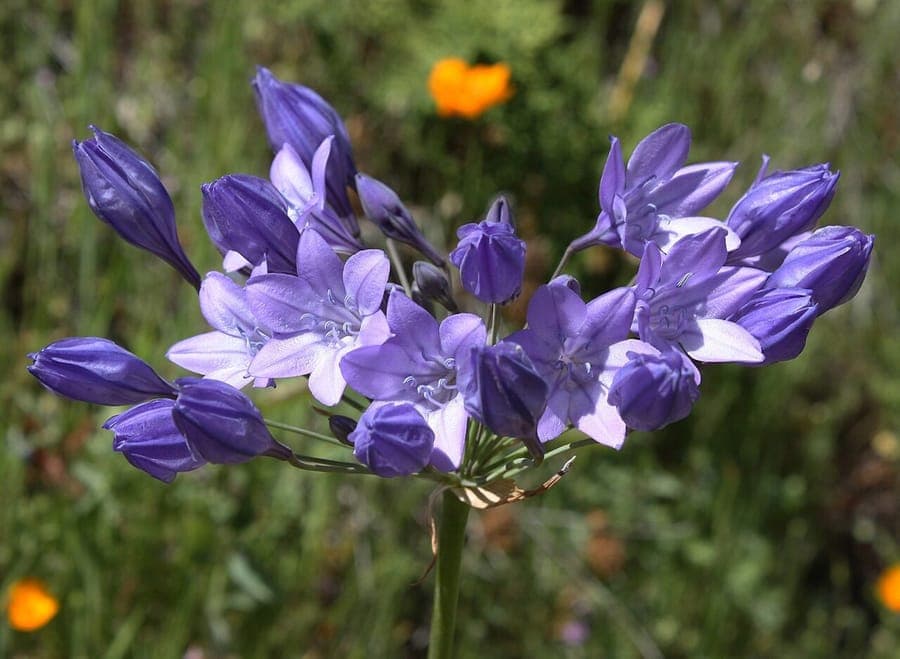
First Light (talk) / CC BY 3.0, via Wikimedia Commons
Ithuriel's spear: complete guide
Triteleia laxa
Want to see Ithuriel's spear: complete guide in your garden?
Full design in HD: €7.99
Look after your Ithuriel's spear with the GardenWorld app
Identify plants with your camera and get a care calendar with reminders for this plant.


Overview
Ithuriel's spear (Triteleia laxa) is one of those bulbs you plant once and keep enjoying for years. In early June, when the tulips and daffodils are long over and the summer border has yet to hit its stride, loose clusters of clear blue to violet funnel-shaped flowers appear on slender stems. They fill exactly that gap between spring and summer.
The plant comes from California and south-west Oregon, where it grows in grassland and open woodland that is wet in winter and bone dry in summer. It belongs to the asparagus family (Asparagaceae). You may also see it sold as Brodiaea laxa, an older name, or as triplet lily. The best-known cultivar is 'Queen Fabiola', also listed as 'Koningin Fabiola', a deep blue selection raised in the Netherlands and named after the Belgian queen. In its homeland it is also called grass nut, as Native Americans once ate the small corms.
Triteleias are tough, undemanding and make excellent cut flowers. If you would like to know where they would show off best in your garden, gardenworld.app can create a garden design that takes sun, soil and your existing plants into account.
Appearance and bloom cycle
Triteleia laxa grows from a small, flattened corm 1 to 2 cm across. In spring it produces one or two narrow, grass-like leaves 20 to 40 cm long. Notably, by the time the plant flowers, those leaves are often already withering. This is entirely normal and part of its natural rhythm.
The flower stem reaches 30 to 60 cm and carries a loose umbel of ten to twenty or more flowers on long individual stalks. Each bloom is funnel-shaped, 2 to 4 cm long, with six spreading lobes. Colours range from pale blue to deep violet-blue, occasionally almost white. The photograph shows such an umbel with open flowers and closed buds, against a backdrop of orange California poppies, a pairing that also occurs in the wild.
In our climate Triteleia laxa usually flowers from late May to early July, peaking in June. As a cut flower the stems easily last ten days or more in a vase, as the buds open one after another.
Ideal location
Give it a sunny position; partial shade is tolerated, but flowering will be less generous. It is ideal for the front of a sunny border, among low perennials, in a gravel garden or a rockery. Because the foliage dies back at flowering time, plant the corms among plants that disguise it, such as low ornamental grasses or herbaceous perennials.
They also do well in pots and troughs. Put fifteen to twenty corms in a 25 cm pot for a full bunch of flowers.
Soil requirements
Above all, the soil must drain well. The corm tolerates winter moisture, but not standing water. Sandy or loamy soil is ideal; improve heavy clay with coarse grit or fine gravel. Rich soil is not needed: ordinary garden soil without fresh manure is fine. The plant grows in neutral to slightly acidic conditions.
In pots, use compost mixed with a third grit or sharp sand, and add a good drainage layer at the bottom.
Planting the corms
Plant the corms in autumn, from September to late November. Set them 8 to 10 cm deep, pointed end up, and 8 to 10 cm apart. Plant in groups of at least fifteen to twenty; a single plant barely registers. Water once after planting and let nature do the rest.
If you miss the autumn window you can still plant in early spring, but the first year's flowering will be a little later and less abundant. Where conditions suit it, the plant slowly increases by offsets and sometimes by seed. Because the corms are so small, mark the spot with a cane or label so you do not damage them when weeding or forking over the bed in spring.
Free preview
Want to see Ithuriel's spear: complete guide in your garden? Make a free preview of your design.
Watering
During growth, from spring to the end of flowering, Triteleia laxa usually manages on normal rainfall. Water only in a dry spring or when grown in pots. After flowering the corm enters summer dormancy and wants to be kept dry, just as in California. Summer watering is then unnecessary and can even do harm; a spot where the soil dries out in July and August is just right.
Feeding is hardly needed. On poor, sandy soil you can scatter a little bulb fertiliser in early spring.
Pruning
No pruning is required. Allow the foliage to die back until it comes away on its own. Spent flower stems can be cut off unless you want the plant to self-seed. For the vase, cut stems when the first two or three flowers have opened. Slugs may nibble the young leaves, but otherwise the plant suffers little from pests or diseases.
Maintenance calendar
September–November: Plant corms 8 to 10 cm deep.
March–April: Leaves emerge. Scatter a little bulb fertiliser if needed and keep an eye out for slugs.
May: Flower buds form; water if the spring is very dry.
June–early July: Flowering. Cut stems for the house.
July–August: Summer dormancy. No watering; let the foliage wither.
Every three to four years in autumn: Lift and divide congested clumps.
The plant calendar on gardenworld.app makes it easy to keep track of moments like these.
Winter hardiness
In free-draining soil Triteleia laxa is reasonably hardy and tolerates frost down to about -10 °C, sometimes lower in dry ground. The greatest threat is not cold but cold, wet soil in winter, which rots the corms. In most of Britain and the Low Countries they can stay in the ground. In cold, wet spots, cover the planting area in winter with a layer of leaves or conifer branches.
Overwintering
In open ground nothing special is needed as long as drainage is good. Pots are more vulnerable because the whole root ball can freeze. In winter, stand them against a sheltered wall, under cover to keep off excess rain, or in a cold but frost-free garage or shed. Keep the compost barely moist, never wet. On heavy clay that stays wet in winter, you can lift the corms in summer once the foliage has died, store them dry and replant in autumn.
Companion plants
The blue of Triteleia laxa works beautifully with warm and silvery colours. Orange California poppies (Eschscholzia californica) are the classic partner, as the photograph shows. The airy Mexican feather grass (Nassella tenuissima) hides the withered foliage and lets the flowers poke through its stems. Lavender (Lavandula angustifolia) flowers just a little later and likes the same dry, sunny soil. Round-headed leek (Allium sphaerocephalon) takes over in July, and spring starflower (Ipheion uniflorum) gives blue accents in the same spot as early as April.
Final thoughts
Ithuriel's spear is a tough, easy-going plant that bridges the gap between spring and summer. It is not known to be toxic to people or pets, but it is sensible to stop dogs chewing any corms they dig up. This autumn, plant a group of twenty corms in a sunny, well-drained bed and cut your first blue bouquet in June.
Frequently asked questions about Ithuriel's spear
Is Ithuriel's spear winter hardy?
In free-draining soil Triteleia laxa is reasonably hardy and tolerates frost down to about -10 °C, sometimes lower in dry ground. The greatest threat is not cold but cold, wet soil in winter, which rots the corms.
When and how do you prune Ithuriel's spear?
No pruning is required. Allow the foliage to die back until it comes away on its own.
How much water does Ithuriel's spear need?
During growth, from spring to the end of flowering, Triteleia laxa usually manages on normal rainfall. Water only in a dry spring or when grown in pots.
Where does Ithuriel's spear grow best?
Give it a sunny position; partial shade is tolerated, but flowering will be less generous. It is ideal for the front of a sunny border, among low perennials, in a gravel garden or a rockery.
What soil does Ithuriel's spear need?
Above all, the soil must drain well. The corm tolerates winter moisture, but not standing water.

See it in your garden
See Ithuriel's spear in your garden
One photo of your garden and a few questions. You see the result in about a minute.
Try it with a photoIdentify this plant in your own garden. Identify a plant
Similar plants
Ball-head onion: complete guide
Allium sphaerocephalon
Discover how to grow and care for Allium sphaerocephalon, a striking ornamental onion with deep purple spherical blooms. Perfect for sunny borders and drought-tolerant gardens.
California-poppy: complete guide
Eschscholzia californica
Everything you need to grow California-poppy: care, sowing, hardiness, and companion plants. Ideal for dry, sunny gardens.
Argentine needlegrass: complete guide
Nassella tenuissima
Nassella tenuissima, the finest ornamental grass. Elegant, silvery threadlike awns that dance in the slightest breeze. Drought hardy.
