
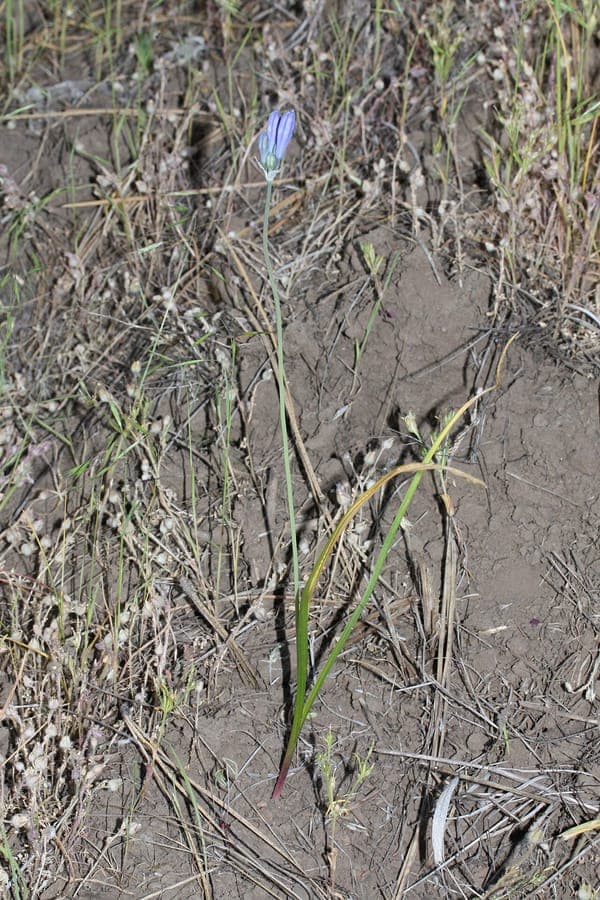
Walter Siegmund (talk) / CC BY-SA 3.0, via Wikimedia Commons
Wild hyacinth (Triteleia grandiflora): complete guide
Triteleia grandiflora
Want to see Wild hyacinth (Triteleia grandiflora): complete guide in your garden?
1 minute, no credit card
Overview
Triteleia grandiflora, commonly called wild hyacinth or large-flower triteleia, is a corm-forming perennial in the asparagus family (Asparagaceae). Native to the Pacific Northwest of North America, from British Columbia south through Idaho, Montana, Oregon, and Washington to northern California and Colorado, it grows naturally in open, dry-summer grasslands, hillsides, and the margins of shrubby woodland.
The genus Triteleia is closely related to the old genus Brodiaea, and you will find Triteleia grandiflora listed in older references as Brodiaea douglasii. Scottish botanist John Lindley formally described the species in 1830, naming it for its impressively large flowers relative to other Triteleia species.
For the gardener, wild hyacinth fills a valuable niche: it blooms in late spring to early summer, bridging the gap between spring bulbs and the main summer perennial season, and its graceful, airy flower umbels bring a wildflower quality that is hard to achieve with more conventional plants. The species is also genuinely drought tolerant once its foliage has died back, making it ideal for low-water gardens and dry Mediterranean-style schemes. Gardenworld.app has design inspiration for incorporating specialty bulbs like this into a garden plan.
Appearance and bloom cycle
Triteleia grandiflora grows from a small, tunicate corm 2 to 4 cm in diameter. In spring, narrow strap-like leaves emerge that resemble grass blades, growing to 20 to 40 cm long. The leaves are relatively inconspicuous and begin to yellow even as the plant comes into bloom.
The flowering stem is the main event: a slender, erect scape 30 to 60 cm tall, topped with an open umbel of 6 to 20 individual flowers. Each flower has six spreading perianth segments in a striking blue-violet to lavender colour, often with a darker midvein. The overall impression is delicate and airy, reminiscent of an allium but with finer-textured flowers and a more graceful poise.
Flowering runs from May through July depending on climate and location. In warm, sheltered gardens it begins in May; in cooler northern or elevated gardens, peak bloom may be in late June or July. Individual flowers last a few days each, but the umbel as a whole remains attractive for several weeks as the blooms open in succession.
After flowering, the plant enters summer dormancy quickly. The foliage yellows and dies back, and the corm rests dry in the soil through summer - exactly the seasonal rhythm of many other western North American and Mediterranean bulbs.
Ideal location
Triteleia grandiflora needs a sunny, warm position with excellent drainage. Full sun is the standard requirement; light partial shade is tolerated but reduces flowering and can cause the stems to lean or flop. Deep shade is not suitable.
The location should dry out naturally in summer - a feature of its native habitat. At the foot of a sunny south- or southwest-facing wall, on a sloping bed, or in a gravel garden are all good choices. Raised beds with a free-draining mix of topsoil and coarse grit work particularly well in heavier-soil gardens.
In borders, plant in groups of at least 10 to 15 corms for a bold cloud of flowers. In smaller beds, clusters of 5 to 7 create a worthwhile display. The slender stems and fine-textured flowers need some mass to make an impact; single specimens get lost.
Avoid positions where summer irrigation reaches the resting corms. If the plant is combined with summer-flowering plants that need regular watering, ensure the corms are positioned where they can remain dry, or grow them in containers that can be kept dry in summer.
Soil requirements
Free-draining soil is essential. The optimal pH range is 6.0 to 7.5, covering most garden soils. Sandy loam or gritty soil is ideal; heavy clay that stays wet in summer will rot the corms.
If you garden on clay, either improve a planting pocket substantially with coarse sand and horticultural grit, or grow the plant in a raised bed. A 50-50 mix of garden soil and coarse grit provides good drainage while retaining enough moisture in the growing season.
Do not enrich the soil with nitrogen-heavy fertilisers. Like many dry-habitat bulbs, Triteleia grandiflora performs best in relatively lean soil. Rich, well-fed soil produces lush foliage but poor flowering, and may increase susceptibility to fungal rots.
In containers, use a well-draining bulb compost mixed with at least 30 percent horticultural grit. Make sure pots have generous drainage holes and raise them on feet to prevent water sitting under the container.
Free design
Want to see Wild hyacinth (Triteleia grandiflora): complete guide in your garden? Make a free design now.
Watering
During the spring growing and flowering season, moderate moisture is beneficial. Water during dry spells, but always ensure water can drain freely away from the corms. The roots are active from spring to early summer and appreciate consistent moisture during this window.
Once the foliage begins to yellow after flowering - typically by late June or July - stop watering entirely. The corms are entering dormancy and require dry conditions. Continued watering at this stage is the primary cause of corm rot. This summer drought tolerance is one of the plant's great strengths in low-maintenance schemes.
If growing in containers, keep the pot just moist through spring, stop watering after flowering, and keep the pot bone dry from midsummer until early autumn when new root growth may begin. Resume light watering from late September.
Pruning
No pruning is required in the conventional sense. After flowering, leave the stems and foliage in place until they have fully yellowed and dried. The green parts continue photosynthesising and sending energy back to the corm. Removing them prematurely weakens the corm for the following year.
Once the foliage is completely yellow and detaches easily - usually 6 to 8 weeks after flowering - it can be tidied away. The dried flower stems have a certain sculptural quality if left standing in a dry gravel border; many gardeners leave them as a natural feature.
Do not cut back living green foliage, even if it looks untidy as it yellows alongside more vigorous summer plants. This is part of the natural cycle and essential for corm health.
Maintenance calendar
September - October: Plant corms 8 to 10 cm deep and 10 to 15 cm apart in a sunny, well-drained position. This is the ideal planting time.
November - February: Corms rest in the ground. No action needed. Ensure the site does not become waterlogged during wet spells.
March - April: First shoot tips appear above soil. Leave undisturbed. A small amount of low-nitrogen bulb fertiliser can be applied as shoots emerge.
May - June: Flowering peak. Enjoy the display. Water during dry spells.
July: Foliage yellowing and dying back. Stop watering. Allow the natural die-back process.
August: Full summer dormancy. Keep dry. If necessary, lift corms for dry storage before replanting in autumn.
Winter hardiness
Triteleia grandiflora is rated hardy in USDA zones 5 to 9. In the milder parts of Northern Europe, where winters are typically in zones 7 to 8, the corms overwinter successfully in the ground provided drainage is good.
In regions with severe prolonged freezing below -15 degrees Celsius, it is safer to lift the corms in autumn after foliage has died back, store them dry in peat or dry sand at 5 to 10 degrees Celsius, and replant in spring from March onwards.
In sheltered town gardens or at the foot of a south-facing wall, the corms often remain in the ground indefinitely, gradually multiplying into larger clumps. After 3 to 5 years in situ, clumps can be lifted and divided in autumn to increase the planting.
Companion plants
Triteleia grandiflora combines well with other summer-dry bulbs and drought-tolerant perennials:
- Allium christophii (star of Persia): spherical purple-pink flower heads that complement the Triteleia in scale and colour.
- Stipa tenuissima (Mexican feather grass): the flowing plumes frame the upright Triteleia stems beautifully.
- Salvia nemorosa (meadow sage): blooms at the same time, with purple-blue spikes that echo the Triteleia colouring.
- Erigeron karvinskianus (Mexican fleabane): small white daisies that weave between the slender stems.
- Sedum spectabile (ice plant): flowers in autumn after the Triteleia has gone over, and tolerates similar dry conditions.
Avoid pairing with moisture-loving plants or any companions that require regular summer irrigation, as this will damage the resting corms.
Closing thoughts
Triteleia grandiflora is a specialist bulb that rewards the gardener who plants it in the right spot. Elegant blue flowers, genuine drought tolerance, and low maintenance during its long summer dormancy make it an outstanding choice for modern, water-conscious gardens. It suits naturalistic planting schemes, gravel gardens, and cottage borders alike.
The corm is not always easy to find in standard garden centres, but specialist bulb suppliers stock it reliably. Order in late summer or early autumn to plant at the right time.
When planning a dry garden or gravel scheme, consider using Triteleia grandiflora as one of the structural elements of early-summer colour, pairing it with ornamental grasses and late-season drought-tolerant perennials. The result is a planting that looks after itself, needs little water, and changes character beautifully through the seasons. Visit gardenworld.app for professional garden design guidance that takes into account your specific soil type, climate zone, and design preferences. A personalised plan from gardenworld.app can show you exactly how to combine bulbs like this with perennials and grasses for a coherent, low-maintenance garden.
Want to see Wild hyacinth (Triteleia grandiflora): complete guide in your garden? Make a free design now.
Upload a photo, pick a style, and get a photorealistic design with plant list in under a minute.
10,000+ gardens designed already
No credit card required


Similar plants
Narrow-leaved dracaena: complete guide
Dracaena angustifolia
Everything about Dracaena angustifolia - the narrow-leaved dracaena: location, care, overwintering and use as a houseplant or patio plant.
Chaparral yucca: complete guide to Hesperoyucca whipplei
Hesperoyucca whipplei
Hesperoyucca whipplei (Our Lord's candle) is a dramatic rosette-forming plant from California that produces a towering flower spike, ideal for dry and gravel gardens.
False lily-of-the-valley: complete guide
Maianthemum dilatatum
Everything about Maianthemum dilatatum, the false lily-of-the-valley. Care, shade location, propagation and garden combinations for this popular shade ground cover.