
Gh5046 at English Wikipedia / Public domain, via Wikimedia Commons
Spanish Moss (Tillandsia usneoides): complete guide
Tillandsia usneoides
Want to see Spanish Moss (Tillandsia usneoides): complete guide in your garden?
1 minute, no credit card
Overview
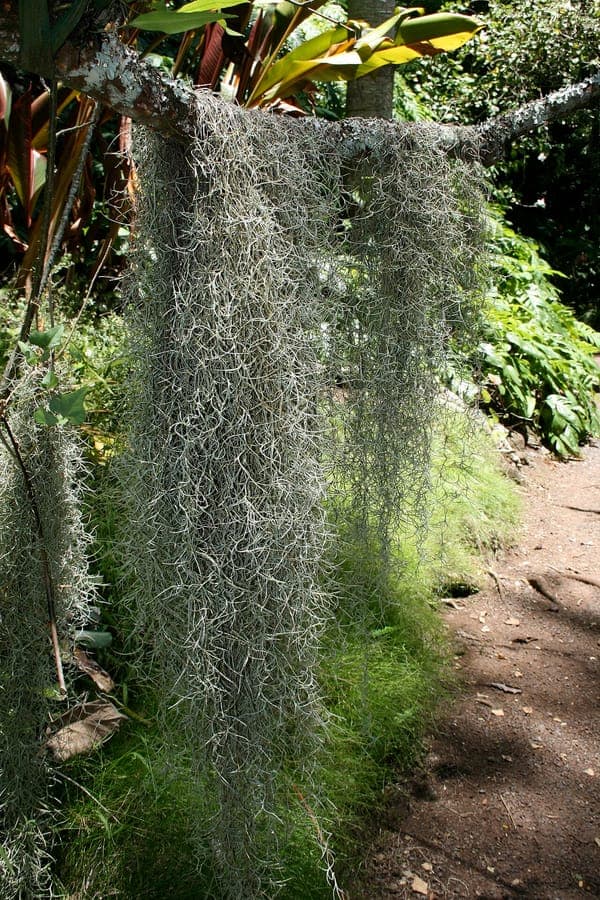
Tillandsia usneoides, better known as Spanish moss, is a fascinating rootless epiphyte belonging to the Bromeliaceae family. Unlike many plants, Spanish moss has no roots for nutrient uptake, but instead absorbs water and nutrients directly from the air through special leaf scales (trichomes). This remarkable plant originates from tropical and subtropical America.
Originally, Spanish moss grows on tree branches in forests, where it forms a ghostly, threadlike canopy. In cultivation, it is a unique decorative plant for indoors or protected outdoor environments.
Appearance and Growth
Spanish moss consists of long, thin, grey-green threads that hang or grow in waves. The plant has no true leaves or flowers like many other plants, but is instead a continuous growth of microscopic leaf scales. This structure gives the plant its characteristic, delicate appearance.
During the growing season (especially summer), the plant may produce small, inconspicuous yellowish-green flowers. These flowers are small but have a subtle, pleasant scent.
The plant grows fairly slowly and will increase in length by a few centimeters annually under ideal conditions.
Ideal Location
Spanish moss thrives in warm, humid climates with indirect to diffuse light. The plant is suitable for places with high air humidity, such as bathrooms or kitchens with moisture. Full sun environments can be harmful, as this may dry out the delicate threads.
Indoors, the plant can hang from tabletops, shelves, or even ceilings as long as there is good air circulation. Outdoors, the plant can grow in very protected, shady locations in warm climate zones.
Soil (Air)
Spanish moss requires no soil in the traditional sense, as it has no true roots. Instead, the plant is attached to a support structure: a twig, thin rope, or steel wire.
The plant draws nutrients and water from the air through its trichomes. It is essential that the plant be regularly misted or submerged to keep these trichomes moist.
Free design
Want to see Spanish Moss (Tillandsia usneoides): complete guide in your garden? Make a free design now.
Watering (Misting)
Because Spanish moss needs no soil, the plant is hydrated through regular misting or submersion. In warm, dry weather, the plant should be misted daily with distilled or rainwater. In cooler, more humid conditions, misting two to three times per week is sufficient.
An alternative method is to fully submerge the plant in lukewarm water for 10-15 minutes once a week. This ensures thorough hydration of all threads.
Spanish moss does not thrive in hard water or chemically treated water. Distilled water or rainwater is always preferable.
Light
Spanish moss performs best in diffuse, indirect light. Morning sun or filtered afternoon light is ideal. Direct afternoon sun can damage the delicate threads and cause drying.
Indoors, the plant can grow well on a shelf near an indirect window. The plant needs no direct sunlight.
Maintenance Calendar
Spring (March-May): Begin regular misting as temperatures rise. Ensure good air circulation.
Summer (June-August): Mist daily in hot, dry conditions. Ensure high humidity. Monitor for drying.
Autumn (September-October): Mist two to three times weekly. Check for mold growth in more humid conditions.
Winter (November-February): Mist twice weekly. Avoid moisture buildup that could cause mold. Ensure minimal air circulation.
Temperature Tolerance
Spanish moss is sensitive to cold and does not thrive in temperatures below 10-13 degrees Celsius. The plant grows best in warm environments between 18-28 degrees Celsius.
On cold winter nights, protection may be needed, and in frost-prone areas, the plant must be brought indoors.
Companion Plants (Indoor)
Indoors, Spanish moss pairs beautifully with other air plants or bromeliads. Other Tillandsia species create interesting texture contrasts. Potted plants with tropical flowers add color.
The plant can also be used as a decorative element with driftwood, branches, or artificial structures to create sculpture-like compositions.
Closing Words
Spanish moss is a special and magical plant for gardeners wanting something truly unique. With its threadlike beauty and fascinating growth pattern, this epiphyte adds a mystical, tropical dimension to indoor spaces. Mount on a support structure, spray regularly, and enjoy this truly unusual, ethereal plant.
For Spanish moss purchase, contact tropical plant nurseries or online suppliers specializing in bromeliads and air plants. Visit gardenworld.app for more unusual and exotic plant ideas that will transform your interior.
Want to see Spanish Moss (Tillandsia usneoides): complete guide in your garden? Make a free design now.
Upload a photo, pick a style, and get a photorealistic design with plant list in under a minute.
No credit card required


Similar plants
Puya raimondii: complete guide
Puya raimondii
Discover the Queen of the Andes: care, cultivation, origin from Peru and Bolivia, and how this remarkable flower can thrive in your garden.
Urnplant: complete guide
Aechmea fasciata
Discover the stunning Urnplant (Aechmea fasciata), an exotic bromeliad with striking silver-banded foliage and brilliant red inflorescences. An easy tropical houseplant.
Pineapple: complete guide
Ananas comosus
Learn how to grow pineapple at home. From planting slips to harvest: watering, light, and nutrition for sweet fruit production.