
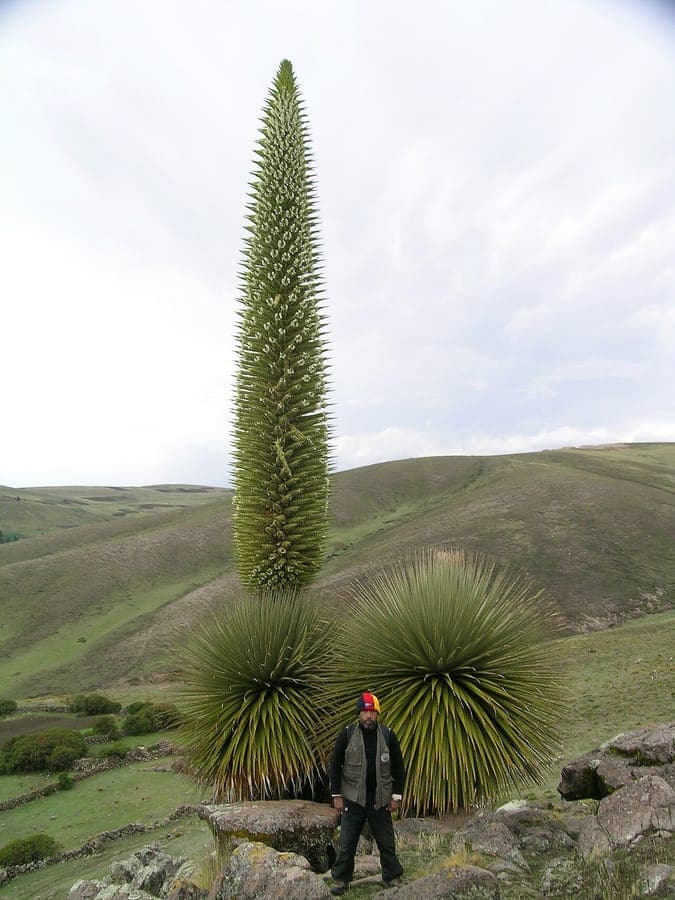
Pepe Roque / CC BY-SA 3.0, via Wikimedia Commons
Puya raimondii: complete guide
Puya raimondii
Want to see Puya raimondii: complete guide in your garden?
1 minute, no credit card
Overview
Puya raimondii, known as the Queen of the Andes, is one of the world's most impressive plants and represents the pinnacle of what tropical and subtropical gardening can achieve. Native to Peru and Bolivia at elevations of 3000-4000 metres, this bromeliad flowers only once in its lifetime at approximately 30-50 years of age, after which it dies. This unique biological phenomenon makes it a sought-after collector's plant for gardeners worldwide.
Puya raimondii is renowned for its gigantic proportions: it can grow to 3 metres high and 2 metres wide. Its characteristic sharp, blue-grey leaves form rosettes that immediately stand out in any garden landscape. When it finally blooms, the flowering stem produces magnificent yellow flowers on a massive spike that can reach 10 metres tall.
Appearance and bloom
The leaves of Puya raimondii are densely packed, pointed, and blue-grey in colour, distinguishing it uniquely amongst other bromeliads. Each plant forms a large rosette, with leaves reaching 1-1.5 metres length on mature specimens.
The blooming is truly a life event. Only when the plant has matured and accumulated energy over decades does the spectacular flower spike emerge. This can grow to 10 metres high and bear thousands of small yellow flowers, some pleasingly scented. The flowering period can last several months.
After blooming, the plant produces seed, then dies (monocarpic). This is not tragic in gardens, as young plants may develop at the base, continuing the lineage.
Ideal location
Puya raimondii grows best in warm, sunny locations with abundant light. Position this plant where it receives full sun exposure. In temperate climates, it can grow outdoors in summer but must overwinter in greenhouses or conservatories.
Protection from strong wind is important: whilst the plant is robust, severe storms can damage leaves. A location against a wall or in semi-sheltered areas is recommended.
In tropical and subtropical regions, Puya raimondii can grow permanently outdoors and forms stunning sculptural accents in gardens. Gardenworld.app recommends using this plant as a centrepiece in large front garden designs for maximum dramatic effect.
Soil
Puya raimondii is not fussy about soil type, but prefers well-draining medium. Like most bromeliads, it grows well in sandy, moisture-poor soils. Avoid heavy clay that retains water.
Add compost or humus for structure, but not excessive organic material. The plant naturally grows on rocks and mountainsides with minimal nutrition. A mixture of sand, perlite, and compost (2:1:1 ratio) works ideally.
The pH should be between 5.5 and 7.0. Slightly acidic to neutral soil is best. Heavy feeding is unnecessary: Puya raimondii grows slowly and does not invite excessive fertilisation.
Free design
Want to see Puya raimondii: complete guide in your garden? Make a free design now.
Watering
Although Puya raimondii originates from mountainous regions, it requires regular watering during the growing season. During spring and summer, water when the soil feels dry 3-5 cm deep.
Unlike many bromeliads, Puya raimondii retains water in the heart (central rosette) of the plant. This water must be renewed regularly and can easily stagnate. Ensure water does not remain in the heart longer than one week.
In winter, when growth is slow, watering can be substantially reduced. Give only enough to prevent the plant from completely drying. In sheltered environments, care must be taken with water management.
Soft water or rainwater is recommended over tap water, which can leave lime deposits on the grey-blue leaves.
Pruning
Puya raimondii requires little pruning. Only remove dead leaves as they wither. Be cautious: the leaves have sharp edges and points that can cut skin.
When the plant flowers, the flower spike can be removed after blooming and seed setting. This helps prevent energy being invested in seed production instead of mother plant growth.
Remove any pups (young plants at the base) if you wish to maintain a single rosette, or allow them to grow if you want to form clusters.
Maintenance calendar
January-February: Minimal winter watering. Check for damage. Remove spent flowers if necessary.
March-April: Gradually increase watering as growth begins. Check for new shoots.
May-July: Regular watering. Renew heart water weekly. Full sunlight.
August-October: Continue summer care. Check for pests. Add light feeding (optional).
November-December: Gradually reduce watering. Prepare for dormancy.
Winter hardiness
Puya raimondii is not actually winter-hardy. It cannot tolerate frost or temperatures below 5 degrees Celsius. In temperate climates, it must overwinter in a greenhouse or indoors in containers.
In frost-free regions (southern areas), it can grow permanently outdoors. For gardeners in temperate zones, the best approach is: plant in large pots that can be moved indoors during winter.
Avoid sudden temperature changes. Gradual acclimatisation when moving from indoors to outdoors is essential.
Companion plants
The monumental size of Puya raimondii makes it work best as a solitary feature in gardens. However, several companions can work well:
- Other large bromeliads such as Alcantarea or Aechmea: Complementary texture
- Succulents: Contrasting forms, similar water needs
- Ornamental grasses: Movement around the static sculpture
- Low-growing ground covers: Interesting backdrop
Gardenworld.app recommends using this plant as a centrepiece in tropical gardens, surrounded by lower vegetation for dramatic effect.
Closing
Puya raimondii is not for everyone, but for gardeners with patience and passion for exotic plants, it offers a lifetime promise: decades of preparation for a blooming that happens once in your lifetime. This is gardening at its finest. With care and attention, this Queen of the Andes will transform your front garden into a botanical wonderland that will astonish your visitors.
Want to see Puya raimondii: complete guide in your garden? Make a free design now.
Upload a photo, pick a style, and get a photorealistic design with plant list in under a minute.
No credit card required


Similar plants
Spanish Moss (Tillandsia usneoides): complete guide
Tillandsia usneoides
Tillandsia usneoides, known as Spanish moss, is an epiphytic bromeliad without roots. Perfect for indoors or protected outdoor spots, this unusual plant offers magical, airy appeal.
Urnplant: complete guide
Aechmea fasciata
Discover the stunning Urnplant (Aechmea fasciata), an exotic bromeliad with striking silver-banded foliage and brilliant red inflorescences. An easy tropical houseplant.
Pineapple: complete guide
Ananas comosus
Learn how to grow pineapple at home. From planting slips to harvest: watering, light, and nutrition for sweet fruit production.