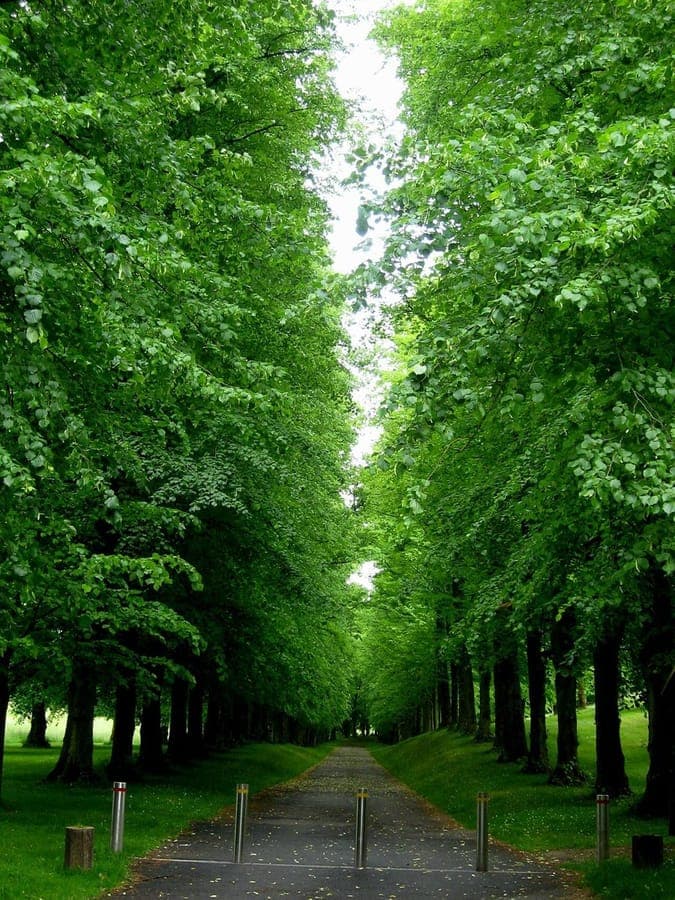
Ptelea / CC BY-SA 4.0, via Wikimedia Commons
Common lime (Tilia × europaea): complete guide
Tilia × europaea
Want to see Common lime (Tilia × europaea): complete guide in your garden?
Full design in HD: €7.99
Look after your Common lime with the GardenWorld app
Identify plants with your camera and get a care calendar with reminders for this plant.


Overview
The common lime (Tilia × europaea), also known as the European linden, is one of the most widely planted trees in Western Europe. You will know it from avenues leading to country houses, from village greens, churchyards and city parks. In summer it casts cool shade, in late June the whole tree hangs with scented flowers, and you can literally hear it humming with bees. A lime avenue in June is an experience you do not easily forget.
Botanically, the common lime is a natural hybrid between the small-leaved lime (Tilia cordata) and the large-leaved lime (Tilia platyphyllos). It combines the vigour of both parents, making it very robust and long-lived: trees several centuries old are not unusual. Limes used to be placed in their own family, the Tiliaceae; today they belong to the mallow family (Malvaceae).
You do need to know what you are planting. A freely growing common lime reaches 25 to 35 metres in height and 12 to 20 metres across. For most gardens that is far too big. In a smaller garden, however, you can grow a lime in a trained form, pleached or as a roof-trained tree. At gardenworld.app you can have a garden design made that gives a lime a place suited to the size of your plot, whether as a specimen on a large property or as a row of pleached trees along the boundary.
Well-known cultivars include 'Pallida', the Kaiser lime, with a slightly more regular crown and paler leaf undersides, and 'Wratislaviensis', whose young leaves emerge golden yellow.
Appearance and flowering
The leaves are heart-shaped, lopsided at the base, 6 to 10 centimetres long and sharply toothed. They are dark green and smooth above, paler beneath, with small brownish tufts of hair in the vein axils. In autumn they turn yellow before falling.
The trunk is grey and becomes coarsely ridged with age. Typical of the common lime are the burrs on the trunk and at its base, from which countless young shoots sprout every year. This suckering makes the tree easy to recognise, but it also means extra maintenance.
Flowering runs from late June to mid-July, slightly after the large-leaved lime and slightly before the small-leaved lime. The yellowish-white flowers hang in clusters of four to ten beneath a long, tongue-shaped bract. They have a sweet, honeyed scent, especially on warm evenings. Bees, bumblebees and hoverflies arrive in huge numbers, and lime honey is highly prized. After flowering, small round nutlets follow, spinning down to the ground on their bract like a propeller.
Ideal position
The common lime grows in sun or partial shade and, as a young tree, even tolerates quite a lot of shade. It copes well with wind and urban conditions, which explains its popularity as a street and avenue tree.
One thing matters when choosing a spot: aphids. In summer limes attract large numbers of aphids that drop sticky honeydew. Everything beneath the canopy becomes tacky and can turn black with sooty mould. So do not plant a lime over a drive, parking space, patio or garden furniture. A lawn or a border of ground cover is a better surface below.
Keep a freely growing tree at least 10 to 15 metres away from buildings. Pleached and roof-trained limes can stand much closer to the house, because you keep the crown small every year.
Soil requirements
Tilia × europaea is undemanding. It prefers deep, fertile, moisture-retentive soil but also grows well on clay, loam and sand. Chalky soil is no problem. It struggles only on very dry, poor sand and on ground that is permanently waterlogged.
Plant ideally between November and March, while the tree is dormant. Dig a generous planting hole, loosen the subsoil and mix the excavated soil with some compost. Secure a young tree with two or three stakes so it does not blow over in its first years. A mulch of leaf mould around the trunk helps keep the soil moist.
Watering
A young lime needs regular watering for the first two to three years after planting. In dry spells give each tree 40 to 60 litres a week, in one go so the water soaks in deeply. Pleached limes planted as large root-balled specimens certainly need this, as part of their roots were lost when they were lifted.
Once established, a lime with its deep root system largely looks after itself. In long, dry summers the leaves may colour and fall early, however. Notably, aphids often increase during drought, and so does the honeydew.
Free preview
Want to see Common lime (Tilia × europaea): complete guide in your garden? Make a free preview of your design.
Pruning
With a freely growing common lime, pruning is mainly needed in the early years. In winter, remove competing leaders, weak or crossing branches and the lowest limbs if you want clearance beneath the crown. Do this gradually and always cut just outside the branch collar.
Most of the work involves suckers. Every year numerous shoots grow from the base and from the burrs on the trunk. Remove them preferably in summer, in June or July, as they regrow less vigorously than after winter pruning. Cut or rub them off as close to the trunk as possible.
Pleached and roof-trained limes need yearly maintenance. In winter, between December and March, cut all of the previous year's shoots back to the framework. Where needed, bend a few young shoots into place and tie them in to fill gaps. In summer, late June or July, give a light trim to keep the shape crisp. The result is a green screen or canopy a few metres up, without the tree becoming too large.
Limes can also be pollarded, a traditional technique in which the branches are cut back to the same point each time. Start this on a young tree; suddenly cutting hard into an old, never-pollarded lime weakens it.
Care calendar
January to March: Winter pruning of pleached and roof-trained limes. Formative pruning of young trees. Plant new trees while the ground is not frozen.
April and May: Leaves emerge. Check stakes and ties on young trees. Apply mulch.
June and July: Flowering and a feast for bees. Remove suckers from the trunk and base. Give pleached limes their summer trim. Water young trees in dry weeks.
August and September: Watch for aphids and honeydew. Do not spray: ladybirds and parasitic wasps usually deal with the aphids themselves.
October to December: Yellow autumn leaves. Rake them off the lawn onto borders, where they will break down into humus.
The plant calendar at gardenworld.app gives a month-by-month overview of the jobs for your lime and the rest of your garden.
Hardiness
The common lime is fully hardy and tolerates frosts down to around -30 °C. In Britain it never needs protection. A late frost can occasionally damage young leaves, but the tree simply produces new ones.
Limes are tough trees with few serious diseases. Besides aphids, you will often see red, pointed galls on the leaves, caused by the lime nail gall mite. They look odd but do the tree no harm. On young trees, lime leaf sawfly or a fungal leaf spot may appear, which is rarely serious either.
The common lime is not poisonous to people or pets. The dried flowers with their bracts have been used for centuries to make lime blossom tea. Only pick them from trees away from busy roads, and dry them in the shade.
Companion plants
Under a lime it is shady and fairly dry in summer. Choose plants that do their work in spring, before the canopy is fully in leaf. Snowdrops (Galanthus nivalis) and native bluebells (Hyacinthoides non-scripta) form wonderful carpets under old limes. Wood anemones and wild garlic belong in the same group.
As an evergreen ground cover, ivy (Hedera helix) works well: it tolerates shade and drought and shows honeydew less than most plants. Cranesbills and lesser periwinkle also do well beneath a lime.
For structure, combine limes with hedges of hornbeam (Carpinus betulus) or beech (Fagus sylvatica). A row of pleached limes above a low beech hedge is a classic sight in formal gardens: it gives privacy at eye level and above, while the garden beneath the trees stays light.
Final thoughts
The common lime is a tree for generations. As a free-growing tree it suits only large gardens, rural properties and parks, but there it becomes a landmark that can stand for centuries. In smaller gardens it brings the same fresh green atmosphere and fragrant flowers as a pleached or roof-trained tree, on a scale you control.
Choose the site with care, away from patio and drive because of the honeydew, and expect some yearly work on the suckers. Do that, and Tilia × europaea gives you a tree that casts shade, feeds bees and fills the garden every late June with the sweet scent of lime blossom.
Frequently asked questions about Common lime
Is Common lime winter hardy?
The common lime is fully hardy and tolerates frosts down to around -30 °C. In Britain it never needs protection.
When and how do you prune Common lime?
With a freely growing common lime, pruning is mainly needed in the early years. In winter, remove competing leaders, weak or crossing branches and the lowest limbs if you want clearance beneath the crown.
How much water does Common lime need?
A young lime needs regular watering for the first two to three years after planting. In dry spells give each tree 40 to 60 litres a week, in one go so the water soaks in deeply.
What soil does Common lime need?
Tilia × europaea is undemanding. It prefers deep, fertile, moisture-retentive soil but also grows well on clay, loam and sand.

See it in your garden
See Common lime in your garden
One photo of your garden and a few questions. You see the result in about a minute.
Try it with a photoIdentify this plant in your own garden. Identify a plant
Similar plants
Beech (Fagus sylvatica): complete guide
Fagus sylvatica
Everything about beech as a hedge plant and specimen tree: planting, pruning, growth rate and winter interest. Practical tips for a dense beech hedge.
European hornbeam: complete guide
Carpinus betulus
Everything you need to know about Carpinus betulus: growing conditions, care, pruning and ideal planting spots for hedges and specimen trees.
English bluebell: complete guide
Hyacinthoides non-scripta
Discover the English bluebell (Hyacinthoides non-scripta): planting tips, blooming time, care requirements, soil needs and winter hardiness for stunning spring displays.
