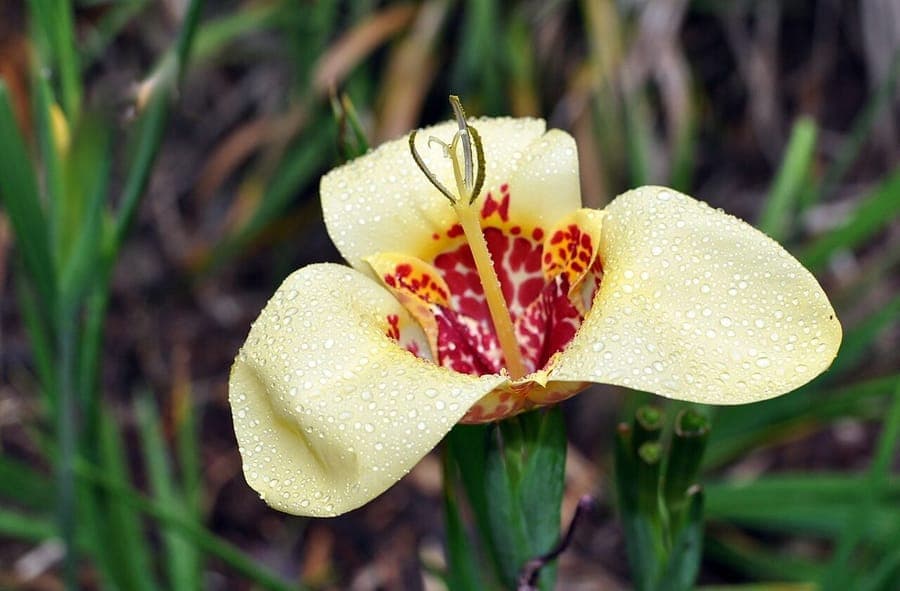
This illustration was made by Citron You must credit this : Citron / CC-BY-SA-3.0 / CC BY-SA 3.0, via Wikimedia Commons
Tiger flower: complete guide
Tigridia pavonia
Want to see Tiger flower: complete guide in your garden?
Full design in HD: €7.99
Look after your Tiger flower with the GardenWorld app
Identify plants with your camera and get a care calendar with reminders for this plant.


Overview
The tiger flower (Tigridia pavonia) is one of the most exotic-looking summer bulbs you can grow in an ordinary garden in north-west Europe. It belongs to the iris family (Iridaceae) and comes from the highlands of Mexico, Guatemala, El Salvador and Honduras, where it grows on sunny, grassy slopes that are warm and moist in summer and dry in winter. That background tells you almost everything about looking after it: plenty of sun and warmth while it grows, followed by a dry, frost-free rest.
The genus name Tigridia refers to the tiger-like spotting in the heart of the flower, while pavonia means "peacock-like", a nod to its showy colours. In Britain it is also sold as Mexican shellflower or peacock flower. Each bloom lasts a single day, yet an established clump keeps producing buds for weeks, so from July into September you will find fresh flowers opening every morning. The Aztecs roasted and ate the corms; in the garden today the appeal is purely ornamental.
If you are unsure where tiger flowers would sit best in your plot, gardenworld.app can draw up a garden design that takes your light, soil and existing plants into account.
Appearance and bloom cycle
Tigridia pavonia grows from a small, elongated corm about 2 to 3 cm long. In late spring it sends up narrow, sword-shaped leaves that are pleated lengthwise like a folded fan, reaching 30 to 50 cm. Above them rise sturdy flowering stems of 40 to 70 cm, sometimes taller after a hot summer.
The flower shape is unmistakable. Three large, broad outer petals spread out to form a triangle, while three much smaller inner petals combine with the bases of the large ones to create a cup-shaped centre. That cup is densely speckled with red, purple or brown. Blooms measure 8 to 15 cm across and come in red, orange, yellow, pink, cream and white, always with the spotted heart. The photograph shows a pale yellow form with a red, tiger-marked centre.
Each flower opens in the morning and fades by evening. Several buds emerge in turn from a single sheath, and each corm usually produces more than one stem. Planted in a group of ten or more, you can expect flowers almost daily from mid-July to late September. Pollinated flowers go on to form slim seed capsules.
Ideal location
Give tiger flowers the sunniest, warmest spot you have. At least six hours of direct sun a day is needed for generous flowering; in partial shade the plants mostly produce leaves. A south-facing border, the foot of a warm wall or a raised bed all work well. Some shelter from strong wind is helpful, as the stems can topple in heavy summer storms.
They also do very well in pots and troughs on a sunny patio, which has the added advantage that the corms are easy to bring indoors in autumn. Use a container at least 25 cm across for five to seven corms and make sure it has a good drainage hole.
Soil requirements
The ideal soil is light and free-draining, holds some moisture in summer and never stays waterlogged. A sandy loam improved with a little compost is perfect. On heavy clay the corms are prone to rot, so work coarse grit and sharp sand into the top 20 cm or plant on a slightly raised ridge. A neutral to mildly acidic soil, roughly pH 6 to 7, suits them.
In containers, use a good multipurpose compost mixed with about a quarter grit or perlite, and add a layer of gravel or clay pebbles at the bottom so surplus water drains away quickly.
Planting the corms
Plant outdoors only once the soil has warmed and the risk of frost has passed, which usually means late April to late May. Set the corms 5 to 8 cm deep, pointed end up, spacing them 10 to 15 cm apart. Groups of at least seven to ten look far better than single corms, which tend to disappear in a border.
For earlier flowers, start the corms in small pots indoors in March or April in a bright, cool spot around 15 °C, then plant them out with the root ball intact in mid-May. Water once after planting and then hold off until the first leaves appear; too much water before the roots form can make the corms rot.
Free preview
Want to see Tiger flower: complete guide in your garden? Make a free preview of your design.
Watering
Once growth is under way, tiger flowers need regular moisture. Keep the soil lightly damp, especially during flowering, as dry spells cause buds to drop. A thorough soak once or twice a week is better than a daily sprinkle. Pots dry out faster and may need watering every day in hot weather.
From June to August, feed every two to three weeks with a liquid fertiliser for flowering plants, ideally one richer in potassium than nitrogen. From late September reduce watering gradually so the corms can ripen.
Pruning
No real pruning is needed. Cut back spent flower stems only after every bud on them has opened, since each stem produces several flowers in succession. If you do not want seed, remove the young capsules so the plant puts its energy into the corm. Leave the foliage until it yellows naturally, because it builds the reserves for next year. Watch for red spider mite in hot, dry spells and protect young shoots from slugs.
Maintenance calendar
March–April: Start corms indoors if you wish. Check stored corms and discard any that are soft or mouldy.
Late April–May: Plant outdoors as soon as the soil is warm. Protect young shoots from slugs.
June: Water regularly and begin feeding.
July–September: Peak flowering, with new blooms every day. Remove stems once all their buds have opened.
October: Reduce watering. Lift the corms after the first light frost or once the foliage turns yellow.
November–February: Store the corms dry and frost-free.
For a month-by-month view of jobs like these, the plant calendar on gardenworld.app is a handy reference.
Winter hardiness
Tigridia pavonia is not reliably hardy in our climate. The corms tolerate at most a few degrees of frost, and only in perfectly dry soil. The real threat is cold combined with wet ground, which rots the corms over winter. In very mild coastal gardens some growers leave them in the ground under a deep mulch, but it is a gamble; if you want to keep your corms, lift them.
Overwintering
Lift the corms in October once the foliage has yellowed or after a first light frost. Ease them out with a fork, shake off the soil and cut the leaves back to a few centimetres above the corm. Dry them for one to two weeks somewhere airy and frost-free, then store them in paper bags or a box of dry sand or wood shavings at 5 to 10 °C. A cool cellar or frost-free garage is ideal. Check a few times over winter for any signs of mould.
Pots can also be left dry as a whole in a frost-free shed and watered again from April. After a few years older corms lose vigour, so top up your group with fresh corms or seedlings.
Companion plants
The vivid tiger flower mixes well with other sun-loving summer bloomers. Good partners include the fragrant Gladiolus murielae, dahlias such as Dahlia pinnata, and the airy purpletop vervain (Verbena bonariensis), which rises well above the tigridias without smothering them. Mealy sage (Salvia farinacea) provides a calm blue backdrop for the red and yellow forms, and Indian shot (Canna indica) adds tropical foliage in a large border. Place tigridias near the front or middle of a planting so the flowers can be admired up close.
Final thoughts
The tiger flower asks for some care: sun, steady watering and lifting each autumn. In return it gives you some of the most striking flowers of the summer, with fresh surprises every day. Toxicity to people and pets is not clearly documented, but it is sensible to stop dogs chewing any corms they dig up. Plant a group of ten corms in a warm corner this spring and see which colours greet you each morning.
Frequently asked questions about Tiger flower
Is Tiger flower winter hardy?
Tigridia pavonia is not reliably hardy in our climate. The corms tolerate at most a few degrees of frost, and only in perfectly dry soil.
When and how do you prune Tiger flower?
No real pruning is needed. Cut back spent flower stems only after every bud on them has opened, since each stem produces several flowers in succession.
How much water does Tiger flower need?
Once growth is under way, tiger flowers need regular moisture. Keep the soil lightly damp, especially during flowering, as dry spells cause buds to drop.
Where does Tiger flower grow best?
Give tiger flowers the sunniest, warmest spot you have. At least six hours of direct sun a day is needed for generous flowering; in partial shade the plants mostly produce leaves.
What soil does Tiger flower need?
The ideal soil is light and free-draining, holds some moisture in summer and never stays waterlogged. A sandy loam improved with a little compost is perfect.

See it in your garden
See Tiger flower in your garden
One photo of your garden and a few questions. You see the result in about a minute.
Try it with a photoIdentify this plant in your own garden. Identify a plant
Similar plants
Gladiolus murielae: complete guide
Gladiolus murielae
Discover how to successfully grow Acidanthera with this comprehensive guide. From planting tips to winter protection and care advice - everything you need to know.
Dahlia: complete guide
Dahlia pinnata
Everything you need to know about Dahlia pinnata: care, bloom time, ideal location and hardiness. Perfect for gardens in temperate climates.
Argentine vervain: complete guide
Verbena bonariensis
Discover how to grow Verbena bonariensis: ideal conditions, pruning tips, hardiness and plant partners. Perfect for wildlife gardens in USDA zones 7-11.
