
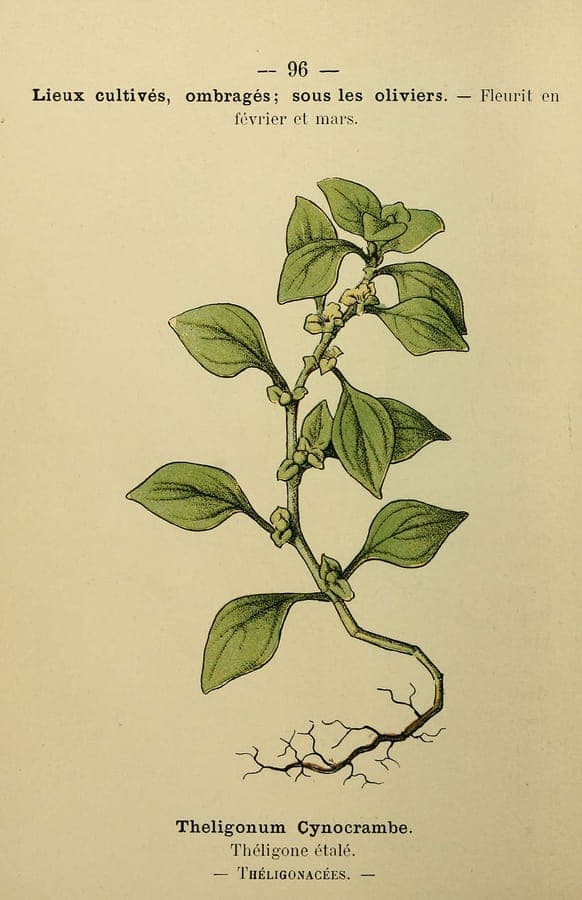
Penzig, O. / Public domain, via Wikimedia Commons
Dog's Cabbage: complete guide
Theligonum cynocrambe
Want to see Dog's Cabbage: complete guide in your garden?
1 minute, no credit card
Overview
Theligonum cynocrambe, commonly called Dog's Cabbage, is a botanically fascinating annual herb in the family Rubiaceae - the same family that includes coffee (Coffea), bedstraw (Galium), and madder (Rubia). Described by Linnaeus in 1753 in his Sp. Pl., the species is native to the Mediterranean region, occurring in southern France, Spain, Italy, North Africa, and parts of the Middle East and Caucasus. In its natural range it colonises rocky, calcareous soils in warm scrubland (maquis and garrigue), dry stone walls, and disturbed ground with high pH substrates.
Botanically, the genus Theligonum is remarkable: it was long placed in its own family (Theligonaceae) before molecular studies confirmed its placement within Rubiaceae. The plant carries both staminate and pistillate flowers on the same individual - the male flowers have slender tepals and long, hanging stamens that sway gracefully in the breeze, while the female flowers are tiny and inconspicuous, tucked into leaf axils. Bloom time runs from March to May, making it one of the first Mediterranean annuals to flower in spring.
For gardeners building a dry Mediterranean or rock garden with unusual specialist plants, gardenworld.app provides planning tools to help compose the right combination of drought-tolerant and calcareous-soil species with complementary seasons of interest.
Appearance & bloom cycle
Theligonum cynocrambe is a low-growing, spreading to upright annual reaching 10 to 40 cm in height. The stems are succulent, moderately branched, and covered with fine sticky hairs. The leaves are alternate, oval to broadly lance-shaped, 2 to 5 cm long, light green, and slightly fleshy in texture - their fresh, lush appearance is somewhat surprising given the plant's preference for hot, dry, bare habitats.
The flowers are small and botanically interesting in their two-sex structure. Staminate (male) flowers have three narrow tepals and long, pendent stamens that form a delicate tassel visible to the careful observer. The pistillate (female) flowers are even smaller, barely visible to the naked eye, hidden in the leaf axils. In the Trefle botanical database, flower colour is recorded as green, reflecting the inconspicuous, wind-pollinated nature of this plant. Bloom time falls from March to May, earlier in sheltered, warm positions.
After flowering, small, hard nutlets develop and are dispersed by gravity and - to a limited extent - by ants (myrmecochory). In garden conditions on suitable alkaline substrates, the plant self-seeds freely, which can be an asset or a nuisance depending on the design context.
Ideal location
Theligonum cynocrambe demands a warm, sunny position with at least six to eight hours of direct sunlight daily. The Trefle botanical database assigns a light value of 7 (on a scale of 1 to 9) to this species, indicating a strong preference for full sun to very lightly shaded conditions. In its Mediterranean homeland it grows on south-facing slopes, warm rocky outcrops, and dry stone wall crevices where the substrate heats up early in spring.
A dry stone wall, raised calcareous rock garden bed, or a south-facing border with sharply drained substrate is the ideal setting. The plant also establishes readily at the foot of a sun-baked south-facing wall. Avoid shaded, moist positions: shade combined with excess soil moisture rapidly leads to stem rot and damping-off disease, which the succulent stems are prone to when conditions are cool and wet.
In regions with cold winters - outside the plant's natural climate zone - treat it as a half-hardy annual: sow indoors in early spring at 15 to 18 °C, or direct-sow outdoors after the last frost date in April.
Soil requirements
The soil requirements of Theligonum cynocrambe are specific and unusual by the standards of most garden plants. The species has a strong preference for alkaline to strongly alkaline substrates: the Trefle database records a minimum pH of 7.5 and a maximum of 8.0. This makes it ideally suited to gardens on calcareous clay or loam soils, and perfect for planting in the mortar joints or crevices of dry stone walls, where lime-rich material keeps the pH elevated.
The substrate should be lean and mineral-rich. In practice, the plant thrives on poor, free-draining calcareous substrates and struggles on rich, heavy soil. A suitable potting or bed mix consists of 50% coarse calcareous sand or granite sand, 25% crushed limestone grit, and 25% neutral pH loam or garden soil - add a handful of broken limestone chips to support an alkaline reaction. Drainage must be excellent: the atmospheric humidity value of 4 (scale 1 to 9) in the Trefle dataset confirms that the plant prefers relatively dry air and substrate conditions.
Avoid peat, acid-forming composts, and fertiliser-rich substrates. The soil nutriment value of 7 in the Trefle data reflects the plant's natural habitat soils, but in garden cultivation a moderately lean substrate is preferred to prevent soft, disease-prone growth.
Watering
Theligonum cynocrambe is adapted to the dry summers of the Mediterranean Basin and tolerates drought well. During its growing season from February to May - corresponding to the wetter season in Mediterranean climates - it requires moderate moisture. Excess water, particularly in combination with cool temperatures, is more harmful than drought.
Water sparingly in the garden: allow the substrate to dry out thoroughly between waterings. In cool, damp spring conditions, once every five to seven days is usually sufficient. In summer, as the plant completes its annual life cycle and begins to die back in the heat, watering is barely needed at all. In containers, always water at the base to keep the foliage dry; overwatering causes collar rot at the stem base. Use calcareous tap water or rainwater supplemented with a small amount of ground limestone to maintain substrate pH.
Free design
Want to see Dog's Cabbage: complete guide in your garden? Make a free design now.
Pruning
As an annual, Theligonum cynocrambe requires no traditional pruning. Lateral shoots can be lightly trimmed to keep the plant compact and encourage additional branching and flower production, but this is optional. Remove spent flowers and developing seed heads if you wish to prevent self-seeding in unwanted locations.
To harvest seed for the following season, leave a few clusters of flowers to set seed until the nutlets turn brown and hard. Collect the ripe seed and store it dry and cool (10 to 15 °C) in a paper bag. Viability remains high for two to three years. In gardens where the plant is welcome as a self-seeder, allow one or two plants to shed seed freely and remove the rest to manage spread on suitable calcareous substrates.
Maintenance calendar
January: In frost-free Mediterranean gardens, young seedlings from autumn self-seeding may be present. No active maintenance needed.
February: First flowers open in mild conditions. Check for slug damage on emerging seedlings.
March: Peak bloom begins. Water only during extended dry spells. Remove unwanted self-seeders from paths and non-designated areas.
April: Full bloom and growth. In cooler regions, sow indoors or directly outdoors after the last frost. Check bed drainage.
May: End of bloom. Seed development begins. Selectively harvest seed or allow plants to self-sow in desired spots.
June–August: Plant dies back in summer heat. Remove dry stems or leave as ornamental dried material. Harvest seed before stems shatter.
September–October: Autumn self-seeding may occur in warm regions. Sow fresh seed in a sheltered spot for winter establishment.
November–December: In frost-free areas, overwintering seedlings may be present as small rosettes. In colder regions, prepare seed for the following spring sowing.
Winter hardiness
Theligonum cynocrambe is a Mediterranean annual sensitive to prolonged frost. It is not adapted to extended sub-zero temperatures. Adult plants survive brief nocturnal frost to -3 or -4 °C on well-drained substrates, but prolonged periods below -5 °C kill both adult plants and seedlings. The seeds, however, are considerably more cold-tolerant and can survive temperatures of -10 °C or lower in the soil, enabling occasional self-seeding persistence in sheltered rock garden situations even in temperate climates.
In USDA hardiness zones 9 to 11 - the Mediterranean Basin and similar climates - the plant behaves as a reliable self-seeding annual, returning year after year from shed seed. In the Netherlands, Belgium, and northern France (zones 8 to 9), grow it as a tender annual: sow fresh each spring, either indoors at 15 to 18 °C from March, or directly in a warm, sheltered outdoor position from mid-April. In colder inland regions, container cultivation with winter protection in a frost-free greenhouse or cool conservatory (minimum 5 °C) is the most reliable approach.
Companion plants
Theligonum cynocrambe suits a Mediterranean or dry rock garden alongside other plants sharing its preference for warm, sunny, alkaline, and low-fertility conditions:
- Euphorbia characias (Mediterranean spurge): large, architectural evergreen spurge with lime-green flower bracts from January to May; same calcareous soil preference.
- Cistus salviifolius (sage-leaved rock rose): low evergreen shrub with white flowers in May–June; ideal for dry, sunny rock gardens.
- Sedum sediforme (pale stonecrop): compact succulent for limestone crevices; grows at similar pH values.
- Phlomis fruticosa (Jerusalem sage): yellow labiate flowers on a robust Mediterranean shrub; identical soil preference.
- Anthemis tinctoria (golden marguerite): bright yellow daisy-like flowers from June to August; drought-tolerant and calcicolous.
- Salvia officinalis (common sage): durable Mediterranean herb with the same light requirements and alkaline soil preference.
- Lavandula angustifolia (lavender): the classic Mediterranean companion for hot, sunny, alkaline conditions; blooms June to August.
This combination creates a coherent Mediterranean planting in which Theligonum cynocrambe provides the first burst of interest in early spring, while the other species carry the display through summer. A plant spacing of 20 to 30 cm suits most companions; Theligonum itself should be allowed 15 to 25 cm per plant. Design your Mediterranean garden on gardenworld.app to visualise these combinations and explore further planting ideas at gardenworld.app.
Conclusion
Theligonum cynocrambe is a rare, botanically unusual Mediterranean annual that deserves wider recognition beyond botanical circles. Its preference for alkaline soil (pH 7.5 to 8.0), full sun, and dry conditions makes it an ideal choice for the Mediterranean rock garden, dry stone wall crevices, or raised beds with calcareous substrates.
With minimal care - excellent drainage, full sun, and a lime-rich substrate - it rewards you each spring from March to May with its modest but botanically intriguing green flowers and fresh, fleshy foliage. For those seeking to build an authentic Mediterranean garden corner, Dog's Cabbage is a rare conversation piece that rewards the curious gardener.
Want to see Dog's Cabbage: complete guide in your garden? Make a free design now.
Upload a photo, pick a style, and get a photorealistic design with plant list in under a minute.
10,000+ gardens designed already
No credit card required


Similar plants
Oregon bedstraw: complete guide
Galium oreganum
Everything about Oregon bedstraw (Galium oreganum): shade planting, soil requirements, care and use as a low groundcover in woodland and shade gardens.
Awned woodruff: complete guide
Asperula aristata
Full guide to growing Asperula aristata, the awned woodruff: sunny location, alkaline soil, minimal watering, and companion plants for dry or rock gardens.
Purple woodruff: complete guide
Asperula purpurea
Full guide to Asperula purpurea, purple woodruff: sunny sites, chalky soil, watering, pruning, winter hardiness and companion plants for rock and dry gardens.