
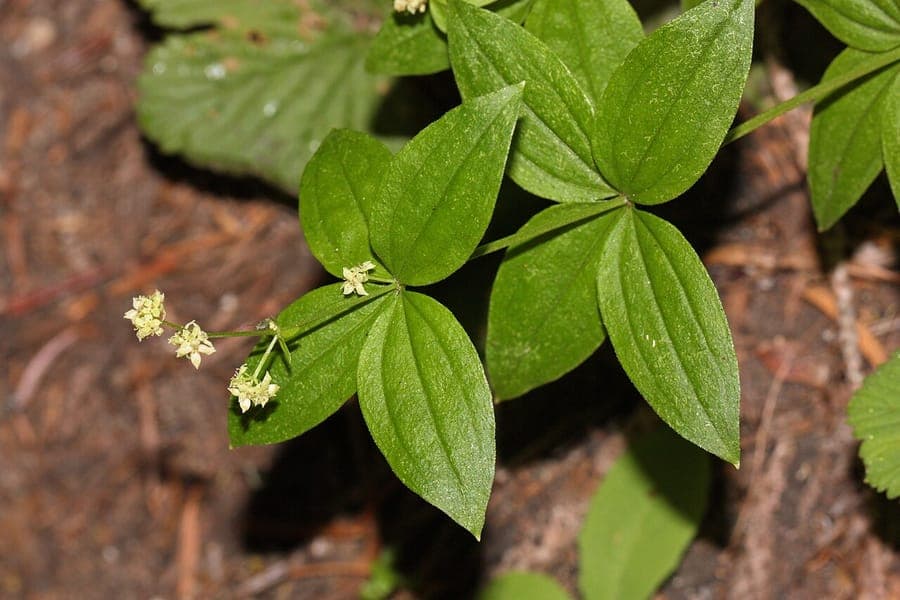
Walter Siegmund (talk) / CC BY-SA 3.0, via Wikimedia Commons
Oregon bedstraw: complete guide
Galium oreganum
Want to see Oregon bedstraw: complete guide in your garden?
1 minute, no credit card
Overview
Galium oreganum, commonly known as Oregon bedstraw, is a perennial, rhizomatous herb in the Rubiaceae family - the same family that includes coffee, gardenia, quinine and the familiar wild European bedstraw (Galium verum). Native to the western coast of North America, its range extends from British Columbia in Canada south through Oregon and Washington to the northern edge of California. In its natural habitat, Oregon bedstraw grows in the understorey of cool, moist temperate rainforests and deciduous woodland, in conditions of low direct sunlight, high humidity and rich, humus-rich forest soil.
The species was formally described in 1894 by the botanist Nathaniel Lord Britton from material collected in Oregon, giving rise to the name 'oreganum'. Botanically, the rhizomatous growth form is a defining feature: horizontal underground stems produce new aerial shoots at regular intervals, gradually forming an expanding mat. This makes Oregon bedstraw a genuinely effective groundcover plant that colonises shaded areas in a controlled but persistent manner.
For European gardens, Galium oreganum offers practical value in situations where many other plants struggle: deep or partial shade, cool and moderately moist soil, and positions where a low, carpet-like green layer is needed. The plant is not invasive in an aggressive sense - it expands gradually and does not crowd out established neighbours with the vigour of, say, ground elder or ivy. At gardenworld.app you can find design inspiration showing how low shade groundcovers like Oregon bedstraw can anchor a woodland garden understorey planting scheme.
The plant's pH tolerance of 6.0 to 7.5 makes it broadly compatible with most European garden soils. Its rapid growth rate - described as such in botanical databases - means it will establish a useful groundcover mat within a single growing season under good conditions. Oregon bedstraw is non-toxic and non-irritating: unlike the related cleavers (Galium aparine), the stems and leaves do not stick to clothing, making it pleasant to work with.
Appearance & bloom cycle
Galium oreganum has the fine, delicate structure typical of the bedstraw genus. It grows as a low, creeping mat 15 to 30 cm in height. The stems are slender, slightly four-angled in cross-section - a family characteristic of the Rubiaceae - and scramble low across the ground or thread through neighbouring plants. The rhizomes run horizontally through the upper layer of soil, producing new aerial shoots at intervals and gradually extending the plant's footprint.
The leaves are the most distinctive feature: narrow, lance-shaped to linear-elliptic, with fine texture and a glossy to mid-green colour. They are arranged in dense whorls of typically six to eight around the stem - the characteristic arrangement that gives bedstraws their elegant, spoke-like appearance when examined at close range. The botanical texture rating is 'fine', confirming the delicate, graceful character of the foliage.
Flowering occurs in summer, typically June through August in its Pacific Northwest native range. The flowers are small - 2 to 3 mm across - white to yellowish-white, four-petalled, and produced in small forked clusters from the leaf axils. Though individually tiny, they are produced in sufficient number to create a soft, drifting effect. They attract bees and small pollinators with a faint sweet scent. After flowering, small paired round fruits develop and are dispersed by animals and wind.
In autumn, the above-ground portions die back at the first frost, though the rhizomes persist through winter. In mild maritime climates - similar to the cool Pacific Northwest of its homeland - the plant may remain semi-evergreen through winter, with the basal whorls staying green.
Ideal location
Galium oreganum is adapted to the cool, moist conditions of the Pacific coastal temperate rainforest. In garden terms, the ideal position translates as: partial to light shade, evenly moist but well-drained, sheltered from drying winds and direct summer sun. The plant does not tolerate full sun well and deteriorates rapidly under prolonged midday sun exposure, especially in warmer summer conditions.
In European garden practice, the best positions are: beneath deciduous trees with a semi-open canopy (birch, alder, willow, lime), along north- or northeast-facing building bases, in the shade of large shrubs, in a moist shade border alongside a pond or stream, or as understorey in a moist woodland garden. The combination of cool, humid microclimate and partial shade is the foundation of a successful siting choice.
Oregon bedstraw also tolerates positions with tree root competition: the shallow, horizontally running rhizomes of Galium oreganum do not compete significantly with the deep roots of large trees, and the plant actually thrives in the shade beneath oaks, beech and limes. This makes it a valuable option for the traditionally difficult situation of dry shade under established trees.
Air humidity is a factor: the plant prefers a relatively high atmospheric humidity and feels less comfortable in dry, hot microclimates such as a south-facing urban courtyard surrounded by heat-absorbing masonry.
Soil requirements
The soil preferences of Oregon bedstraw are relatively broad, but with clear limits. It thrives on humus-rich, lightly moist soils with a pH of 6.0 to 7.5 - a range covering most standard European garden soils. It tolerates both mildly acidic and neutral to slightly alkaline conditions, making it more versatile than many shade plants that specifically require acidic ground.
Soil texture can range from sandy humus-rich material to light clay, provided drainage is adequate. Waterlogging and prolonged wet conditions are harmful: the rhizomes rot in anaerobic soil. On heavy clay: incorporate 10 cm of coarse sand and 10 cm of leafmould into the top 20 cm of the planting zone to improve air and water movement.
Nutritional requirements are low to moderate. An annual dressing of 3 to 5 cm of half-rotted leafmould or compost as a surface mulch is sufficient to meet nutritional needs while improving soil structure and moisture retention. Heavy nitrogen feeding stimulates excessive growth at the expense of flowers and produces weak, floppy stems.
Plant spacing: 25 to 40 cm for a closed groundcover mat within two growing seasons. The plant expands laterally via rhizomes and fills in gaps gradually. Mulch after planting with 3 to 5 cm of semi-rotted organic material to retain moisture and suppress weeds during establishment.
Free design
Want to see Oregon bedstraw: complete guide in your garden? Make a free design now.
Watering
Oregon bedstraw has moderate and consistent water requirements, reflecting its origin in the moist Pacific coastal climate. In its homeland, rainfall occurs throughout most of the year, with a relatively dry summer partly offset by high atmospheric humidity and cool temperatures.
In European garden conditions: keep the soil around the plant lightly moist through the growing season (April to September) without allowing waterlogging. Check soil moisture weekly during dry spells: when the top 5 cm feels dry, water is needed. A guideline of 8 to 12 litres per square metre per week in dry weather is reasonable during the main growing season.
In the summer months of July and August - the driest period in many European climates - twice-weekly watering may be needed during persistent drought. The plant signals moisture stress through slight leaf colour change and curling at the leaf edges: this is an early cue that watering is overdue. A stable mulch layer 5 cm deep substantially extends the time between necessary waterings.
In shaded positions under a dense tree canopy, supplemental watering requirements are somewhat reduced, as shade limits evaporation significantly. In fully shaded positions beneath dense evergreen shrubs, normal rainfall may suffice without supplemental irrigation in most European climates, except during dry spells. In autumn and winter, supplemental watering is generally not required in northwest Europe.
Pruning
Galium oreganum requires minimal pruning. The main maintenance task is removing dead above-ground material in early spring - February to April - by pulling it away or cutting it off just above ground level. The stems are not woody and come away easily by hand.
No pruning is needed during the growing season. If the plant spreads more than desired and encroaches on neighbouring plants, draw back the runners in early spring and remove surplus rhizome sections. This is not really pruning but rather expansion control: pull excess rhizomes carefully from the soil and compost them.
Division is a simple and effective propagation method: dig up a clump of rhizomes in early spring, divide into smaller sections and replant on new positions or share with other gardeners. The plant recovers quickly from division and new sections establish readily.
A light trim of stems after flowering in August or September can keep the plant more compact. This is not essential but can be useful if the plant becomes loose and open in structure. New shoots emerge quickly from the rhizomes after cutting back.
Maintenance calendar
January-February: Plant is dormant. Check and top up mulch layer if needed. Protect rhizomes during prolonged hard frost with an additional dry leaf layer.
March: First new shoots emerge from rhizomes. Remove dead stems. Apply leafmould or compost mulch around the plant.
April: Regrowth proceeds rapidly. Remove weeds before they shade out young shoots. Monitor soil moisture in dry spring conditions.
May-June: Full growth. First flower buds appear from late May. Monitor soil moisture regularly and water when needed.
July-August: Flowering period. Flowers attract bees and small pollinators. Water twice weekly in drought conditions. Monitor for excessive spread.
September: Flowering ends. Fruits ripen. Consider a light trim of any loose, straggling stems to maintain compact appearance.
October-November: Stems begin to die back. Replenish mulch layer before winter to protect rhizomes.
December: Full dormancy. No active tasks needed.
Winter hardiness
Galium oreganum is robustly cold hardy. Native to British Columbia and Oregon - regions with sometimes severe winters - it survives temperatures well below -20 degrees Celsius without damage to the rhizomes. It corresponds to USDA hardiness zones 5 to 8, covering virtually all of western and central Europe. No winter protection is needed in the Netherlands, Belgium, Germany, France or the United Kingdom.
The above-ground portions die back at the first autumn frost, but the rhizomes survive undamaged in frozen soil. Regrowth begins early in spring as temperatures rise, often in March in northwest Europe. In mild maritime winters, the plant may remain semi-evergreen with basal whorls staying green.
Fallen leaf litter from surrounding trees typically provides adequate insulation for the root zone. On fully exposed, wind-swept positions without tree shelter, a light mulch of 5 to 8 cm of dry leaves or bark provides additional security, though this is rarely strictly necessary for this robust species.
The plant has no particular difficulty with alternating dry and wet winters. As long as the soil does not persistently waterlog, frost damage and winter losses are virtually unknown with Oregon bedstraw.
Companion plants
Galium oreganum pairs beautifully with taller shade-tolerant perennials and woodland plants:
- Dryopteris filix-mas (male fern): the large, arching fronds create beautiful structural contrast against the fine mat of Oregon bedstraw. Both prefer moist shade.
- Polygonatum multiflorum (Solomon's seal): the arching stems and pendant white bells provide height and elegance above the low bedstraw carpet.
- Trillium grandiflorum (wake-robin): a stunning spring-flowering woodland plant with the same moist-forest soil preference; large white flowers above the green bedstraw mat are spectacular.
- Cardamine pratensis (cuckoo flower): a spring-flowering native with lilac-white flowers that combines naturally in a moist shade border.
- Epimedium grandiflorum (barrenwort): tolerant of drier shade than bedstraw, but works well as a neighbour in mixed shade plantings, with fine flowers and attractive foliage.
- Asarum europaeum (wild ginger): another low shade groundcover with round, glossy dark-green leaves that contrast elegantly with the fine whorled texture of bedstraw.
At gardenworld.app you can explore how moist, shaded garden corners are built up layer by layer with groundcovers, mid-height perennials and structural plants to create a woodland garden effect that provides interest throughout the year.
Closing
Galium oreganum is a modest but genuinely useful member of the bedstraw family for the moist shade border and naturalistic woodland garden. Its rapid rhizomatous spread, broad soil tolerance, fine and graceful whorled foliage and minimal maintenance needs make it a practical choice for situations where a low, carpet-forming groundcover is needed in partial to full shade.
Looking for the right groundcover pattern for your shade border or woodland garden? Visit gardenworld.app for a professional tailored garden design that accounts for the specific light, soil and moisture conditions of your outdoor space, including smart use of shade-tolerant groundcovers like Oregon bedstraw.
Want to see Oregon bedstraw: complete guide in your garden? Make a free design now.
Upload a photo, pick a style, and get a photorealistic design with plant list in under a minute.
10,000+ gardens designed already
No credit card required


Similar plants
Forest bedstraw: complete guide
Galium circaezans
Everything about forest bedstraw (Galium circaezans): cultivation, shade requirements, soil conditions and care for this elegant woodland perennial.
Bluntleaf bedstraw: complete guide
Galium obtusum
Full guide to bluntleaf bedstraw (Galium obtusum): wet-site planting, soil pH, companion plants and year-round care tips.