
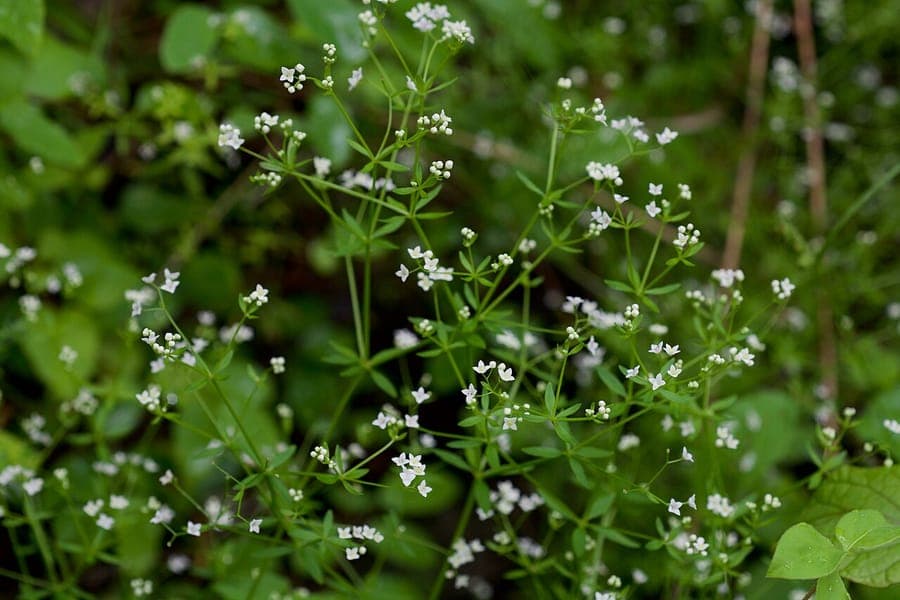
Eric Hunt / CC BY-SA 4.0, via Wikimedia Commons
Bluntleaf bedstraw: complete guide
Galium obtusum
Want to see Bluntleaf bedstraw: complete guide in your garden?
1 minute, no credit card
Overview
Bluntleaf bedstraw (Galium obtusum) is a perennial herb belonging to the Rubiaceae family, native to the eastern and central United States and southeastern Canada. Its natural range stretches from Nova Scotia and Quebec in the north, through New England and the Mid-Atlantic states, westward to Wisconsin, Missouri, and Nebraska. The species was first formally described by Bigelow in his 1824 Flora Bostonensis and has since remained a taxonomically stable, accepted species with no synonyms.
The genus Galium is one of the largest in the plant kingdom, with over 600 species distributed across every continent. In Europe, related species such as Galium verum (Lady's bedstraw) and Galium aparine (cleavers or goosegrass) are well-known garden companions and hedgerow plants. Galium obtusum shares their characteristic square stems covered in tiny backward-pointing hooks, whorled leaves, and masses of tiny white flowers, but has evolved specifically for moist, marshy habitats.
In garden use outside its native range, bluntleaf bedstraw is an underutilised native plant that deserves wider recognition. It excels as a groundcover in wet border zones, pond margins, rain gardens, and shaded stream banks, providing ecological value for small pollinators while suppressing weeds through dense growth.
Appearance & bloom cycle
Bluntleaf bedstraw forms an upright to scrambling clump of slender, square stems typically reaching 30 to 60 cm in height, occasionally taller on rich, moist soils. The stems are lined with minute, backward-pointing bristles that help the plant cling to nearby vegetation - a structural feature shared across the entire Galium genus and responsible for the common name 'cleavers' applied to related species.
Leaves are arranged in whorls of four to six around each stem node, giving the plant a visually distinctive, layered geometry. Each leaf is narrow-elliptic to lanceolate, 1 to 3 cm long, with a blunt or rounded tip - the feature that gives this species its name (obtusum means 'blunt' in Latin). Leaf colour is light to medium green with a fine texture.
Flowering occurs from May to July. The individual flowers are tiny, measuring just 2 to 3 mm across, but they are produced in such abundance at the tips of branched cymes that they create a delicate white haze over the entire plant. Each flower is four-petalled and cross-shaped, typical of the family. The blooms attract small hoverflies, midges, and other micro-pollinators that favour open, easily accessible flowers with shallow nectaries.
After flowering, the plant produces small, brownish, slightly bristly fruits that are dispersed by birds, mammals, and by adhesion to clothing and animal fur - the same mechanism used by the closely related goosegrass (Galium aparine).
Ideal location
Bluntleaf bedstraw is at home in wet to moist environments: pond margins, stream banks, wet meadows, marshy depressions, and the edges of woodland where water collects. In the wild it often grows in partial shade beneath open canopy trees, though it will tolerate full sun as long as the soil remains consistently moist throughout summer.
In a garden setting, the ideal position is at the margin of a garden pond, in a rain garden designed to hold moisture, or in a shaded, low-lying border that stays damp. Spacing plants 20 to 30 cm apart allows them to knit together into a weed-suppressing mat within one to two growing seasons. In mixed plantings with other wetland perennials, 30 to 40 cm spacing works well.
Avoid dry, sunny positions, compacted soils, and limestone-rich substrates. Plants placed in summer-dry conditions will turn yellow, decline, and ultimately die out. The best growth is achieved in conditions mimicking the margins of a calm stream: permanently moist, lightly shaded, with open, well-structured soil.
Soil requirements
Bluntleaf bedstraw tolerates a broad soil pH range from 4.6 to 7.0, making it suitable for mildly acidic peat soils through to neutral loams. The optimal substrate is humus-rich, moisture-retentive loam or silt. Before planting, work 5 to 8 cm of mature garden compost or leaf mould into the top 20 cm of soil to improve water retention and organic content.
On sandy soils, a thicker layer of organic matter (8 to 10 cm) is essential to prevent rapid moisture loss. A 5 cm surface mulch of shredded leaves or wood chip applied around plants helps maintain soil moisture and temperature through summer drought periods.
The plant has modest nutrient requirements. On already-fertile soils, no additional feeding is necessary. On poor soils, a single spring application of an organic fertiliser (such as composted cattle manure pellets at the manufacturer's recommended rate) will promote good establishment. Avoid high-nitrogen synthetic fertilisers, which encourage lush, floppy growth susceptible to lodging.
Watering
Consistent moisture is the single most important factor for bluntleaf bedstraw. In its natural habitat it grows along permanently wet streambanks and marsh margins, and garden cultivation should replicate these conditions as closely as possible. During dry summer periods, water two to three times per week to ensure the soil never dries out completely.
Drip irrigation or a soaker hose laid at the base of the planting is ideal, as it delivers water directly to the root zone while keeping foliage dry, reducing the risk of fungal diseases on the fine-textured leaves and stems. Overhead watering in the evening should be avoided for the same reason.
In pond-margin plantings or constructed bog gardens, supplemental watering is usually unnecessary because capillary rise from the water feature keeps the soil permanently moist. Monitor during prolonged hot, dry spells to ensure the bog does not dry out at depth. Newly planted specimens require attentive watering for the first four to six weeks until roots are well established.
In autumn and winter, supplemental watering is generally unnecessary, but in unusually dry springs, begin watering early to support emerging shoots.
Free design
Want to see Bluntleaf bedstraw: complete guide in your garden? Make a free design now.
Pruning
Bluntleaf bedstraw requires minimal pruning. The plant's natural, slightly scrambling habit does not need shaping or restraining under normal garden conditions. In March, cut back the previous year's dead stems to within 5 to 10 cm of the ground to make way for fresh spring growth. A sharp pair of garden shears or secateurs works well for this task.
During the growing season, any stems that scramble too far into neighbouring plants can be trimmed back as needed. The plant spreads through self-seeding and lateral shoot extension, but is rarely aggressive enough to overwhelm established companions. On overly moist, fertile sites where growth is particularly vigorous, hand-pulling excess stems in midsummer keeps the planting tidy.
Leave spent flower stems standing through autumn to allow seed dispersal and to provide winter interest and structural habitat for overwintering insects. The dried stems and seed heads also add modest textural value to the dormant garden. Clear dead material in late winter before new growth begins.
Maintenance calendar
January–February: Minimal maintenance. Leave dead stems standing as winter structure for insects. Check soil moisture if there has been prolonged dry weather.
March: Remove previous year's dead growth, cutting stems to 5–10 cm. Apply a 5 cm layer of compost or leaf mould as mulch around plants.
April: Assess establishment. Fill gaps with new plants spaced 20–30 cm apart. Begin watering if spring is dry.
May: Monitor growing shoots. First flowers appear late May. Water regularly during dry periods.
June–July: Peak flowering. White flower haze over the planting. Maintain consistent moisture. No pruning required.
August: Fruit set after flowering. Trim any stems spreading too far into adjacent plantings.
September: Growth begins to slow. Divide overcrowded clumps if needed, replanting divisions 20–25 cm apart.
October–November: Top growth begins to die back. Apply or refresh mulch layer to protect roots and retain moisture.
December: Dormancy. Maintain soil moisture during dry periods.
Winter hardiness
Bluntleaf bedstraw is a robustly hardy perennial. Across its native North American range, it survives temperatures of -20 °C and below. On the USDA hardiness scale, it falls in zones 4 to 8, covering the entirety of Western and Central Europe including the Netherlands, Belgium, Germany, France, and the UK without difficulty.
No special winter protection is required in typical European garden conditions. The above-ground portions die back in autumn, but roots survive frost reliably and produce vigorous new growth in spring. A light mulch of dry leaves (5 to 8 cm) around the crown provides additional protection during exceptionally severe cold snaps, though this is rarely necessary in most gardens within USDA zone 6 or warmer. On sites with a high water table, ensure that standing water can drain away before hard frosts set in, as prolonged ice formation around roots can cause damage.
Companion plants
Bluntleaf bedstraw integrates naturally into wet-edge plantings alongside other moisture-loving perennials. Recommended companions include:
- Caltha palustris (marsh marigold): brilliant yellow flowers in April–May; enjoys the same wet conditions and creates a striking colour contrast with the white flowers of bedstraw.
- Iris pseudacorus (yellow flag iris): upright sword-shaped leaves provide vertical contrast to the fine texture of bedstraw; both thrive at pond margins.
- Filipendula ulmaria (meadowsweet): large white plumes in June–July complement the delicate white flower clusters of bedstraw; together they create a lush, naturalistic wetland edge.
- Lysimachia nummularia (creeping Jenny): low-growing, moisture-tolerant groundcover that fills gaps between bedstraw clumps and provides a carpet of yellow flowers in summer.
- Carex acutiformis (lesser pond sedge): dark green, strap-like foliage provides structural contrast to the fine-stemmed, whorled bedstraw; both perform well in shallow standing water.
- Mentha aquatica (water mint): aromatic foliage and pale purple flower spikes contrast attractively with the white bedstraw flowers; plant 30 cm apart to prevent mint from outcompeting.
Avoid combining with drought-tolerant plants such as lavender, rosemary, or ornamental grasses from dry habitats, as their soil requirements are incompatible with those of bluntleaf bedstraw.
For garden design inspiration combining wetland natives, visit gardenworld.app to explore planting plans and design ideas suited to your garden. More in-depth articles on moisture-loving perennials are available at gardenworld.app.
Conclusion
Bluntleaf bedstraw is a low-maintenance, ecologically valuable perennial for wet garden zones, pond margins, and shaded stream-bank plantings. Its fine-textured whorled foliage, masses of tiny white flowers from May to July, and reliable winter hardiness across USDA zones 4 to 8 make it a sound choice for naturalistic and wildlife-friendly planting schemes.
Successful cultivation begins with matching the plant to the right conditions: consistently moist, humus-rich soil at pH 4.6 to 7.0, partial shade to full shade, and enough space for the gently scrambling stems to spread. Given these fundamentals, bluntleaf bedstraw will establish reliably, suppress weeds, support small pollinators, and require little more than an annual spring tidy to perform year after year.
Want to see Bluntleaf bedstraw: complete guide in your garden? Make a free design now.
Upload a photo, pick a style, and get a photorealistic design with plant list in under a minute.
10,000+ gardens designed already
No credit card required


Similar plants
Oregon bedstraw: complete guide
Galium oreganum
Everything about Oregon bedstraw (Galium oreganum): shade planting, soil requirements, care and use as a low groundcover in woodland and shade gardens.
Awned woodruff: complete guide
Asperula aristata
Full guide to growing Asperula aristata, the awned woodruff: sunny location, alkaline soil, minimal watering, and companion plants for dry or rock gardens.
Purple woodruff: complete guide
Asperula purpurea
Full guide to Asperula purpurea, purple woodruff: sunny sites, chalky soil, watering, pruning, winter hardiness and companion plants for rock and dry gardens.