
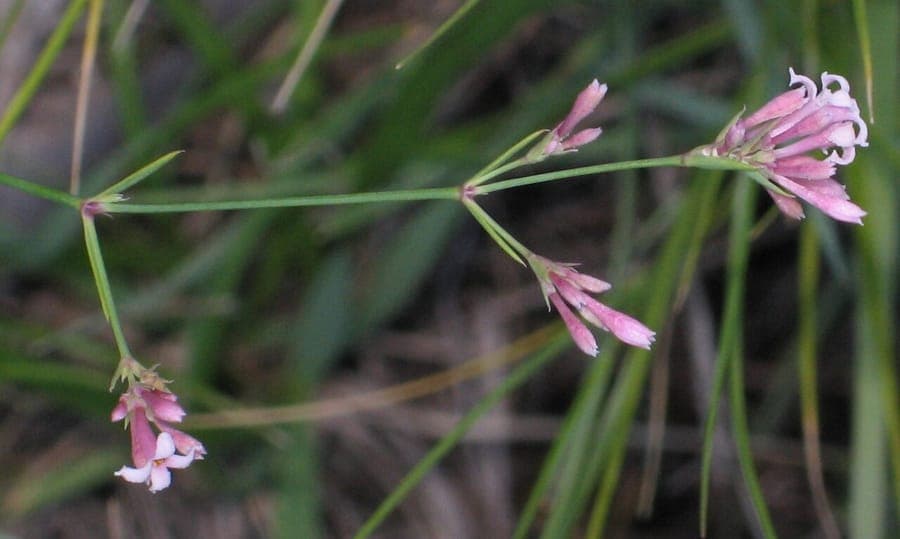
Robert Flogaus-Faust / CC BY 4.0, via Wikimedia Commons
Awned woodruff: complete guide
Asperula aristata
Want to see Awned woodruff: complete guide in your garden?
1 minute, no credit card
Overview
Asperula aristata, commonly called awned woodruff, is a little-known but quietly charming perennial from the family Rubiaceae - the same botanical family as Galium and the familiar sweet woodruff. While it rarely appears on the shelves of mainstream garden centres, it deserves attention from anyone interested in dry garden planting, chalk scree beds, or naturalistic designs that welcome wildlife.
Native to southern and central Europe, from the Pyrenees to the Balkans, this plant grows wild on open, rocky hillsides, limestone grasslands, and dry slopes where it shares space with other thin-soiled specialists. Its small purple flowers attract bees, hoverflies, and butterflies from June through August, making it a worthwhile addition to any biodiversity-focused planting scheme.
On gardenworld.app you can design a garden layout where awned woodruff fills the gaps between bolder plants in a rock garden or chalk border, weaving delicate purple haze through a composition built for dry conditions.
Appearance and bloom cycle
Asperula aristata is a low, herbaceous perennial typically reaching 15 to 40 cm in height. The stems are slender and upright or slightly spreading, clothed in narrow, linear leaves arranged in whorls of four to eight around each stem node - a characteristic arrangement that immediately identifies it as a relative of the bedstraws (Galium). The leaves are dark green, slightly rough-hairy, and tipped with a tiny bristle point - the feature behind the name 'aristata', from the Latin for 'awned' or 'bristle-tipped'.
Flowering occurs from June to August, sometimes into September in cooler sites. The blooms are small, purple-pink, four-petalled tubes, gathered into loose, branching cymes. Individually the flowers are unremarkable, but en masse they give the plant a frothy, delicate texture that works beautifully as a contrast to the stronger architectural forms of neighbouring plants. After flowering, small round fruits form and ripen in late summer.
Ideal location
Awned woodruff grows best in full sun to light partial shade. In the wild it occupies open, sun-drenched limestone hillsides and rocky grasslands. A south-facing or west-facing bank, a raised scree bed, or an open border in a sunny part of the garden are all ideal situations.
Avoid deep shade entirely - in shaded conditions the plant etiolates, loses its compact shape, and barely flowers. Four to six hours of direct sun per day is the minimum for satisfying performance. Good air circulation around the plant reduces the risk of fungal problems in the whorled foliage.
The plant also does well at path edges, between paving stones, and on dry slopes where more competitive plants struggle to establish. Its relatively modest spreading habit makes it easy to manage alongside smaller rock garden plants.
Soil
Asperula aristata is a classic chalk-lover. In its natural range it grows on limestone and calcareous substrates, preferring a soil pH of 7.5 to 8.0. It also performs well in neutral soils around pH 6.5 to 7.0. Acidic, peaty substrates are unsuitable.
The most critical soil property is drainage. Standing water and prolonged wet conditions will kill the plant. A lean, sharply draining soil is far preferable to a rich, heavily amended bed. In too fertile a soil, awned woodruff grows rapidly but becomes loose and floppy, losing its characteristic neat habit.
When planting in heavy clay garden soil, mix in generous quantities of coarse sand or fine grit to improve drainage. A surface dressing of fine gravel keeps the whorled leaves dry and prevents soil splash during rain, both of which help to reduce disease. The soil nutriment index recorded for this species is low (3 out of 10), confirming its preference for infertile conditions.
Watering
Once established, Asperula aristata needs very little supplemental water. It is adapted to moderately dry to dry conditions and handles extended dry spells well, particularly in free-draining soil where roots can track moisture to depth.
Freshly planted specimens need regular watering during their first growing season to support establishment. After that, taper off steadily. Mature plants in open ground will generally cope with a typical north-west European summer without additional water, although a deep drink during a prolonged dry spell of three or more weeks is beneficial.
In containers, soil dries out more quickly than in open ground. Check moisture levels weekly by pressing a finger into the growing mix. Water when the top few centimetres are thoroughly dry, then water thoroughly so that moisture reaches the roots, and ensure good drainage so surplus water can escape.
Overwatering is the more common mistake. Keeping the foliage dry is important - wet whorled leaves in low-airflow conditions invite fungal disease.
Free design
Want to see Awned woodruff: complete guide in your garden? Make a free design now.
Pruning
Awned woodruff needs minimal cutting back. After the main flowering period finishes in August or early September, you can cut the flowered stems back by half to tidy the plant and encourage a second flush of bloom. This is optional - plants left in place will self-seed freely, which is welcome in a naturalistic setting.
In early spring, once new basal shoots are visible, remove the old stems cleanly at ground level. This clears last season's growth and gives new shoots room to develop. No hard cutting into woody base material is needed, as this species does not form a persistent woody crown.
A light trim in midsummer after the first flowering peak can extend the bloom period and keep the plant more compact through the second half of the season.
Maintenance calendar
- January: Plant dormant; ensure drainage is clear after winter rains.
- February: Check crown for winter damage; remove any dead or collapsed stems.
- March: New basal shoots appear; remove old stems cleanly at the base.
- April: Active growth resuming; minimal care needed.
- May: Flower buds forming; light weeding around the plant.
- June: First flowers open; bees and butterflies visiting.
- July: Peak bloom; no intervention required.
- August: Flowering winding down; optionally cut back by half for tidiness.
- September: Seeds ripening; leave for self-seeding or remove to limit spread.
- October: Plant entering dormancy; stop additional watering.
- November: No action needed; remove fallen leaves if they smother the crown.
- December: Full dormancy; leave undisturbed.
Winter hardiness
Asperula aristata is a hardy perennial that copes well with European winters. Specific USDA zone data for this species is limited, but its natural range and close relatives suggest hardiness in zones 5 to 8, equivalent to winter temperatures from around -26 to -12 degrees Celsius.
In the mild climate of the low countries and similar zone 8 regions, the plant overwinters reliably as long as drainage is good. As with many Mediterranean-origin rock garden plants, the real threat is not cold alone but the combination of cold and persistently wet soil during the dormant period. Keep the drainage sharp and leave the plant in place: the dried stems offer a degree of protection to the crown through winter.
A light application of fine grit around the base in November helps to prevent water pooling at the crown without the moisture-retaining drawback of organic mulch.
Companion plants
Asperula aristata pairs well with other chalk-tolerant, drought-resistant plants. Its purple flowers complement the blue-mauve tones of lavender and the warmer pinks of thyme, while its fine-textured foliage contrasts agreeably with broader, fleshier leaves.
Recommended companions:
- Lavender (Lavandula angustifolia): shares the same preference for dry, calcareous soils in full sun.
- Wild thyme (Thymus serpyllum): low mat-forming companion for path edges and rock gardens.
- Maiden pink (Dianthus deltoides): rosy flowers that complement the purple of awned woodruff.
- Mountain alyssum (Alyssum montanum): yellow-flowered, similar requirements, a good neighbour in spring.
- Sun rose (Helianthemum): low-growing, sun-loving, perfectly suited to the same dry conditions.
Visit gardenworld.app to see how these companions look together in garden design and to find colour combinations that suit your particular garden space.
Closing
Asperula aristata is an undervalued but genuinely rewarding garden plant for naturalistic, ecologically sensitive planting on dry, calcareous soils. Its modest purple flowers, fine texture, and low maintenance requirements make it a reliable addition to rock gardens, gravel borders, and dry-slope plantings.
Look for it at specialist perennial nurseries and rock garden suppliers rather than mainstream garden centres. It responds well to a sunny position, free-draining soil, and minimal interference. Given those conditions, awned woodruff will reward you with years of delicate summer colour and valuable food for pollinators. Use gardenworld.app to plan where it fits in your garden and to discover further plants that share its care requirements.
Want to see Awned woodruff: complete guide in your garden? Make a free design now.
Upload a photo, pick a style, and get a photorealistic design with plant list in under a minute.
10,000+ gardens designed already
No credit card required


Similar plants
Squinancywort: complete guide
Asperula cynanchica
Grow Squinancywort (Asperula cynanchica), a delicate alpine plant with pink flowers. Perfect for rock gardens and dry sunny locations. Complete care guide included.
Pink woodruff: complete guide
Asperula taurina
A practical guide to growing Asperula taurina: ideal conditions, care tips, and companion plants for a thriving shade garden.
Purple woodruff: complete guide
Asperula purpurea
Full guide to Asperula purpurea, purple woodruff: sunny sites, chalky soil, watering, pruning, winter hardiness and companion plants for rock and dry gardens.