
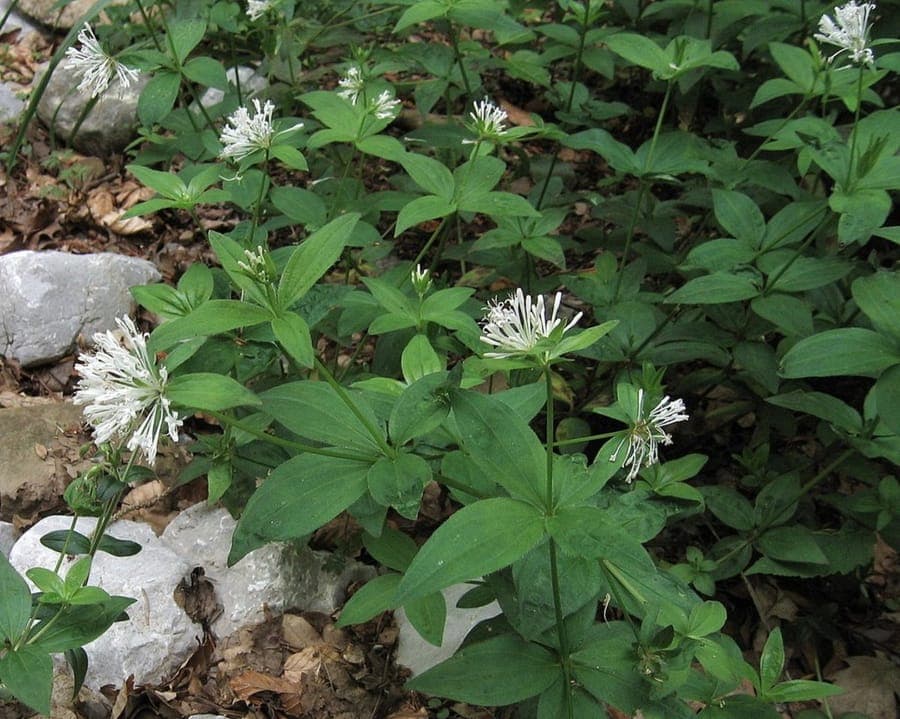
Boris Gaberšček / CC BY 2.5 si, via Wikimedia Commons
Pink woodruff: complete guide
Asperula taurina
Want to see Pink woodruff: complete guide in your garden?
1 minute, no credit card
Overview
Pink woodruff, or Asperula taurina, is a modest yet resilient perennial that brings subtle charm to shaded garden areas. Native to forested slopes and woodland edges across Southern and Eastern Europe-from Austria and Greece to Bulgaria and northern Iran-this member of the Rubiaceae family thrives where many other plants struggle. Reaching heights of 30–40 cm, it forms upright, lightly branched clumps with a delicate texture that softens hard lines in garden design.
Unlike its more aggressive relative Asperula odorata, Pink woodruff spreads slowly and remains well-behaved, making it ideal for structured yet natural-looking borders. It's not commonly found in mainstream garden centres, but specialist nurseries and online retailers often stock it. On gardenworld.app, you can design a shaded planting scheme that integrates Pink woodruff seamlessly with ferns, hellebores, and other shade-loving perennials.
Appearance & bloom cycle
The plant features whorls of narrow, lance-shaped leaves arranged in groups of four to six around square stems-typical of the coffee family. The foliage is deep green, slightly glossy, and remains attractive from spring through late autumn. In May through July, terminal clusters of small, star-shaped white flowers emerge. Though not showy, they emit a light, sweet fragrance that attracts hoverflies, solitary bees, and small butterflies.
Each flower is about 5 mm across, with four petals and prominent yellow stamens. After flowering, the plant sets seed readily, though self-seeding is moderate and rarely invasive. The overall effect is one of quiet elegance-perfect for gardens aiming for understated sophistication.
Ideal location
Pink woodruff performs best in partial shade, rated around 5 on the light scale (1–10). It prefers dappled sunlight beneath deciduous trees like beech or maple, where it receives morning light and afternoon shade. Full sun, especially in southern exposures, leads to leaf scorch and stunted growth. Deep, constant shade from dense evergreens suppresses flowering and weakens the plant over time.
Ideal microclimates include woodland margins, north-facing slopes, or beneath open-canopy shrubs. Avoid hot, dry spots near paved areas. Use gardenworld.app to map your garden's light patterns and identify the best spots for Pink woodruff before planting.
Soil requirements
This species prefers neutral to slightly alkaline soils with a pH of 7.0–7.5. It tolerates a range of textures but excels in well-drained, loamy or sandy loam soils rich in organic matter. Avoid heavy clay or waterlogged conditions, which cause root rot.
If your soil is acidic, a light application of garden lime in autumn can help bring it into range. Incorporate leaf mould or composted bark to improve structure and moisture retention. A soil test kit from a local garden centre can confirm pH and nutrient levels before planting.
Free design
Want to see Pink woodruff: complete guide in your garden? Make a free design now.
Watering
Once established, Pink woodruff is moderately drought-tolerant, but consistent moisture during the first growing season is crucial. Water weekly if rainfall is below 25 mm, especially in May and June. Use rainwater when possible, as chlorinated tap water may stress the roots.
During prolonged dry spells in summer, provide a deep soak every 10–14 days. Avoid overhead watering to prevent fungal issues. Mulch with leaf litter or shredded bark to retain moisture and suppress weeds.
Pruning
Minimal pruning is required. After flowering, you can trim back spent stems to maintain a tidy appearance, but this isn't essential. In late autumn or early spring, remove any damaged or dead foliage to encourage fresh growth. Use clean, sharp shears to prevent disease spread.
If self-seeding becomes excessive, deadhead before seeds mature. Otherwise, allow natural dispersal for gradual colony expansion.
Maintenance calendar
- Jan: Check for winter damage; mulch if needed
- Feb: Inspect for pests; prepare soil amendments
- Mar: Loosen compacted soil; add compost
- Apr: Monitor new shoots; protect from late frost
- May: Begin flowering; reduce watering if rainy
- Jun: Peak bloom; watch for pollinators
- Jul: End of flowering; maintain moisture
- Aug: Low maintenance; check for drought stress
- Sep: Thin seedlings if overcrowded
- Oct: Leave foliage for winter cover
- Nov: Clear debris; mulch lightly
- Dec: Winter observation; no action unless severe cold
Winter hardiness
Pink woodruff is hardy in USDA zones 5–8. In zone 5, a light mulch helps protect crowns during freeze-thaw cycles. The plant often remains semi-evergreen, with foliage persisting through mild winters. In colder areas, top growth may die back, but roots survive and re-sprout in spring.
Container-grown plants need extra protection-move to a sheltered spot or wrap pots with hessian.
Companion plants
Pair with ferns like Dryopteris filix-mas, spring ephemerals such as Erythronium dens-canis, or shade-tolerant Geraniums. It also contrasts beautifully with the bold foliage of Hosta or the airy plumes of Athyrium filix-femina. Avoid aggressive spreaders like Vinca minor, which can overpower it.
In naturalistic planting schemes, Pink woodruff works well with Pulmonaria, Alchemilla, and early Alliums. Its fine texture bridges gaps between larger-leaved plants, adding rhythm to the border.
Closing
Pink woodruff isn't flashy, but its reliability and subtle beauty make it a gardener's quiet favourite. It asks for little-moderate shade, decent drainage, and a bit of patience in the first year-and rewards with years of dependable performance. Look for it at independent garden centres or online nurseries specialising in woodland plants. With thoughtful placement and minimal care, it becomes a lasting feature in any shaded garden.
Want to see Pink woodruff: complete guide in your garden? Make a free design now.
Upload a photo, pick a style, and get a photorealistic design with plant list in under a minute.
No credit card required


Similar plants
Oregon bedstraw: complete guide
Galium oreganum
Everything about Oregon bedstraw (Galium oreganum): shade planting, soil requirements, care and use as a low groundcover in woodland and shade gardens.
Awned woodruff: complete guide
Asperula aristata
Full guide to growing Asperula aristata, the awned woodruff: sunny location, alkaline soil, minimal watering, and companion plants for dry or rock gardens.
Purple woodruff: complete guide
Asperula purpurea
Full guide to Asperula purpurea, purple woodruff: sunny sites, chalky soil, watering, pruning, winter hardiness and companion plants for rock and dry gardens.