
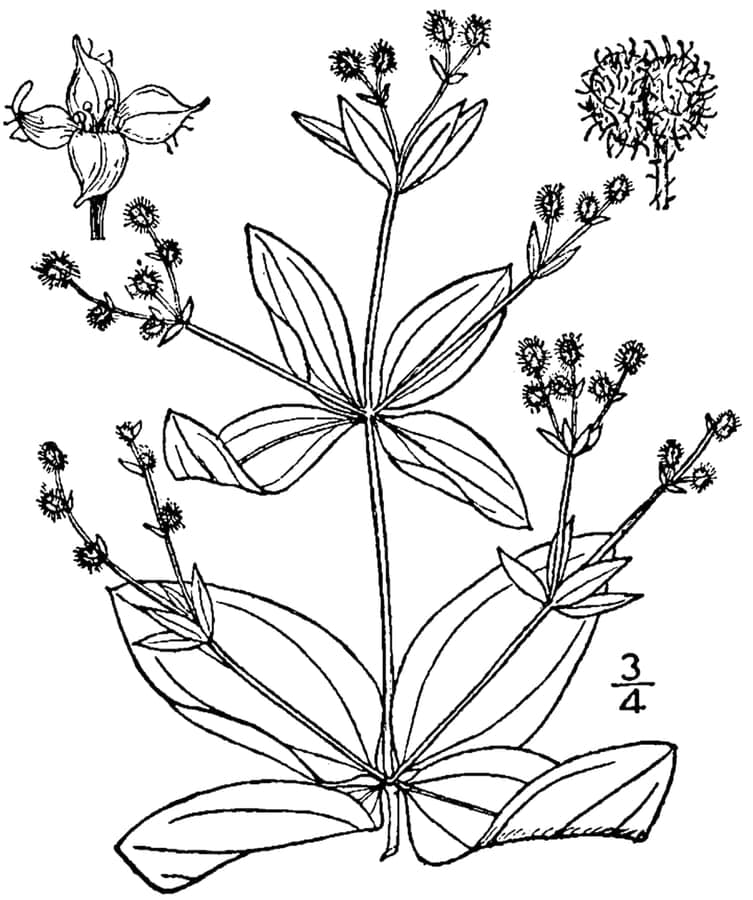
Britton, N.L., and A. Brown. 1913. An illustrated flora of the northern United States, Canada and the British Possessions. 3 vols. Charles Scribner's Sons, New York. Vol. 3: 261. Courtesy of Kentucky Native Plant Society. Scanned by Omnitek Inc. / Public domain, via Wikimedia Commons
Forest bedstraw: complete guide
Galium circaezans
Want to see Forest bedstraw: complete guide in your garden?
1 minute, no credit card
Overview
Galium circaezans, known by the common names forest bedstraw, licorice bedstraw, wild licorice, and woods bedstraw, is a perennial herb in the Rubiaceae family - the same family that includes coffee, gardenia, and the familiar native bedstraw Galium verum. Native to eastern North America and southern Canada, its range extends from Quebec and Ontario westward to South Dakota and Kansas, and south to Texas, Louisiana, and Alabama. The species was first described in 1803 by botanist André Michaux in his Flora Boreali-Americana.
The species name 'circaezans' refers to the resemblance of its leaves to those of Circaea (enchanter's nightshade), another woodland plant. The common name 'licorice bedstraw' derives from the faint liquorice-like scent of the roots, which also gave rise to the alternative names 'wild licorice' and 'white wild licorice'. The name 'cross-cleavers' describes the cross-like arrangement of the leaf whorls around the stem.
In its natural habitat, forest bedstraw is a plant of rich, shaded woodland floors - growing beneath the canopy of deciduous forests in moist to moderately dry conditions. Unlike the notorious cleavers (Galium aparine), this species is not sticky and does not cling to clothing, making it a far more garden-friendly member of its genus. Its broader, ovate leaves distinguish it visually from most other bedstraw species, and it has a more upright, less scrambling habit.
For European gardens, Galium circaezans is a fascinating choice for shade borders, woodland gardens, and the underplanting of deciduous trees and large shrubs. Its tolerance for alkaline soils - with a preferred pH of 7.5 to 8.0, distinctly higher than most shade plants - makes it particularly valuable for gardens on chalky clay or limestone-derived soils. At gardenworld.app you can find design inspiration and professional planting design tools to incorporate shade-tolerant species like forest bedstraw into a coherent and beautiful garden layout.
The plant grows to 20–60 cm in height with a moderately upright to slightly lax habit. It spreads gently from its crown but is not invasive or aggressive, making it well-suited for controlled planting under trees or in formal shade borders alongside more vigorous companions.
Appearance & bloom cycle
Forest bedstraw has a delicate, airy appearance that suits naturalistic woodland plantings and refined shade borders alike. The stems are slender, slightly four-angled (a characteristic of the Rubiaceae), and finely hairy, reaching 20–60 cm in height. The most striking visual feature is the leaf arrangement: broad, ovate to elliptic leaves, 2–5 cm long and 1–3 cm wide, arranged in whorls of four (sometimes six) around the stem. Each leaf has three distinct veins and a slightly heart-shaped base. The foliage is mid to dark green, softly hairy along the margins and veins, and notably broader than the needle-like leaves of most other Galium species.
Flowering occurs from May through August. The flowers are tiny - 2–3 mm across - four-petalled, pale yellow to greenish-white, and borne in forked clusters from the leaf axils. Though individually inconspicuous, they appear in sufficient numbers to create a delicate, foam-like effect at close range. In warm summer conditions the flowers emit a subtle, faintly sweet scent. After flowering, small round fruits 2–3 mm across develop, covered with tiny hooked hairs that allow dispersal by passing animals and clothing - giving rise to the name 'cross-cleavers' in reference to this sticky-footed dispersal strategy.
Fruits ripen August through October. In autumn, the foliage turns pale yellow-green before the stems die back completely. The plant overwinters as a compact basal rosette or via short rhizomes, resuming vigorous growth early in spring - often before the tree canopy has fully leafed out, taking advantage of the early-season light window.
Ideal location
Forest bedstraw is an obligate shade plant. In nature it grows exclusively in the understorey of deciduous woodland, under filtered to moderate shade. Botanical records assign it a light preference of 7 on a 1–10 scale, corresponding to dappled or light shade from a deciduous canopy. Full sun is harmful to this plant: direct summer sun causes leaf scorch, bleaching, and progressive decline.
In European gardens, ideal positions include: beneath deciduous trees with light to moderate canopies (oak, lime, birch), under large shrubs, along the north- or east-facing base of walls and fences, within shaded courtyard gardens, and as understorey in woodland garden schemes. The plant also works beautifully as a fine-textured filler in deep shade borders where coarser-leaved shade plants like hostas provide structural contrast.
Atmospheric humidity is a factor in this plant's comfort: it prefers a relatively humid microclimate, reflected in the botanical humidity rating of 7 out of 10. Hot, dry shade positions with desiccating air movement are unsuitable. A sheltered, cool spot with gentle air movement is optimal.
Soil requirements
One of the most noteworthy horticultural characteristics of forest bedstraw is its preference for alkaline soil - a pH of 7.5 to 8.0. This places it in a relatively rare category among shade perennials, most of which prefer slightly acidic to neutral conditions. The alkaline pH tolerance makes this plant especially useful in gardens on chalk, limestone-derived soil, or chalky clay where many shade-tolerant alternatives struggle with chlorosis.
The plant's nutritional requirements are low, rated 2 out of 10 in botanical databases - meaning it thrives on lean to moderately infertile soils. On overly rich, heavily fertilised soils, growth becomes lush but floppy; an annual top-dressing of 2–3 cm of half-rotted leaf litter or leafmould is ample nutrition. Good drainage is important despite the moisture preference: the plant does not tolerate waterlogging or standing water around the crown. A loose, open, humus-rich woodland soil with good aeration is ideal.
On heavy clay, incorporate 10 cm of coarse sand and 10 cm of leafmould before planting to improve structure and drainage. On sandy soils, add 10–15 cm of well-rotted compost. Plant spacing 25–35 cm for a closed groundcover mat; mulch with 3–5 cm of semi-rotted leaf litter after planting.
Free design
Want to see Forest bedstraw: complete guide in your garden? Make a free design now.
Watering
Galium circaezans has moderate water requirements. In its native forest habitat it grows on moderately moist woodland floors - consistently cool and slightly moist but never waterlogged. In garden cultivation, water once weekly in dry periods during the growing season (April–September), aiming to keep the soil evenly moist but not wet. In shaded positions under a dense tree canopy, the soil retains moisture longer and supplemental watering needs are reduced.
During the growing and flowering season (May–August), check soil moisture weekly and water when the top 5 cm becomes dry. Deep watering of 10–15 litres per square metre per week is a suitable guideline. In hot summer conditions (July–August), twice-weekly watering may be needed if soil dries rapidly. The plant tolerates short dry spells (1–2 weeks) once established but prolonged drought causes leaf drop and dieback.
Avoid overhead watering that keeps foliage wet for extended periods in warm, humid conditions. Drip irrigation or careful hand watering at soil level is preferred. In autumn and winter, rainfall in northwest European climates is generally adequate without supplemental irrigation.
Pruning
Forest bedstraw requires minimal pruning. The main task is removing dead above-ground material in late winter to early spring (late February to early April), cutting back to ground level or simply pulling away the dead stems by hand - they are not woody and break away easily.
No pruning is needed during the growing season. If the plant spreads more than desired, simply remove excess sections in early spring before new growth commences. Division is rarely necessary but possible: lift a clump in early spring, divide into sections of several stems each, and replant at 25–30 cm spacing.
In woodland garden settings where leaf fall from trees provides a natural mulch, the dead stems of Galium circaezans may simply be left to decay over winter and removed when clearing the bed in spring.
Maintenance calendar
January–February: Plant is dormant. Check mulch layer; top up if necessary. Leave dead material in place as winter insulation.
March: Remove dead stems. Basal rosettes are already visible and growing. Dress with leafmould or composted bark.
April: Monitor regrowth. Remove weeds before they shade out young shoots. Water if unusually dry.
May–June: Flowering begins. Pale yellow-white flowers open in leaf axils. Check soil moisture weekly.
July–August: Fruiting period begins. Water in dry spells. Seed heads develop.
September–October: Fruits ripen. Stems begin dying back after seed set.
November: Stems die back completely. Apply mulch of leaf litter around the crown.
December: Full dormancy. Maintain mulch layer for frost protection.
Winter hardiness
Galium circaezans is exceptionally cold hardy. Native to regions with severe winters - Quebec, Manitoba, South Dakota - it withstands temperatures well below -20 °C without damage. It corresponds to USDA hardiness zones 4–8, covering all of temperate Europe with ease. No winter protection is needed in the Netherlands, Belgium, the UK, France, or Germany.
The above-ground portions die back completely in autumn, while the plant overwinters from its basal crown or short rhizomes. Regrowth begins early in spring - often in March in northwest Europe, when the plant takes advantage of the early-season light before deciduous trees leaf out. In mild winters, the basal rosette may remain semi-evergreen.
A natural leaf fall from overhead trees provides adequate insulation for the root zone. On open, exposed positions, a light mulch of dry leaves or bark provides a useful buffer in the rare event of prolonged hard frost without snow cover.
Companion plants
Forest bedstraw combines beautifully with other woodland plants and shade-tolerant perennials. Recommended companions available at specialist garden centres include:
- Epimedium x perralchicum or Epimedium grandiflorum (barrenwort): a classic shade groundcover with fine flowers and attractive foliage; its compact, spreading habit complements the upright, airy texture of Galium circaezans.
- Pulmonaria saccharata (lungwort): the spotted leaves and early blue-pink flowers of lungwort provide attractive contrast to the small pale flowers of forest bedstraw.
- Geranium phaeum (mourning widow): the dark purple flowers and lobe-cut leaves make an appealing textural partner in deep shade borders.
- Maianthemum racemosum (false Solomon's seal): a woodland floor plant with similar habitat and soil preferences that creates a layered woodland understorey effect.
- Polygonatum multiflorum (Solomon's seal): the arching stems and pendant white bells provide graceful structural contrast alongside the more upright bedstraw.
- Lamium maculatum (spotted deadnettle): on alkaline soils, an excellent companion groundcover that shares the preference for chalky conditions.
In designing a woodland floor planting, combine forest bedstraw with these companions in an irregular, naturalistic pattern that reflects their relative height and texture. Visit gardenworld.app for professional design tools to help you build a layered shade garden that looks good throughout the year.
Closing
Galium circaezans is a quietly distinguished woodland perennial that brings refinement and ecological interest to the shade garden. Its tolerance for alkaline soils, delicate texture, early spring emergence, and low maintenance requirements make it an unexpectedly versatile choice for difficult, shaded positions where many other plants struggle. The faint liquorice scent of its roots and the precise geometry of its leaf whorls reward close-up appreciation in the garden.
To discover how shade-tolerant plants like forest bedstraw can be used to best effect in your garden design, visit gardenworld.app and explore professional planting design tools tailored to your garden's unique conditions.
Want to see Forest bedstraw: complete guide in your garden? Make a free design now.
Upload a photo, pick a style, and get a photorealistic design with plant list in under a minute.
10,000+ gardens designed already
No credit card required


Similar plants
Oregon bedstraw: complete guide
Galium oreganum
Everything about Oregon bedstraw (Galium oreganum): shade planting, soil requirements, care and use as a low groundcover in woodland and shade gardens.
Awned woodruff: complete guide
Asperula aristata
Full guide to growing Asperula aristata, the awned woodruff: sunny location, alkaline soil, minimal watering, and companion plants for dry or rock gardens.
Purple woodruff: complete guide
Asperula purpurea
Full guide to Asperula purpurea, purple woodruff: sunny sites, chalky soil, watering, pruning, winter hardiness and companion plants for rock and dry gardens.