
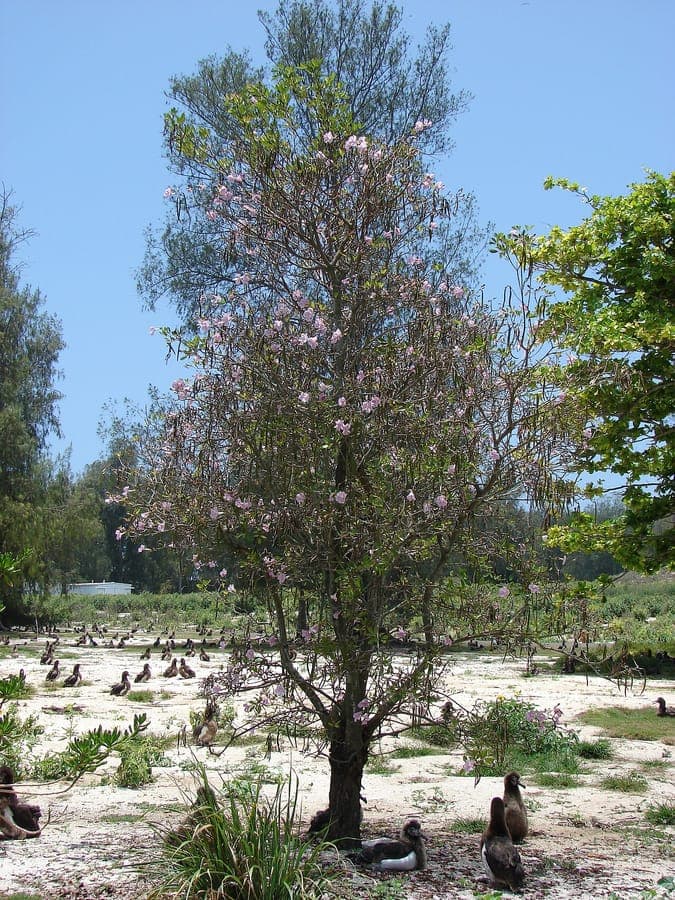
Forest & Kim Starr / CC BY 3.0, via Wikimedia Commons
Pink trumpet tree: complete guide
Tabebuia heterophylla
Want to see Pink trumpet tree: complete guide in your garden?
1 minute, no credit card
Overview
Tabebuia heterophylla, commonly known as the pink trumpet tree or white cedar, is one of the most visually dramatic flowering trees native to the Caribbean. Its natural range covers Cuba, Jamaica, Puerto Rico, Haiti, Trinidad and Tobago, and the Windward and Leeward Islands, where it grows on dry, rocky hillsides and forest edges. In warm gardens worldwide it has earned a devoted following for its breathtaking display of pink to lavender trumpet-shaped flowers.
The genus name Tabebuia derives from a Tupi word from the Caribbean basin. The species epithet heterophylla means "variable-leaved," reflecting the fact that leaves of different shapes can appear on the same tree. In the Spanish-speaking Caribbean it goes by Roble or Roble blanco, while French speakers know it as Poirier blanc or Poirier pei. On gardenworld.app you can explore garden design ideas that incorporate statement trees like this one into a cohesive planting scheme.
Appearance and bloom cycle
The pink trumpet tree is a medium-sized tree reaching 10 to 15 metres in its native habitat, though container-grown specimens in temperate regions typically stay between 3 and 6 metres. The trunk develops a grey-brown, slightly furrowed bark that becomes more characterful with age. The canopy is open and irregularly branched, giving the tree an airy, sculptural silhouette.
The leaves are palmately compound, consisting of three to five oval leaflets attached to a central stalk. The tree is semi-deciduous: during dry periods it may shed much of its foliage, while in favourable conditions it remains largely evergreen. This leaf-drop behaviour is a natural stress response and not a cause for alarm.
The flowers are the undisputed highlight. Each individual bloom is trumpet-shaped, 5 to 7 cm long, and ranges from deep rose-pink to pale lilac, with a cream or pale yellow throat. They appear in large terminal clusters at the branch tips, often when the tree is nearly bare of leaves. The result is a breathtaking sight: an entire tree covered in pink blossoms, with barely a leaf in sight. In its native range flowering occurs several times a year, but the main spectacle falls between January and April. After flowering, elongated seed pods develop and can reach 30 cm in length.
Ideal location
The pink trumpet tree is a full-sun plant that needs at least six hours of direct sunlight daily for a rich flower display. In its home climate it grows in open, exposed positions with warm sea air and excellent drainage. In the garden, replicate these conditions as closely as possible: choose the sunniest, most sheltered spot you have, ideally against a south-facing wall that retains heat.
In temperate climates it must be overwintered under frost-free conditions. Once night temperatures drop below 5 degrees Celsius in autumn, move it indoors or into a heated greenhouse. A minimum of 8 degrees Celsius during winter prevents damage. A large container makes this practical: use a sturdy pot on casters that can be moved easily.
In USDA hardiness zones 10 and 11, the tree can stay outdoors year-round. Florida and Hawaii are examples of US regions where it grows permanently in gardens.
Soil requirements
This tree is remarkably unfussy about soil composition, provided drainage is excellent. In nature it colonises poor, dry, calcareous soils on rocky slopes - this explains its impressive drought tolerance once established. The preferred pH range is 4.5 to 8.0, meaning it copes equally well with slightly acidic and alkaline conditions.
For container growing, use a free-draining mix of good potting compost combined with perlite or coarse sand in roughly a 2:1 ratio. Always ensure the pot has adequate drainage holes - waterlogged roots cause root rot rapidly. In the open garden, avoid heavy clay soils without amendment; work in grit or coarse gravel to improve drainage before planting.
The soil does not need to be rich. An annual application of a balanced, slow-release fertiliser in spring provides all the nutrients needed for healthy growth and flowering.
Free design
Want to see Pink trumpet tree: complete guide in your garden? Make a free design now.
Watering
Once established, the pink trumpet tree tolerates considerable drought. Young trees and container specimens, however, require more consistent moisture than mature, in-ground plants. During the growing season (spring and summer), water generously when the top 5 cm of compost feels dry to the touch. In winter, when the tree is resting or partly leafless, reduce watering significantly.
For container specimens, water thoroughly until it runs freely from the drainage holes, then empty the saucer after fifteen minutes. In hot summer weather, daily watering may be necessary. In winter, watering every two weeks or less is often sufficient.
Natural rainfall is generally adequate during summer in most temperate climates. During prolonged dry spells, check that the root ball has not dried out completely, as extreme drought during active growth can cause heavy leaf drop.
Pruning
The pink trumpet tree requires minimal pruning. It naturally develops a pleasing rounded crown and needs little corrective attention. Remove dead, damaged, or crossing branches in early spring before new growth begins.
To keep container specimens compact and bushy, you can cut back the longest shoots by up to one third after flowering. This encourages lateral branching and maintains a tidy shape. Do not prune back into old bare wood, as regrowth from very old stems is unreliable.
Always use sharp, clean tools to reduce the risk of disease transmission. When repotting, you can lightly trim the outer root layer to encourage fresh root growth within the new container.
Maintenance calendar
January to February: Keep indoors in a cool, frost-free room at 8 to 12 degrees Celsius. Water sparingly. Check for scale insects on stems.
March to April: Begin increasing water as buds appear. Apply a slow-release balanced fertiliser. This is the right moment for any structural pruning.
May: Move outside once night temperatures consistently stay above 10 degrees Celsius. Start in a sheltered spot and gradually increase sun exposure over two weeks.
June to August: Full outdoor placement in full sun. Water regularly, feed with liquid fertiliser every two weeks.
September to October: Reduce watering. Inspect for pests and disease before bringing indoors.
November to December: Move to greenhouse or cool indoor room. Water sparingly.
Winter hardiness
The pink trumpet tree is not winter-hardy in temperate climates. It is suited to USDA hardiness zones 10 to 11, tolerating minimum temperatures of -1 to +4 degrees Celsius at best. In practice, even light frost can damage stems and foliage. In the Netherlands, Belgium, and northern France, frost-free overwintering is essential every year.
The ideal overwintering spot is a heated greenhouse or conservatory where temperatures stay between 8 and 15 degrees Celsius. Avoid temperatures much above 18 degrees in winter, as excessive warmth can disrupt the rest period and reduce the following year's flower production.
In marginal areas of USDA zone 9b - such as parts of southern France and the Canary Islands - well-established trees may survive mild winters outdoors with root mulching and stem protection using horticultural fleece.
Companion plants
The pink trumpet tree pairs beautifully with other tropical and subtropical plants for a lush, exotic atmosphere. Bougainvillea offers vivid colour contrast, while hibiscus extends the flowering season into summer. Cannas and Alocasia (elephant ear) provide bold leaf structure at the base of the tree.
For a more restrained combination, pair it with ornamental grasses and agapanthus. On a terrace or patio, lemon trees, bay, and oleander make harmonious companions. Lavender and rosemary, which share the same preference for sun and well-drained conditions, are excellent ground-level neighbours.
At most garden centres you will find compatible subtropical species to build a varied, exotic planting scheme around this tree. Look for companion plants that share its preference for warmth and excellent drainage.
Closing thoughts
The pink trumpet tree is a show-stopping specimen for anyone drawn to tropical garden styles. Its cloud of pink blossoms in early spring and its impressive drought tolerance make it a rewarding container plant even in cool-climate regions. With proper winter care and a sunny summer position, gardeners in northern Europe can enjoy this Caribbean gem for many years.
Visit gardenworld.app to discover how a garden design centred on bold flowering trees can transform your outdoor space into a year-round feature.
Want to see Pink trumpet tree: complete guide in your garden? Make a free design now.
Upload a photo, pick a style, and get a photorealistic design with plant list in under a minute.
10,000+ gardens designed already
No credit card required


Similar plants
Tabebuia pallida: complete guide
Tabebuia pallida
Full growing guide for Tabebuia pallida: location, soil, watering, pruning, hardiness and companion plants for this tropical trumpet tree.
Northern catalpa: complete guide
Catalpa speciosa
Everything about northern catalpa (Catalpa speciosa): bold white flowers, fast growth, and how to grow this striking tree in your garden.
Desert willow: complete guide to Chilopsis linearis
Chilopsis linearis
Complete growing guide for desert willow (Chilopsis linearis): sun, soil, flowering, pruning, and winter care for this spectacular flowering small tree.