
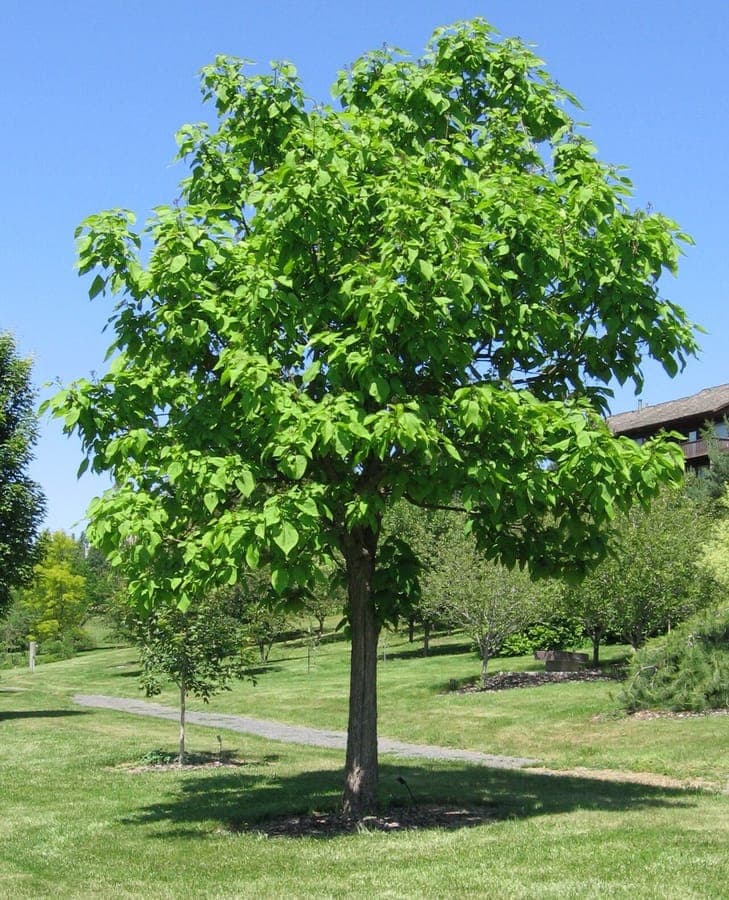
Mark Wagner / CC BY 2.5, via Wikimedia Commons
Northern catalpa: complete guide
Catalpa speciosa
Want to see Northern catalpa: complete guide in your garden?
1 minute, no credit card
Overview
The northern catalpa (Catalpa speciosa) is one of the most dramatic ornamental trees available to gardeners in temperate climates. Native to the central and eastern United States, from Indiana and Illinois south to Tennessee and Arkansas, it has been widely planted as a landscape specimen tree across North America and Europe since the nineteenth century. Its enormous heart-shaped leaves, showy white flower panicles, and long dangling seed pods make it instantly recognisable.
Botanically described by Teas in 1875, northern catalpa belongs to the family Bignoniaceae - the same family as the jacaranda and trumpet vine. It is the hardier of the two commonly grown catalpa species, tolerating temperatures down to USDA zone 4, making it far more suitable for gardens in northern Europe and the colder parts of North America than its southern relative Catalpa bignonioides. Gardeners who want a tree that makes a bold statement without requiring a frost-free climate will find northern catalpa a genuinely outstanding choice.
The tree grows rapidly - often 30 to 60 cm per year under good conditions - so an empty corner of the garden fills up reassuringly quickly. Whether you want a majestic free-growing specimen, a shady canopy for a seating area, or a dramatically pollarded focal point with outsized tropical foliage, this one tree can deliver all three depending on how you manage it. For design inspiration, gardenworld.app shows how a large specimen tree can anchor a complete front garden composition.
Appearance and bloom cycle
Outside the flowering season, northern catalpa is defined by its leaves. Each leaf is broadly heart-shaped, sometimes slightly three-lobed, and can reach 30 cm across on vigorous young growth. The upper surface is a rich mid-green; the underside is pale and slightly hairy. In autumn, leaves turn clear yellow before dropping. There is no great autumn colour spectacle, but the yellow is cheerful and the bare winter silhouette - with the long pendant pods remaining on the branches - has its own quiet appeal.
Flowering takes place in June and July. The flowers appear in upright panicles, each flower individually resembling a small trumpet or orchid, white with purple spots and yellow streaks in the throat. A large tree in full flower is a magnificent sight. The fragrance is light and pleasant, and the flowers attract bees, bumblebees and hummingbirds where these are present. After flowering, the developing seed pods elongate through the summer, eventually reaching 30 to 50 cm. They persist on the branches well into winter, turning from green to mid-brown and rattling in the wind.
The overall tree shape is broadly rounded to slightly irregular. Mature trees in open situations can reach 15 to 20 metres tall with a crown spread of 8 to 12 metres, but in garden settings, where pruning keeps the size in check, they are often considerably smaller. The bark is grey-brown, becoming coarsely ridged and furrowed with age.
Ideal location
Northern catalpa thrives in full sun and requires at minimum a half-day of direct sunshine to flower well. It is moderately tolerant of partial shade but will produce fewer flowers and a less compact crown in shadier positions. The most important siting consideration is shelter from strong wind. Those enormous leaves tear easily in a gale, giving the tree a tatty appearance and reducing photosynthetic efficiency. A wall, building, or dense hedge to the prevailing wind side protects the leaves and keeps the tree looking its best.
The species is notably tolerant of urban conditions - air pollution, compacted soil, and reflected heat from paving do not faze it unduly. This makes it a good choice for town gardens, courtyard plantings, and roadside situations. It is also reasonably tolerant of drought once established, though not as tough as some Mediterranean shrubs.
Allow plenty of space. Even with regular pruning, a northern catalpa needs a clear circle of about 5 to 6 metres to develop properly. Keep it well clear of buildings, drains, and overhead cables. A south- or south-west-facing position maximises warmth and light, which in turn promotes better flowering and better ripening of the pods.
Soil
Northern catalpa is adaptable across a reasonable range of soil types, but does best in a deep, fertile, moisture-retentive but well-drained loam. The pH range of 5.5 to 7.0 covers most garden soils. Very heavy clay that stays waterlogged for weeks at a time is the main thing to avoid, as roots sitting in water for long periods can rot.
When planting, dig a generous pit, loosen the subsoil, and incorporate a good quantity of well-rotted compost or manure. This encourages deep, far-reaching root development. A mulch layer of 8 to 10 cm of bark chips or composted material around the base - keeping it a few centimetres away from the trunk - helps conserve moisture and suppresses competing vegetation.
On sandy or very free-draining soils, water retention is the main challenge. Adding organic matter generously at planting time and watering consistently during the first two growing seasons sets the tree up for long-term success. On these soils, supplementary watering through dry summers may be needed even for established trees.
Free design
Want to see Northern catalpa: complete guide in your garden? Make a free design now.
Watering
In the first two years after planting, consistent watering is essential. Newly planted trees cannot yet explore a large soil volume for moisture and are vulnerable to stress during dry spells. Water deeply two or three times a week during warm, dry weather - the goal is to wet the soil to at least 40 to 50 cm depth so that roots chase the moisture downward rather than remaining near the surface.
Once established, northern catalpa is moderately drought tolerant. It will get through most British and north-western European summers without supplementary irrigation. During genuine droughts, particularly in August, it may shed leaves prematurely - this is a natural drought-avoidance response and does not indicate disease or permanent damage. The tree will recover fully the following spring.
Avoid overwatering. Consistently wet soil around the roots causes far more problems than moderate drought. If your garden retains water after rainfall, check drainage before planting rather than compensating with less irrigation.
Pruning
Northern catalpa is remarkably tolerant of pruning, including very hard cutting back. There are two quite distinct management approaches, each giving a different character to the tree.
The first approach is minimal intervention: leave the tree to develop its natural form, removing only dead, diseased, crossing, or structurally problematic branches. Do this in early spring before bud break, or in summer immediately after flowering. Avoid pruning in autumn or winter, as fresh wounds in cold conditions are slow to callous and more vulnerable to disease.
The second approach is annual or biennial hard pollarding. Every year in late February or early March, cut all the previous year's growth back to a short framework of stubs. The response is dramatic: long, vigorous shoots carrying leaves that can be twice the normal size sprout from the stubs within weeks. This method keeps the tree a manageable size and produces the most spectacular foliage effect - resembling a tropical plant more than a temperate-zone tree. It also means you will sacrifice the flowers, since catalpas bloom on mature wood.
For young trees in the first two to three years, do very little pruning - allow the tree to establish its permanent framework. Remove only competing leaders and badly placed branches.
Maintenance calendar
January - February: inspect for winter damage. Hard pollarding or major structural pruning can be done now while the tree is fully dormant.
March - April: apply a slow-release general fertiliser around the drip line. Renew the mulch layer. Established trees need no watering unless the soil is extremely dry.
May - June: watch the buds break - catalpa often leafs out later than surrounding trees, which can cause unnecessary concern. Flowering begins in June.
July: peak flowering. Enjoy the show and note the number of bees visiting. Avoid heavy feeding or pruning during this period.
August - September: pods develop and lengthen. In dry years, early leaf drop is normal. No action needed.
October - November: full leaf drop. Leave the pods in place for winter interest and bird activity.
December: full dormancy. Check for storm damage after severe weather events.
Winter hardiness
Northern catalpa earns its "speciosa" epithet not just for its showy appearance but for its toughness. It is rated USDA hardiness zone 4, meaning it can withstand temperatures below -25 degrees Celsius. This makes it reliably hardy throughout the British Isles, the Netherlands, Belgium, northern France, and Germany. Only in the most exposed upland positions or the coldest parts of Scandinavia would there be any winter risk.
Very young trees in their first winter after planting can suffer dieback on the softest shoot tips in severe freezes. A protective mulch over the root zone and, in extreme cases, a wrapping of horticultural fleece around the trunk provides adequate insurance. By the second winter, even young trees are well-established enough to need no protection.
One behaviour that can alarm gardeners unfamiliar with the species: catalpa leafs out noticeably late in spring, sometimes not until late May. This is completely normal. Be patient. The tree is dormant, not dead.
Companion plants
Choosing plants to grow around and beneath a northern catalpa is mostly a matter of working with shade and scale. The wide spreading crown creates a substantial shaded zone by midsummer. Good companions include:
- Hydrangea paniculata cultivars on the sunny edges of the canopy: white flowers in August echo the catalpa's earlier display.
- Large-leaved hostas beneath the canopy, where they appreciate the dappled shade.
- Astilbe and ferns for moisture-retentive shade positions.
- Persicaria amplexicaulis on the sunlit perimeter for summer-long colour.
- Ornamental grasses such as Miscanthus sinensis as a contrast to the bold catalpa leaves.
For help visualising how these combinations work in an actual garden design, gardenworld.app lets you explore different planting schemes before committing to a plan.
Closing
Northern catalpa is a tree that rewards boldness. It asks for space and sunlight, and in return it delivers decades of spring drama as the enormous leaves unfold, summer spectacle as the flower clusters open, and year-round interest from the long persistent pods rattling in the breeze. Few temperate-climate trees combine this scale, this flower power, and this ease of cultivation in a single package.
Specimens are available from specialist nurseries and larger garden centres across the UK, often in 10 to 25 litre containers. Plant in spring for the best establishment, water well in the first two seasons, and then largely leave it to get on with the business of becoming magnificent.
Want to see Northern catalpa: complete guide in your garden? Make a free design now.
Upload a photo, pick a style, and get a photorealistic design with plant list in under a minute.
10,000+ gardens designed already
No credit card required


Similar plants
Indian-bean: complete guide
Catalpa bignonioides
Indian-bean (Catalpa bignonioides) is a striking deciduous tree with large heart-shaped leaves and distinctive white flowers. Discover how to grow this exotic-looking tree in temperate gardens.
Paulownia tomentosa: complete guide
Paulownia tomentosa
Princess Tree is a magnificent Asian deciduous tree with large heart-shaped leaves and lilac-purple flowers. Learn everything about cultivation, care, and maintenance.
Linden: complete guide
Tilia cordata
A full guide to Tilia cordata: ideal growing conditions, care, pruning, and companion planting. Perfect for UK and North American gardens.