
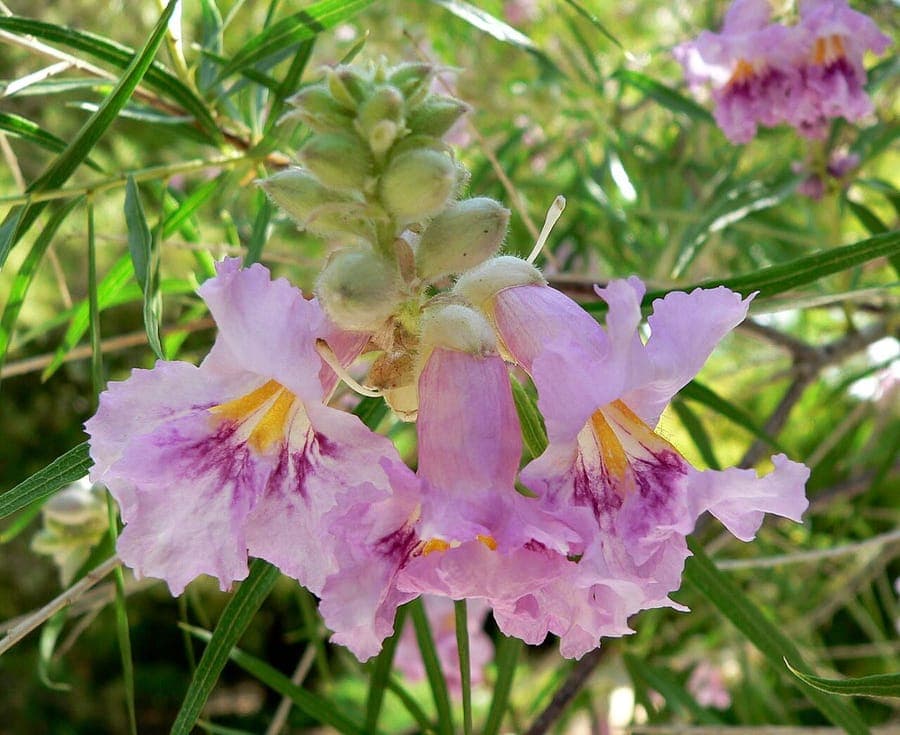
Stan Shebs / CC BY-SA 3.0, via Wikimedia Commons
Desert willow: complete guide to Chilopsis linearis
Chilopsis linearis
Want to see Desert willow: complete guide to Chilopsis linearis in your garden?
1 minute, no credit card
Overview
Chilopsis linearis, commonly known as desert willow, is one of the most spectacular flowering small trees or large multi-stemmed shrubs available for dry, sunny gardens. It is the sole member of the genus Chilopsis and belongs to the Bignoniaceae family - the same family as catalpas and trumpet vines. Native to the arid Southwest of the United States (Arizona, California, Nevada, New Mexico, Texas, and Utah) and northern Mexico, it grows naturally along dry streambeds and washes where it can access intermittent groundwater. The species name linearis refers to the narrow, linear leaves that closely resemble willow foliage, explaining the common name desert willow despite being entirely unrelated to true willows. On gardenworld.app you can see how striking architectural trees like this anchor a complete front garden design for warm, dry climates.
What sets desert willow apart from other drought-tolerant plants is the sheer spectacle of its flowers. Large, trumpet-shaped blooms in shades of pink, purple, and white appear in abundance from June through September - an exceptionally long bloom window for any tree, let alone one that thrives on minimal water. Garden designers working with Mediterranean-style, xeriscape, or Southwest American planting schemes consistently rank Chilopsis linearis among the most valuable flowering trees for warm, dry landscapes.
The plant has a notably rapid growth rate, reaching 3 to 9 metres in its native habitat. In cooler climates it typically remains more compact, between 2 and 5 metres. Regular pruning can keep it at virtually any desired height and width, making it adaptable to smaller garden spaces.
Appearance and bloom cycle
Chilopsis linearis is a deciduous tree or large shrub with multiple slender stems. The branches are light and graceful, grey-brown in colour, with a slightly pendulous quality that adds elegance to the overall form. The bark is grey-brown and develops light ridging on older specimens.
The leaves are narrow, linear, 10 to 25 cm long, and deep green. They are distributed evenly along the branches, creating the willow-like silhouette that gives the plant its name. In autumn the leaves turn yellow before dropping. In warm weather the leaves become slightly sticky due to resinous secretions.
The flowers are the defining feature of this plant. Each bloom is 3 to 5 cm long, trumpet-shaped with a two-lobed upper lip and three-lobed lower lip, often with yellow or white markings on the interior of the tube. Colour ranges from pale pink and soft lavender to deep purple, with numerous named cultivars available covering virtually the full spectrum from white through rose to deep burgundy. The flowers appear in clusters at the branch tips from June through September - sometimes into October in mild years. The bloom period is unusually long, with the plant continuously producing new flower clusters throughout summer. After flowering, distinctive narrow seed pods 15 to 30 cm long develop and remain on the tree through winter.
Ideal location
Desert willow is an uncompromising sun lover. Full sun - at least eight hours of direct sunlight per day - is non-negotiable. In shadier positions the plant flowers poorly, produces weak, floppy growth, and becomes susceptible to disease.
The plant excels as a specimen accent tree, as a focal point at the corner of a terrace or driveway, or as an informal screen between properties. In a front garden planting with drought-tolerant perennials and decorative gravel, it serves as an outstanding centrepiece. As a large container plant on a sunny terrace it is also worth considering in cooler climates, as this allows it to be moved to a frost-free spot in winter.
In northern European climates a sheltered, south-facing position against a wall or building is essential. The reflected warmth extends the growing season, promotes fuller flowering, and provides critical protection against hard frosts. Cold northerly winds in particular can cause significant damage to established plants.
Soil
Chilopsis linearis grows naturally along dry washes and riverbanks in sandy or rocky, free-draining soils with a pH of 7 to 10 - neutral to alkaline. The plant is remarkably tolerant of poor, nutrient-depleted soils and will actually flower more freely under lean conditions than in rich ground.
Heavy clay soil is problematic. It retains water around the roots, which causes rot, particularly in winter. When planting, work generous quantities of coarse grit, gravel, or sharp sand into the planting site to ensure drainage. On clay soils a raised mound or raised bed is strongly recommended. A gravel mulch at the base of the tree keeps weeds down, retains some soil warmth, and prevents wet soil from sitting against the base of the stems in wet winters.
Avoid heavy fertilising, which encourages soft, leafy growth at the expense of flowering. Only on very depleted soils is a light application of low-nitrogen, potassium-rich slow-release fertiliser in early spring likely to be beneficial.
Watering
Once established after one to two growing seasons, Chilopsis linearis is among the most drought-tolerant flowering trees available for temperate climates. In its desert homeland it survives on irregular rainfall and taps into subsurface moisture along dry streambeds. It can endure months of near-total drought once the root system is fully developed.
In the first year after planting, deep, infrequent watering is essential to develop a strong root system. Water deeply every one to two weeks, allowing the water to penetrate well below the surface to encourage deep rooting. Avoid light, frequent watering.
From the second year onwards, summer irrigation can be progressively reduced and eventually eliminated for established plants in most northern European summers. During extreme heat or prolonged dry spells, watering every two to three weeks deeply is adequate. Overwatering in summer is the most common cause of decline - symptoms include poor flowering, yellowing leaves, and dieback at the branch tips. The plant's roots actively seek out deep moisture, allowing it to bridge long dry periods with ease once well established.
Free design
Want to see Desert willow: complete guide to Chilopsis linearis in your garden? Make a free design now.
Pruning
Chilopsis linearis responds well to pruning and can be maintained as a compact tree or shrub through regular intervention. The natural growth form is multi-stemmed and open, but with selective pruning the plant can be trained into a single-trunked small tree with an airy crown.
The preferred pruning time is late winter or early spring, before new growth begins. At this point, shorten the previous year's growth lightly, improve the branching structure, and remove any dead or crossing stems. The plant tolerates moderately hard pruning and regrows readily.
During the growing season, removing spent flower clusters encourages new flower bud development and extends the bloom period. Simply tip-prune the branches where clusters have finished - new blooms will form on the fresh growth. The long, slender seed pods can be removed for a tidier appearance, though they have their own winter interest left in place.
In cooler climates, avoid heavy autumn pruning that would stimulate new growth vulnerable to frost. A light cleanup is fine; structural pruning is best left until late winter.
Maintenance calendar
January to February: Check for frost damage and remove any killed stems. Late winter is the best time for structural pruning.
March to April: New growth appears. Check that emerging shoots are healthy. Remove any further dead wood that becomes visible as the plant leafs out.
May to June: Growth accelerates and first flower buds appear. No intervention needed.
June to September: Peak flowering. Tip-prune spent clusters to encourage continuous bloom. No supplemental water needed for established plants in a typical northern European summer.
October: Leaf drop begins. Remove seed pods if desired. The plant enters dormancy.
November to December: Frost protection for young or vulnerable specimens in cold zones. A gravel mulch at the base and, in exposed positions, a wrapping of horticultural fleece during the hardest cold spells.
Winter hardiness
Chilopsis linearis is hardier than often assumed. In its native range it regularly encounters frosts to -10 degrees Celsius and occasionally lower. USDA zone 7 is generally the accepted minimum for reliable outdoor cultivation, corresponding to minimum temperatures of around -17 degrees Celsius. In zone 8 and warmer, the plant is reliably hardy outdoors with no protection needed.
In the Netherlands, Belgium, and the milder parts of northern France and the UK - which fall broadly in USDA zones 8 to 9 - outdoor cultivation is possible with the right siting. A sheltered south-facing position against a building, sharp drainage, and a gravel mulch over the root zone are the three critical factors.
Wet cold is more damaging than dry cold. A plant in perfectly drained soil will survive temperatures that would kill one in waterlogged ground. Young plants that experience top-kill in a hard winter will often resprout vigorously from the root zone the following spring, particularly if the root system was well established before the freeze.
For inspiration on how to position sun-loving, drought-tolerant trees for maximum effect in a visualised front garden layout, visit gardenworld.app.
Companion plants
Chilopsis linearis makes a magnificent centrepiece for a dry Mediterranean or Southwest American-style garden. Excellent companions include:
Agave species provide bold structural form and graphically powerful rosettes that contrast beautifully with the desert willow's graceful branches and large flowers. They thrive in the same dry, lean conditions.
Penstemon species offer tubular flowers in red, pink, and blue that complement the pink-purple desert willow blooms and extend the season of colour. Penstemon strictus, eatonii, and barbatus are particularly good choices.
Salvia greggii and Salvia microphylla are compact, free-flowering sage shrubs that work excellently as underplanting. Their red or pink flowers extend the blooming season well into autumn.
Echeveria and sedum species as ground-cover or edging plants provide textural contrast and need virtually no water once established.
Lavender (Lavandula angustifolia or Lavandula stoechas) fits perfectly in this dry, sunny company and adds a fragrant dimension to the planting.
Low-growing juniper cultivars at the base of the tree fill the ground level, suppress weeds, and add year-round evergreen structure.
Closing thoughts
Chilopsis linearis is one of the most rewarding flowering trees for dry, sunny gardens in temperate climates. Its exceptionally long blooming period from June through September, its spectacular trumpet flowers in purple and pink tones, its genuine drought tolerance once established, and its relative hardiness for a desert species make it a top-tier choice for warm, south-facing garden designs. The formula for success is simple: full sun, sharp drainage, a sheltered position in cooler climates, and patience through the establishment phase. After that, the desert willow will reward you with years of vibrant colour and a constant flow of pollinators drawn to its generous flowers.
Want to see Desert willow: complete guide to Chilopsis linearis in your garden? Make a free design now.
Upload a photo, pick a style, and get a photorealistic design with plant list in under a minute.
10,000+ gardens designed already
No credit card required


Similar plants
Bigpod ceanothus: complete guide
Ceanothus megacarpus
Full growing guide for Ceanothus megacarpus: sun, drainage, pruning, and care tips for this striking California chaparral shrub.
Fernbush: complete guide to Chamaebatiaria millefolium
Chamaebatiaria millefolium
Complete growing guide for fernbush (Chamaebatiaria millefolium): sun, drainage, pruning, and care for this aromatic western US native shrub.