
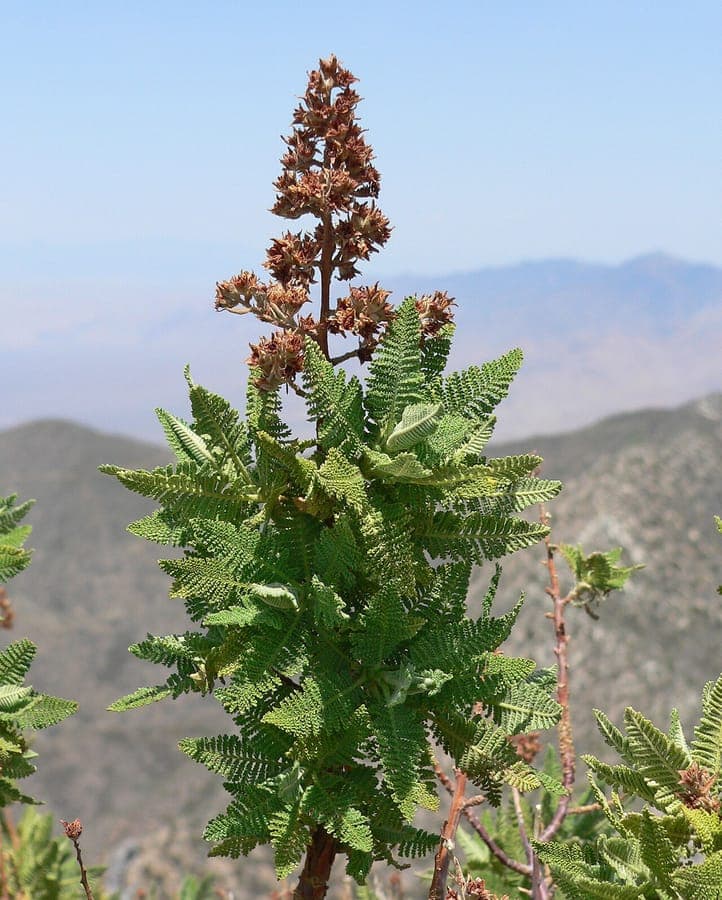
Stan Shebs / CC BY-SA 3.0, via Wikimedia Commons
Fernbush: complete guide to Chamaebatiaria millefolium
Chamaebatiaria millefolium
Want to see Fernbush: complete guide to Chamaebatiaria millefolium in your garden?
1 minute, no credit card
Overview
Chamaebatiaria millefolium, commonly called fernbush or desert sweet, is a distinctive aromatic shrub native to the dry mountain ranges of the western United States. It is the only member of the genus Chamaebatiaria, making it botanically unique within the rose family (Rosaceae). Its natural range covers Arizona, California, Idaho, Nevada, Oregon, and Utah, where it grows on dry, rocky slopes and in sagebrush communities at elevations of 1,200 to 3,000 metres. The species name millefolium - meaning 'thousand-leaved' - refers to the finely divided, fern-like foliage that makes the plant instantly recognisable. On gardenworld.app you can see how native drought-tolerant shrubs like this can anchor a low-maintenance front garden design.
The fragrance of the foliage is one of the plant's most distinctive characteristics. Brushing against or lightly crushing the leaves releases a sharp, resinous scent reminiscent of camphor and pine resin. This aromatic quality makes the plant interesting beyond its ornamental value: deer and other large browsers tend to avoid heavily scented foliage, making fernbush a practical choice for gardens in rural settings where deer pressure is an issue.
The plant's membership in the Rosaceae family is immediately apparent in its flowers: five-petalled white blooms that closely resemble small roses appear in midsummer. This later bloom time distinguishes fernbush from many other drought-tolerant shrubs that flower in spring, allowing it to provide nectar and pollen when other shrubs have already finished.
Appearance and bloom cycle
Chamaebatiaria millefolium forms a broad, dense, multi-stemmed shrub. In the wild it commonly reaches 60 to 200 cm in height with a similar spread. In garden conditions, specimens typically settle between 80 and 150 cm. The branches are light to reddish-brown, clothed in finely divided, sticky leaves that give the whole plant a feathery, light appearance.
The leaves are bipinnately compound - divided twice, into smaller and smaller segments - which creates the characteristic fern-like texture that gives the plant its English name. The individual leaflets are sticky with resinous secretions, which contribute to the plant's strong aroma. Leaf colour ranges from bright to grey-green. In cold winters most leaves drop, but in mild conditions the plant retains some foliage through the cold months.
Flowers appear in July and August in upright, branched plumes at the tips of the stems. Each flower is pure white with five petals, smaller than a garden rose but clearly in the same family. The plumes are produced abundantly, giving the plant a creamy-white appearance in full summer bloom. Pollinators are strongly attracted to the flowers, particularly bees and hoverflies. After flowering, small brown seed capsules develop on the stems.
Ideal location
Fernbush is a full-sun plant that requires at least six hours of direct sunlight per day. In partial shade it becomes loose and untidy, flowers poorly, and is more vulnerable to fungal disease. South or southwest-facing beds, slopes, and rock gardens are ideal locations.
The plant excels in dry rock gardens, xeriscaped beds, slopes with thin soil, and planting areas near buildings where rainfall is limited. Its resinous fragrance is pleasant on warm summer days. As an informal hedge or border plant it works well, providing both visual interest and the practical benefit of deer deterrence.
In cooler climates like those of northern Europe, a sheltered south-facing position against a wall gives the best results. The reflected warmth extends the growing season and protects against the hardest frosts. Avoid positions with poor air circulation, as persistent damp conditions can encourage powdery mildew.
Soil
In its native habitat, fernbush grows in thin, rocky, sharply drained soil with a pH between 7 and 8. The roots have evolved for lean conditions and perform poorly in heavy, wet, or nutrient-rich ground. A dry to moderately moist, free-draining soil is the ideal.
When planting, work coarse grit, gravel, or perlite into the existing soil at a ratio of 30 to 40 percent to ensure drainage. On clay soils, a raised bed or mounded planting position is strongly recommended. A gravel mulch at the base keeps weeds down and reflects warmth back to the plant while preventing soil from splashing onto the lower branches.
Heavy fertilising causes soft, weak growth that is more vulnerable to frost and disease. A light application of a slow-release, potassium-rich fertiliser in early spring is sufficient - and on a reasonably fertile garden soil, even that can be omitted entirely.
Watering
Once established after one to two growing seasons, fernbush is strongly drought tolerant and requires little supplemental water in summer. In its natural range it survives on winter and spring precipitation alone, enduring the dry summer months without additional irrigation.
During establishment, water deeply every two to three weeks, allowing water to penetrate well below the surface. Avoid shallow, frequent watering that only moistens the top layers and encourages shallow rooting. As the plant matures, summer irrigation can be progressively reduced.
Mature shrubs in free-draining soil can tolerate drought periods of four to six weeks without distress. In exceptional heat or prolonged dry spells, a deep watering every three weeks is adequate. Overwatering in summer is one of the most common causes of decline. Yellowing leaves and limp stems are warning signs of waterlogged conditions. A plant in well-drained ground will outlast one in heavy soil by many years.
Free design
Want to see Fernbush: complete guide to Chamaebatiaria millefolium in your garden? Make a free design now.
Pruning
Fernbush responds well to pruning and is more forgiving than some other drought-tolerant shrubs. It will resprout from moderately cut-back stems, making it easier to manage in confined spaces. However, deep cuts into very old, bare wood are best avoided.
The preferred time to prune is late winter or early spring, just before new growth begins. At this point remove any dead, damaged, or crossing stems and lightly shorten others to encourage branching and maintain a compact form. Do not remove more than one-third of the plant's total mass in a single season.
After the summer bloom in August or September, spent flower plumes can be trimmed away for a tidier appearance. This is optional - the old plumes have their own textural interest through autumn and into winter. Avoid heavy summer pruning that would remove developing flower buds.
Maintenance calendar
January to February: Check for frost damage. Remove any broken branches. Late winter is the best time for structural pruning.
March to April: New growth begins. A light application of slow-release fertiliser is possible if desired. Check drainage after winter rain.
May to June: Active growth phase. The resinous fragrance intensifies as temperatures rise. No intervention needed.
July to August: Flowering period. Enjoy the white flower plumes and the pollinators they attract. No supplemental water needed for established plants.
September: Trim spent flower clusters if desired. The plant begins its transition to autumn rest.
October to December: In cold zones, a gravel mulch at the base protects roots from freeze-thaw cycles. Young specimens benefit from a light wrap of horticultural fleece in the hardest frosts.
Winter hardiness
Chamaebatiaria millefolium is significantly hardier than many other western American shrubs. In its mountain homeland it endures heavy snowfall and temperatures to -20 degrees Celsius or colder. USDA zone 4 hardiness is generally attributed to this species, which means it is suitable for virtually all garden climates in the Netherlands, Belgium, and the British Isles.
As with most drought-tolerant plants, winter survival depends heavily on soil drainage. A plant in perfectly drained soil will endure temperatures that would kill one sitting in waterlogged ground. In a wet winter with moderate frost, drainage is often the deciding factor between a thriving plant and a dead one.
Young, recently established plants are somewhat more vulnerable in their first winter. A gravel mulch around the base and, in very exposed positions, a light covering of horticultural fleece during the hardest cold spells will see them through safely. Mature, well-established specimens typically need no winter protection at all in a maritime northwest European climate.
For advice on combining fernbush with other hardy, low-water perennials and shrubs in your garden design, visit gardenworld.app.
Companion plants
Fernbush pairs naturally with other plants that share its preference for sun, sharp drainage, and lean soil. The following are excellent companions:
Salvia species - both ornamental and culinary - share fernbush's requirements almost exactly. Salvia nemorosa, Salvia officinalis, and Salvia gregii all bloom at compatible times and enjoy the same conditions.
Lavender (Lavandula angustifolia) blooms earlier in the season and extends the colour display from spring into the summer weeks when fernbush takes over.
Penstemon species provide tubular flowers in red, pink, or blue that contrast beautifully with the flat white fernbush plumes. Many penstemon species are native to the same western mountain habitats.
Yucca species add bold structural form to a dry garden composition and thrive in the same lean, sandy conditions.
Juniper cultivars (Juniperus) provide year-round evergreen structure and are equally at home on dry, alkaline soils.
Ornamental bunch grasses such as Stipa tenuissima or Nassella pulchra bring movement and fine texture that complements the fernbush's own feathery foliage without competing for water.
Closing thoughts
Chamaebatiaria millefolium is an underrated gem for the low-water garden. Its finely textured, aromatic foliage, its generous white summer bloom - at a time of year when many other drought-tolerant shrubs have already finished - and its strong winter hardiness make it one of the most versatile choices for a sunny, dry planting scheme. Compared with many better-known shrubs, it is easier to overwinter in northwest European climates, less susceptible to disease in a garden setting, and more generous to summer pollinators. Give it sun, sharp drainage, and space to breathe, and it will reward you for many years with minimal care.
Want to see Fernbush: complete guide to Chamaebatiaria millefolium in your garden? Make a free design now.
Upload a photo, pick a style, and get a photorealistic design with plant list in under a minute.
10,000+ gardens designed already
No credit card required


Similar plants
Bigpod ceanothus: complete guide
Ceanothus megacarpus
Full growing guide for Ceanothus megacarpus: sun, drainage, pruning, and care tips for this striking California chaparral shrub.
Desert willow: complete guide to Chilopsis linearis
Chilopsis linearis
Complete growing guide for desert willow (Chilopsis linearis): sun, soil, flowering, pruning, and winter care for this spectacular flowering small tree.