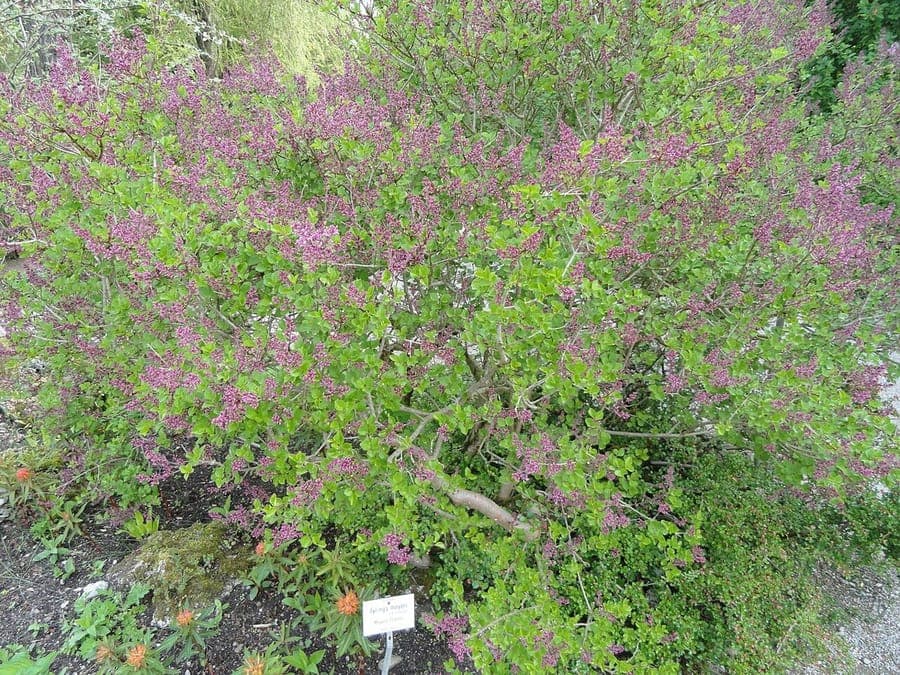
Daderot / Public domain, via Wikimedia Commons
Meyer lilac: complete guide
Syringa meyeri
Want to see Meyer lilac: complete guide in your garden?
Full design in HD: €7.99
Look after your Meyer lilac with the GardenWorld app
Identify plants with your camera and get a care calendar with reminders for this plant.


Overview
Meyer lilac (Syringa meyeri) is the lilac for gardens that simply have no room for the real thing. Common lilac (Syringa vulgaris) eventually becomes a suckering, tree-like shrub of four metres or more, whereas this species stays low, rounded and densely branched. Expect a mature height of 1 to 1.5 metres with a similar spread, which makes it a natural fit for small town gardens, front gardens, mixed borders and even large containers on a patio.
The plant is named after Frank Meyer, a Dutch-born plant explorer working for the United States Department of Agriculture, who found it growing in a garden near Beijing in 1908. It has never been reliably recorded in the wild, so every plant in cultivation traces back to gardens in northern China. Most nurseries sell the cultivar 'Palibin', sometimes labelled Syringa palibiniana or dwarf Korean lilac. 'Palibin' is the best-selling compact lilac in Europe: low, wide, generous with its flowers and remarkably tough. A handful of newer selections offer slightly different colours or a longer flowering season, but 'Palibin' remains the benchmark.
If you are unsure where a Meyer lilac would look best in your own plot, you can have a garden design drawn up on gardenworld.app that takes your space, light and existing plants into account.
Appearance and bloom cycle
For a lilac, the leaves are small: oval to almost round, 2 to 4 cm long, fresh green and slightly glossy on top. The result is a finer, calmer texture than the large heart-shaped foliage of common lilac. The twigs are numerous and slender, building a dense, domed crown that stays clothed to the ground.
Flowering starts in May, usually a week or two after common lilac, and lasts around three weeks. The panicles are only 5 to 10 cm long, but they appear in such numbers that the whole shrub turns lilac-pink. In bud they are deep purplish red; once open they soften to a pale lilac-pink. The scent is sweet and slightly spicy, lighter than that of the classic lilac yet clearly noticeable on a warm evening. Bees, bumblebees and butterflies visit the flowers readily.
A welcome trait of Syringa meyeri is its habit of producing a second, smaller flush of flowers in August or September after a warm summer. It is never as lavish as the spring display, but it is a pleasant bonus. Autumn colour is modest, with leaves sometimes turning yellowish or bronze before they drop. Small brown seed capsules follow the flowers and have little ornamental value.
As far as is known, Meyer lilac is not toxic to people, dogs or cats. Lilacs do not appear on the usual lists of poisonous garden plants, so it is a safe choice for family gardens.
Ideal location
Full sun gives the best flowering. Six hours of direct sun a day or more is ideal; in light shade it still flowers reasonably well, but in deep shade you mainly get leaves. Because it shrugs off cold, it does not need a sheltered spot. An open, airy position is actually better, as good air movement keeps powdery mildew at bay, although this species is far less prone to it than common lilac.
Its compact shape makes it very versatile. Use it in a mixed border among perennials, as a specimen in a gravel garden, as a low informal hedge beside a path or as a focal point by the front door. For a hedge, space plants 60 to 80 cm apart. In a container of at least 40 litres with a good drainage layer it will thrive for years. It is also widely sold as a standard, a neat ball on a stem of 80 to 120 cm, which suits a formal patio or a small front garden very well.
Soil requirements
Lilacs are not fussy, and Syringa meyeri is no exception. Any ordinary garden soil will do, provided water drains away freely. Sand, loam and lighter clay are all suitable. A pH between 6 and 7.5 is ideal; it is perfectly happy on chalk and limestone, a little less so on very acidic soil.
What it will not tolerate is waterlogging. On heavy clay that stays saturated in winter, mix coarse grit into the planting hole. Dig a hole twice as wide as the root ball and blend the excavated soil with a few spadefuls of garden compost. Rich feeding is unnecessary: fertile soil produces long, soft shoots and fewer flowers. A handful of organic slow-release fertiliser in March is plenty.
Free preview
Want to see Meyer lilac: complete guide in your garden? Make a free preview of your design.
Watering
The first year after planting matters most. During dry spells, give each plant a full watering can, roughly 10 litres, once or twice a week so the roots grow deep. A 5 cm mulch of compost or bark keeps the soil cool and moist.
Once established, Meyer lilac copes well with drought. In a typical north-west European summer it needs no extra water at all. Only during a long dry spell of three weeks or more, and especially in the weeks before and during flowering, is a thorough soak worthwhile. Container plants are a different matter and may need water daily in summer. Check with a finger whether the top few centimetres are dry, and never leave water standing in the saucer.
Pruning
Pruning is straightforward as long as you get the timing right. Next year's flower buds form during summer, so prune immediately after flowering, in June. Pruning in autumn or winter removes the following spring's flowers.
Snip off the faded panicles just above a pair of leaves; this keeps the shrub tidy and often encourages the late-summer repeat. To adjust the shape, shorten the longest shoots by a third. Older shrubs of ten years or more can be rejuvenated by cutting one or two of the oldest stems to near ground level each year. Keep a standard in shape by lightly clipping the head all round after flowering, and remove any shoots appearing on the stem or below the graft.
Maintenance calendar
March: Scatter organic fertiliser around the base. Plant new shrubs in open ground while the soil is not frozen.
April: Top up the mulch. Check containers for dryness as the days lengthen.
May: Peak flowering. Water during dry weather.
June: Prune straight after flowering: remove spent panicles and shorten overlong shoots.
July–August: Water during prolonged drought, particularly in pots. After a warm summer the first repeat flowers may appear.
September–October: Repeat flowering. Good months to plant container-grown or root-balled shrubs.
November–February: Dormancy. No pruning. Make sure pots are not standing in water.
Winter hardiness
Syringa meyeri is exceptionally hardy and survives temperatures of -30 °C and below without trouble, equivalent to USDA zones 3 to 4. Anywhere in Britain, Ireland and the Low Countries it needs no winter protection in open ground. The flower buds tolerate an ordinary April night frost, although a hard frost while the buds are opening can cost part of the display.
Roots in a container are more exposed than roots in the ground. A large, thick-walled pot is usually sufficient; during a prolonged hard freeze you can wrap it in hessian or bubble wrap, or move it against a house wall. Even here, wet is a bigger threat than cold, so raise the pot on feet to keep the drainage hole clear.
Companion plants
Because Meyer lilac stays low, it can sit at the front or middle of a border. A classic pairing is with ornamental onion: Allium hollandicum flowers at the same time, and its purple drumsticks look superb against the lilac panicles. Peonies (Paeonia lactiflora) follow on just afterwards and fill the border once the lilac has finished.
At its feet, ground-covering perennials such as Geranium macrorrhizum and lady's mantle (Alchemilla mollis) work very well. They keep the soil covered, tolerate some drought and provide a calm green base. For a romantic look, combine it with Rosa rugosa or with lavender along a path. If you need more height behind it, plant a common lilac or a Japanese snowball (Viburnum plicatum).
Final thoughts
Syringa meyeri brings everything people love about lilac, the mass of flowers and the sweet scent, to gardens where a big shrub would never fit. It is tough, takes frost and drought in its stride, needs little pruning and stays compact on its own. Follow the one simple rule of pruning only after flowering and you will be rewarded each spring with a shrub smothered in lilac-pink panicles, and often a second round in late summer.
Not sure when each job is due? The plant calendar on gardenworld.app lists the monthly tasks for your lilacs and every other plant in your garden.
Frequently asked questions about Meyer lilac
Is Meyer lilac winter hardy?
Syringa meyeri is exceptionally hardy and survives temperatures of -30 °C and below without trouble, equivalent to USDA zones 3 to 4. Anywhere in Britain, Ireland and the Low Countries it needs no winter protection in open ground.
When and how do you prune Meyer lilac?
Pruning is straightforward as long as you get the timing right. Next year's flower buds form during summer, so prune immediately after flowering, in June.
How much water does Meyer lilac need?
The first year after planting matters most. During dry spells, give each plant a full watering can, roughly 10 litres, once or twice a week so the roots grow deep.
Where does Meyer lilac grow best?
Full sun gives the best flowering. Six hours of direct sun a day or more is ideal; in light shade it still flowers reasonably well, but in deep shade you mainly get leaves.
What soil does Meyer lilac need?
Lilacs are not fussy, and Syringa meyeri is no exception. Any ordinary garden soil will do, provided water drains away freely.

See it in your garden
See Meyer lilac in your garden
One photo of your garden and a few questions. You see the result in about a minute.
Try it with a photoIdentify this plant in your own garden. Identify a plant
Similar plants
Common Lilac: complete guide
Syringa vulgaris
Everything about Common Lilac (Syringa vulgaris): planting, pruning, care and propagation. Practical tips for abundant, fragrant May blooms.
Persian onion: complete guide
Allium hollandicum
Persian onion (Allium hollandicum) blooms with striking purple spherical flower heads. Learn how to grow this spectacular bulb plant and enjoy its dramatic spring display.
Garden peony: complete guide
Paeonia lactiflora
Everything about the garden peony (Paeonia lactiflora): planting depth, fragrant blooms, cultivars and long-term care. Expert tips for flowers that last a lifetime.
