
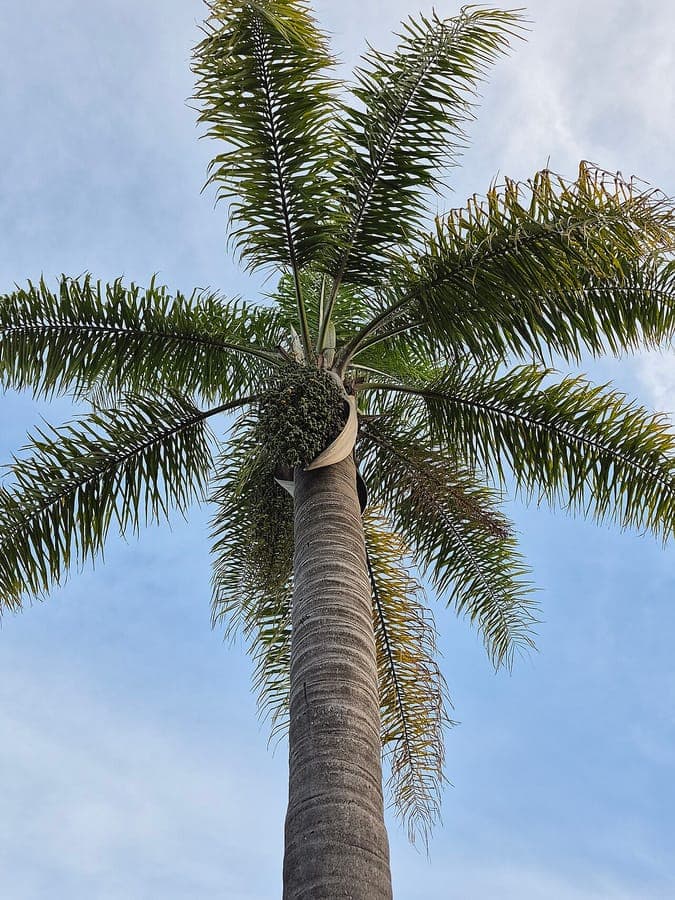
Bageense / CC BY-SA 4.0, via Wikimedia Commons
Queen Palm: complete guide
Syagrus romanzoffiana
Want to see Queen Palm: complete guide in your garden?
1 minute, no credit card
Overview
Syagrus romanzoffiana, commonly called queen palm or giriba palm, is one of the most planted and admired palms in mild-warm climates worldwide. Native to southeastern and central Brazil, this slender, elegant palm reaches 10 to 15 meters tall and forms a spectacular crown of gracefully arching, feathery fronds. Its rapid growth makes it beloved in landscaping throughout subtropical regions.
Appearance and Bloom
The queen palm develops a straight, light gray trunk adorned with leaf-scar patterns. The crown consists of long, double-pinnate leaves that arch gracefully downward, lending the tree elegance and refinement. Each frond may reach 2 to 3 meters long. Flowers appear in large, yellowish-white flower clusters with subtle fragrance attracting many bees. Fruit follows in late summer through fall, producing small orange-red drupes resembling large berries, highly favored by birds and wildlife.
Ideal Location
Syagrus romanzoffiana prefers full sun, though showing shade tolerance in extremely hot climates. Plant in open locations with unobstructed sky exposure. The tree excels along coastal areas due to exceptional salt and wind tolerance. In high-wind regions, provide light wind protection against severe storms to prevent trunk or frond damage.
Soil
The queen palm grows in virtually all soil types provided drainage exists. It thrives best on well-draining, sandy-to-loamy substrates. Swampy or permanently wet conditions prove serious problems, causing root rot. A pH range of 6.0 to 7.5 is ideal. When planting in heavy clay, amend with sharp sand and organic matter to improve drainage.
Watering
Once established, Syagrus romanzoffiana proves quite drought tolerant and flourishes with natural rainfall in subtropical areas. Young palms, however, require regular watering during the first and second growing seasons. Water deeply but infrequently; this encourages deeper rooting. Weekly watering typically suffices unless exceptional heat or drought occurs. Avoid waterlogging.
Free design
Want to see Queen Palm: complete guide in your garden? Make a free design now.
Pruning
Pruning is minimal for this naturally elegant palm. Remove only dead fronds and desiccated flower clusters. Removing healthy green fronds halts nutrition to trunk thickening. Allow dead fronds to remain until naturally dropped; this adds characteristic texture and wildlife habitat. Young plants may be lightly pruned to encourage branching.
Maintenance Calendar
Spring: growth period begins; regular feeding and watering. Summer: continue feeding; water during droughts. Fall: reduce feeding; collect seed if desired. Winter: minimal maintenance in non-tropical zones; protect from cold.
Winter Hardiness
Syagrus romanzoffiana tolerates brief frost periods but cannot withstand severe winters. In zones 9b-11, it grows outdoors permanently. In zone 9a and colder, plant in containers and move to protection during winter. Temperatures below negative 5 degrees Celsius cause frond damage and potential death of young material.
Companion Plants
The queen palm pairs beautifully with other subtropical plants. Underplanting with Ophiopogon, Liriope, and fine-textured plants creates elegant contrast. Traditional Brazilian gardens combine it with Butia capitata (yellow palm) and other native palms.
Closing Thoughts
Syagrus romanzoffiana is an excellent choice for subtropical and warm temperate gardens. Its elegance, rapid growth, and relatively low maintenance make it extremely popular. Many nurseries in warm zones offer young specimens. Visit local garden centers or online suppliers. Discover more about palm gardens and tropical architecture at gardenworld.app. This regal palm will add structure and elegance to your landscape for decades. Learn more about sustainable palm trees at gardenworld.app.
Want to see Queen Palm: complete guide in your garden? Make a free design now.
Upload a photo, pick a style, and get a photorealistic design with plant list in under a minute.
No credit card required


Similar plants
Needle palm: complete guide
Rhapidophyllum hystrix
Everything about the needle palm: the world's hardiest palm, suitable for gardens in temperate climates down to USDA zone 7b.
Saw palmetto: complete guide
Serenoa repens
A complete guide to saw palmetto (Serenoa repens), the iconic fan palm from Florida and the southeastern United States, prized for its toughness.
Puerto Rican hat palm: complete guide
Sabal causiarum
Grow Puerto Rican hat palm successfully. A majestic fan palm with tropical presence suited to sheltered Mediterranean-style gardens.