
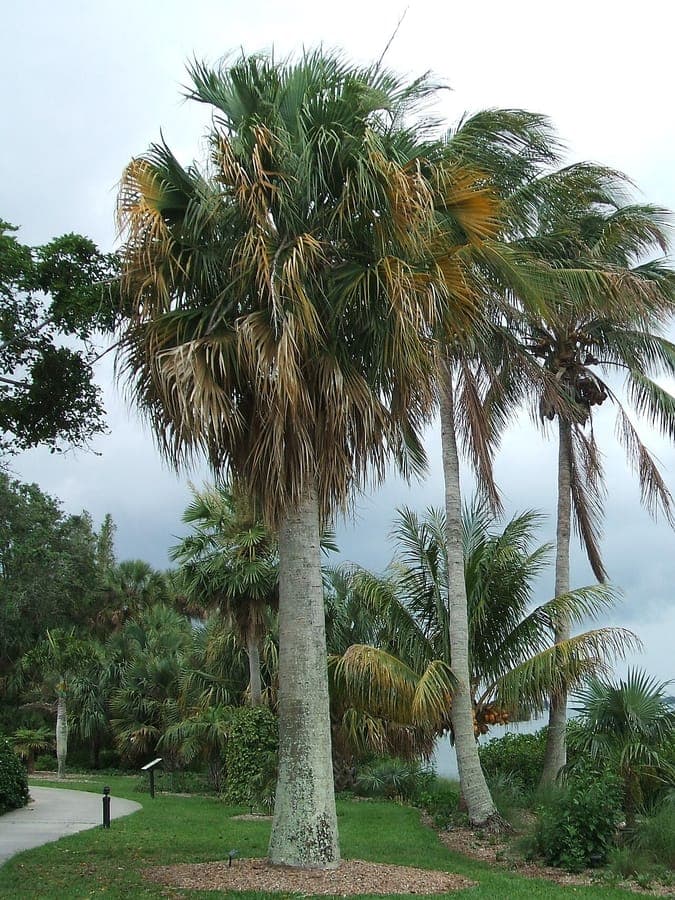
Guettarda / CC BY-SA 3.0, via Wikimedia Commons
Puerto Rican hat palm: complete guide
Sabal causiarum
Want to see Puerto Rican hat palm: complete guide in your garden?
1 minute, no credit card
Overview
The Puerto Rican hat palm (Sabal causiarum) is one of the most impressive members of the Arecaceae family. Native to Hispaniola (Haiti and the Dominican Republic), Puerto Rico, and the Leeward Islands in the Caribbean, it was scientifically described in 1907 by botanist Beccari, drawing on earlier collections by O.F. Cook. The species name causiarum refers to a broad, flat Macedonian hat - the causia - alluding to the wide, fan-shaped leaf blades that characterise this species.
Sabal causiarum belongs to the genus Sabal, which contains around 16 species distributed from the Bahamas and the Caribbean through the southeastern United States to Mexico. It is a classic single-stemmed palm that grows slowly erect and in nature reaches 15 to 25 metres in height, though in cultivation in temperate regions it typically remains between 5 and 12 metres. The trunk displays the characteristic rough, sculpted appearance left by the persistent bases of fallen leaf stalks - a distinctive identification feature of the genus.
The species is widely regarded as one of the hardier representatives of the Sabal genus and is increasingly planted in Europe as a specimen tree in Mediterranean-style gardens, subtropical theme gardens, and large private gardens with warm, sheltered corners. In the warm south of Spain, Portugal, and Italy it has grown outdoors for decades. In the Netherlands and Belgium it can be cultivated in sheltered urban gardens that benefit from the heat-storage of buildings and walls. At gardenworld.app you can find inspiration for Mediterranean garden designs in which palms like Sabal causiarum take centre stage.
In its Caribbean homeland the palm grows on a wide range of soils: calcareous coastal sands, clayey lowland areas, and stony hillsides. In Puerto Rico and Hispaniola it has been used for centuries: the leaves for thatching huts, the young leaves for weaving hats (hence the name causiarum), and the trunk as a source of fibre and palm hearts.
Appearance & bloom cycle
Sabal causiarum is an impressive, erect palm with a grey-green to grey-brown trunk. The trunk is columnar, 25 to 50 cm in diameter at maturity, and displays a distinctive cross-hatched pattern left by persistent leaf base remnants. On older specimens this pattern gradually weathers away, leaving the trunk smooth or lightly furrowed.
The leaves are large, rounded fan leaves - palmate in botanical terms - reaching 1.5 to 2.5 metres in diameter. They are light green on the upper surface and grey-green below. The leaf stalks are long, up to 2 metres, and unarmed (without teeth), which distinguishes Sabal palms from the closely related Washingtonia palms that carry toothed petioles. The leaf segments are deeply divided and hang slightly downward, giving the palm an elegant, graceful silhouette.
The flower cluster is a large, branched panicle that unfolds from between the leaves and can reach 2 to 3 metres in length. The individual flowers are small, cream-white, and carry a sweet, subtle fragrance that attracts bees and other pollinators. After pollination, fruits ripen into round, deep-black berries of 1 to 1.5 cm diameter. The glossy black fruits are decoratively attractive on the drooping fruiting branches.
Growth rate for Sabal causiarum is slow compared to faster-growing palms such as Washingtonia robusta. In cultivation, once well established, expect roughly 15 to 30 cm of trunk growth per year. Young plants invest energy in root development before visible trunk growth begins, which can create a seemingly stationary establishment period of two to five years after planting.
Ideal location
Sabal causiarum is in its natural habitat a full-sun palm that tolerates very little shade. In European and other temperate climates, a full-sun position is therefore the first requirement. The palm does best in a heat-retaining location: against a south-facing wall, in an enclosed courtyard, on a terrace, or in another sheltered spot that accumulates solar warmth and reduces night cold.
In urban gardens in the Netherlands and Belgium, walls and paving are valuable allies: they absorb warmth during the day and release it gradually at night, noticeably improving the microclimate around the palm. A distance of 50 to 100 cm from a south- or west-facing wall radiating heat is ideal. Avoid north-facing and shaded positions entirely.
The palm is also sensitive to sharp wind, particularly when young. Windbreaks in the form of walls, hedges, or other large plants surrounding the palm protect young leaves from discolouration and damage from cold easterly winds in winter.
When designing a Mediterranean or subtropical outdoor space, the Puerto Rican hat palm is a powerful specimen that immediately conveys a tropical atmosphere. At gardenworld.app you can commission a garden design that optimises the positioning of your palm within your specific garden conditions.
Spacing for multiple specimens: a minimum of 4 to 6 metres between individuals, since the leaves of mature trees can span 3 to 4 metres across.
Soil requirements
Sabal causiarum is an adaptable tree that in its Caribbean homeland grows on a very wide range of soils: from calcareous, stony coastal sands to heavy clay loam in lowlands. This tolerance is one of the strengths of the species for European use.
In the garden, the palm requires well-draining soil to prevent root rot, since standing water is one of the most dangerous threats to the palm in temperate climates. The ideal pH range is 6.0 to 8.0: the palm tolerates both slightly acidic and alkaline, calcium-rich soils equally well.
When planting in heavy clay soil, a generous planting hole of at least 80 by 80 by 80 cm is recommended, backfilled with a mixture of 50 percent garden soil, 30 percent coarse sand, and 20 percent mature compost. This blend guarantees good drainage while maintaining adequate nutrition. On sandy soil, adding compost is the main amendment needed.
Feeding requirements for Sabal causiarum are relatively modest compared to fast-growing palms. A slow-release fertiliser with a potassium- and magnesium-rich NPK ratio, such as a specialist palm fertiliser, applied monthly to bimonthly from April to September, supports healthy development. Magnesium deficiency shows up as yellowing of the margins of older fronds and can be corrected with Epsom salt (magnesium sulphate) as a foliar feed.
For container-grown younger palms, a clay-based palm compost with good drainage granules and a layer of coarse grit at the base of the pot prevents waterlogging.
Watering
The Puerto Rican hat palm in its native habitat is accustomed to tropical summers with high rainfall but also to distinct dry periods. In the European garden this translates most practically as: generous watering in summer, moderate in autumn, and keeping the root zone as dry as practical in winter.
During the active growth period from May to August, water the palm thoroughly once per week: enough water to saturate the soil to 30 cm depth. In hot, dry summers this may need increasing to twice per week, particularly for young specimens and container-grown plants. Tap water is fine; preferably use water at ambient temperature and avoid very cold tap water on hot summer days, as this can cause thermal shock to the root zone.
From September to November, gradually reduce watering: once every two weeks is sufficient in normal autumn conditions. In winter, from December to March, minimal watering is the rule: only when the soil has completely dried to 15 cm depth should a small quantity of water be applied. The root zone should never remain wet for prolonged periods in winter, as this is the primary cause of root rot and basal stem rot in palms in temperate climates.
For container palms, drainage is absolutely critical: always use pots with generous drainage holes and a layer of coarse grit or pot shards at the base. After heavy rainfall, check that water is draining freely.
Free design
Want to see Puerto Rican hat palm: complete guide in your garden? Make a free design now.
Pruning
Sabal causiarum requires minimal pruning work. The main pruning task is removing dead or damaged fronds. Key guidelines are:
Never remove green or still light-green fronds, as these are still photosynthetically active and supply energy to the root system. Remove only fully brown, dead fronds. The petiole stubs left after cutting remain on the trunk; leave these stubs as long as possible, as they protect the trunk and contribute to the characteristic sculpted trunk texture that makes Sabal palms so distinctive. Over multiple years the stubs gradually weather away naturally.
Remove flower clusters after bloom if you wish to limit fruit set, but again only once the flower stalk is fully dry and brown. Cutting through still-green trunk tissue introduces infection risk.
Always use sharp, disinfected tools for pruning work. A clean pruning saw or sharp blade, disinfected with 70% alcohol, significantly reduces the risk of transmitting fungal or bacterial pathogens.
Palm fronds are large and heavy: wear sturdy gloves when pruning, as broken petioles can have sharp edges. For tall specimens, professional pruning by a tree surgeon with climbing equipment is recommended for safety.
Maintenance calendar
January and February: Winter dormancy. Minimal watering, only if the soil has dried completely. Check for root rot or basal decay if moisture damage is present. Protect the growing crown with hessian or fleece when temperatures fall below minus 8 degrees Celsius. In severe winters, additional wrapping of the trunk with insulating material provides extra protection.
March: Recovery begins. Remove winter protection carefully once night temperatures are reliably above freezing. First watering of the season. Apply a layer of slow-release palm fertiliser around the base of the palm.
April: First new growth visible. Begin monthly fertilisation. Check whether the growing crown (the centrally positioned, still-closed leaf spear) shows any winter damage.
May and June: Active growth period. Weekly watering and monthly fertilisation. Remove any winter-damaged fronds that are now fully brown. Check for pests such as red spider mite during dry spells.
July and August: Hottest months; highest water demand. In prolonged drought, water twice per week. Apply a 10 cm mulch layer to shade the root zone and retain moisture.
September: Start of the wind-down phase. Reduce fertilisation. Reduce watering to once every two weeks. Harvest ripe fruit clusters if desired for decorative use.
October and November: Further reduction in watering. Remove fully dead fronds. Apply a protective mulch layer of 10 to 15 cm around the trunk base to insulate roots for winter.
December: Provide crown protection when frost periods are forecast. Minimal watering.
Winter hardiness
Sabal causiarum is regarded as one of the hardier species in the Sabal genus. Mature specimens tolerate brief frost periods down to minus 8 to minus 10 degrees Celsius without lasting damage. At lower temperatures of minus 12 to minus 15 degrees Celsius the palm can survive, but outer fronds will be damaged or killed; the growing crown typically remains intact provided the frost is not excessively prolonged.
In USDA terms Sabal causiarum is categorised as zones 9a to 11, but in sheltered microclimates in Western Europe there are positive experiences with the palm in zone 8b (minus 9 to minus 12 degrees Celsius) with good winter protection management.
The core principle for success in temperate climates is: a dry root zone is more effective protection than a warm root zone. A palm that is cold but dry overwinters better than one that is somewhat warmer but persistently wet. Winter protection therefore must always combine crown insulation with measures to limit moisture exposure of the root zone.
In the Netherlands and Belgium, Sabal causiarum is best suited to sheltered urban gardens, enclosed courtyards, and covered terraces, as well as to southern and coastal regions. In northern areas, overwintering in a cool but frost-free structure - a greenhouse, conservatory, or cold frame - is the safest approach for valued specimens.
For further winter hardiness information and garden planning support for a Mediterranean palm garden, gardenworld.app offers comprehensive assistance via its personalised garden design service.
Companion plants
The Puerto Rican hat palm combines best with other Mediterranean, subtropical, and warmth-loving plants that share the same requirements for sun and drainage:
- Agave americana (century plant): an impressive rosette plant that pairs excellently with the vertical profile of the palm. Both are drought-tolerant and heat-loving. Plant 1.5 to 2 metres from the trunk.
- Cordyline australis (New Zealand cabbage tree): a graceful plant with narrow, upright leaves that offers a fine textural contrast next to the broad fan leaves of the Sabal. Available from specialist garden centres.
- Lavandula dentata (fringed lavender): a low, grey-leaved plant that works well as a low edge planting around the base of the palm. The grey colour complements the grey-green fronds of the palm.
- Phormium tenax (New Zealand flax): provides strong vertical lines and rich texture as a border planting around the palm. Bronze or reddish-brown cultivars such as 'Purpureum' add an elegant colour accent.
- Olea europaea (olive tree): a perfect companion in a Mediterranean-style garden. Both plants are warmth-loving, drought-tolerant, and share a Mediterranean aesthetic. Allow a minimum of 3 to 4 metres between them.
- Yucca gloriosa (Spanish dagger): a spiky, ornamental plant that works well as a contrast beside the softer fan leaves of the Sabal. Hardy to USDA zone 7, making it particularly suitable for temperate European gardens.
Avoid combining with moisture-loving plants such as hostas, astilbes, and bog-garden shrubs that require perpetually moist soils incompatible with the drainage requirements of the palm.
Closing
The Puerto Rican hat palm (Sabal causiarum) is a majestic palm with a powerful tropical presence that, with the right site choice and winter protection, can be successfully grown even in temperate European climates. Its broad fan leaves, imposing trunk, and elegant flower clusters make it an outstanding specimen plant for Mediterranean gardens, urban courtyards, and large terraces.
The key to success lies in combining maximum sun exposure, excellent drainage, restrained winter watering, and crown protection during hard frosts. Gardeners who respect these fundamentals will enjoy a long-lasting and impressive addition to their outdoor space.
Visit gardenworld.app for a personalised garden design featuring Mediterranean palms and complementary tropical planting schemes. More plant inspiration and garden ideas are available at gardenworld.app.
Want to see Puerto Rican hat palm: complete guide in your garden? Make a free design now.
Upload a photo, pick a style, and get a photorealistic design with plant list in under a minute.
10,000+ gardens designed already
No credit card required


Similar plants
Needle palm: complete guide
Rhapidophyllum hystrix
Everything about the needle palm: the world's hardiest palm, suitable for gardens in temperate climates down to USDA zone 7b.
Saw palmetto: complete guide
Serenoa repens
A complete guide to saw palmetto (Serenoa repens), the iconic fan palm from Florida and the southeastern United States, prized for its toughness.
Lipstick palm: complete guide
Cyrtostachys renda
Discover how to care for the gorgeous Lipstick palm (Cyrtostachys renda). Tips for cultivation, watering and winter protection of this tropical palm.