
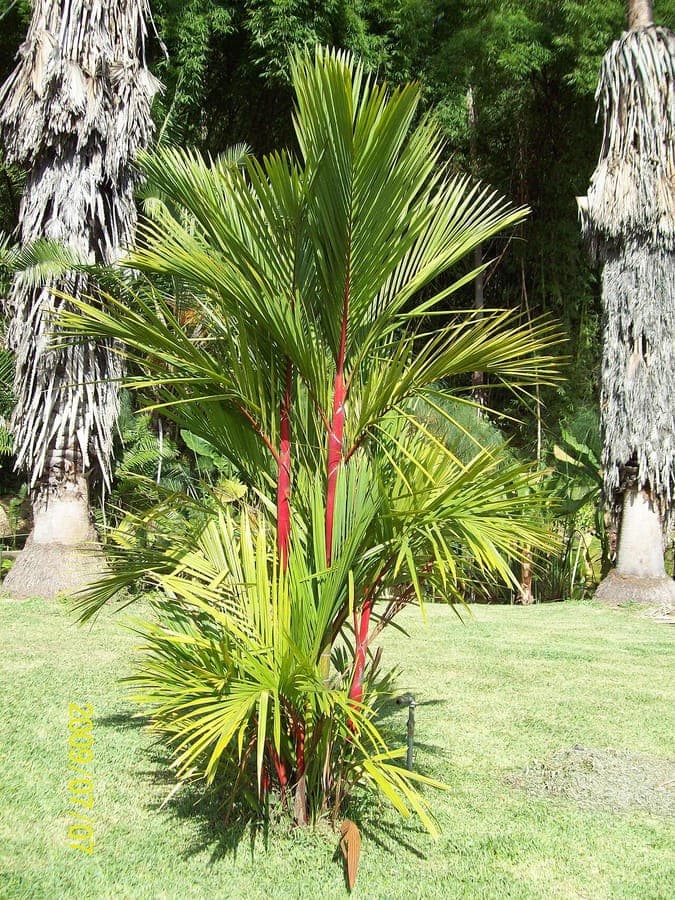
Danielrengelm / CC BY-SA 4.0, via Wikimedia Commons
Lipstick palm: complete guide
Cyrtostachys renda
Want to see Lipstick palm: complete guide in your garden?
1 minute, no credit card
Overview
The Lipstick palm (Cyrtostachys renda), also known as Sealing wax palm, Red seal wax palm, or Maharajah palm, is one of the most striking and elegant palm species in the world. This beautiful palm originates from the rainforest areas of Thailand, Malaysia, Borneo, and Sumatra. The name refers to the intense red to orange-red color of the sheath under the leaves and the leaf stems. This characteristic red color truly resembles women's lipstick, hence the poetic name. In their natural habitat, these palms can grow up to 12 meters tall, although they remain much smaller in households. This is a plant that truly transforms every interior with its tropical beauty and elegant presence.
Appearance and Growth
The Lipstick palm reaches usually 1.5 to 3 meters height in households, but can grow larger under ideal greenhouse conditions. The leaves are large, feathery, and dark green, with finely serrated leaf edges that arc gracefully downward. The most characteristic feature is the red to deep orange-red color of the leaf stems (petioles) and the lip-shaped sheath under the leaves. The naming refers to this characteristic red women's lipstick color. This color is particularly intense on young leaves. The stems themselves are thin and sensitive to breaking, requiring careful handling. Mature plants can form stunning displays with elegant arching leaves that create a tropical ambiance.
Ideal Growing Location
The Lipstick palm appreciates bright, filtered indirect light conditions best. This can best be achieved by placing the plant several meters from a large, east or north-facing window. Direct sunlight can scorch the leaves, especially during the summer season when the sun is stronger. In tropical climates, this palm can also grow outdoors in partial shade under larger trees. Choose a protected location where strong winds or storms cannot directly hit, as the thinner stems can break easily. Ideal locations also have some humidity level due to proximity to water or other green plants. Avoid placement near heating vents or air conditioning units that create dry air.
Soil Composition
The type of soil is crucial for success. Use a moisture-retaining but well-draining potting soil with the addition of coconut fiber or peat moss, processed humus, and about 20% coarse bark or perlite. A pH of 5.5 to 6.5 is ideal. Ensure good drainage by making sure the pot hole is sufficiently large. The plant feels most comfortable in somewhat moist soil, so do not be afraid of regular watering. Some growers also add some orchid bark for extra structure and aeration. Repotting every two to three years helps keep the palm healthy. A pot that is slightly tight helps promote better growth compared to an oversized one.
Free design
Want to see Lipstick palm: complete guide in your garden? Make a free design now.
Watering
Watering must be regular and consistent. During the growing season, the soil should be constantly moist but not drenched. In winter, you can reduce watering slightly, but never let the soil completely dry out. Use lukewarm water and prefer rainwater or distilled water to prevent mineral buildup. Water about 2 to 3 times per week in summer, 1 to 2 times per week in winter depending on conditions. Monitor moisture levels with your finger or use a moisture meter. Too much water can cause root rot, especially in the roots. Ensure the pot has adequate drainage holes.
Pruning
Pruning is generally minimal for the Lipstick palm. Only remove dead or seriously damaged leaves when they become yellow or brown. Cut dead leaves off when they fall from the plant. Careful handling of the tender stems is essential, as breaks do not heal well and can cause permanent damage. Clean the plant regularly with a soft damp cloth to remove dust accumulation on the leaves, which improves photosynthesis. Avoid using leaf shine products which can be harmful to palms. Never use harsh chemicals or abrasive cloths on delicate fronds.
Maintenance Calendar
Spring: Begin with monthly applications of diluted plant food. Repot in a larger pot if needed (normally every 2-3 years). Check for spider mites. Summer: Maintain high moisture levels. Keep leaves clean. Feed monthly. Fall: Begin gradually reducing moisture and fertilizer. Winter: Reduce water and feeding significantly. Keep temperature above 15 degrees Celsius. This is the resting period for the plant.
Winter Hardiness
The Lipstick palm is not hardy in temperate climates. In zones below 9, you must keep this plant indoors or protect it carefully against frost. Ideal growing conditions are between 18 and 28 degrees Celsius. If temperatures drop below 10 degrees Celsius, the plant will suffer and growth will stop. In tropical areas, this palm can grow outdoors year-round without protection. For potted plants, it is important to maintain consistently warm conditions. Avoid sudden temperature fluctuations that can cause leaf drop.
Companion Plants
The Lipstick palm grows wonderfully in combination with other tropical foliage plants. Ideal companions are Anthurium, Spathiphyllum, Rhaphidophora, Rhaphidophora tetrasperma, and understory Alocasia species. Together they create a true jungle atmosphere at home. For larger spaces, you can also add Monstera or Ficus species. The red tint of the palm creates a beautiful contrast with the green foliage of other plants. This creates a dynamic and naturally appearing composition in your room.
Conclusion
The Lipstick palm from gardenworld.app brings true tropical luxury to your home or front garden. With consistent moisture management, warmth, and indirect lighting, you create the perfect environment for this beautiful palm. This plant is ideal for those who want to experience the glamour of the tropics without having to travel abroad. Visit gardenworld.app for more plant care tips and inspiration for creating your own tropical paradise.
Want to see Lipstick palm: complete guide in your garden? Make a free design now.
Upload a photo, pick a style, and get a photorealistic design with plant list in under a minute.
No credit card required


Similar plants
Needle palm: complete guide
Rhapidophyllum hystrix
Everything about the needle palm: the world's hardiest palm, suitable for gardens in temperate climates down to USDA zone 7b.
Saw palmetto: complete guide
Serenoa repens
A complete guide to saw palmetto (Serenoa repens), the iconic fan palm from Florida and the southeastern United States, prized for its toughness.
Puerto Rican hat palm: complete guide
Sabal causiarum
Grow Puerto Rican hat palm successfully. A majestic fan palm with tropical presence suited to sheltered Mediterranean-style gardens.