
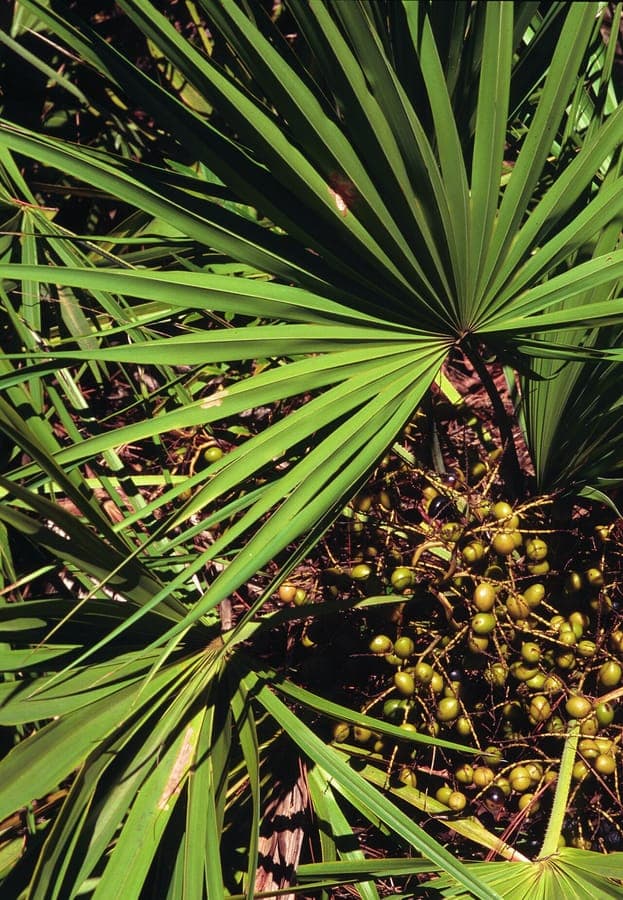
Ted Bodner, Southern Weed Science Society, United States / CC BY 3.0 us, via Wikimedia Commons
Saw palmetto: complete guide
Serenoa repens
Want to see Saw palmetto: complete guide in your garden?
1 minute, no credit card
Overview
Saw palmetto (Serenoa repens) is the sole species in the genus Serenoa and one of the most ecologically significant plants of the southeastern United States. It is native to Florida, Georgia, Alabama, Mississippi, Louisiana, and South Carolina, where it forms vast, dense thickets across coastal plains, sand scrub, pine flatwoods, and marsh edges. The common name refers to the sharply serrated leaf stalks, which can lacerate skin and clothing when walked through - a memorable feature of the Florida wilderness.
As a garden plant, saw palmetto has much to offer beyond its rugged reputation. It is one of the hardiest fan palms available for temperate gardens, surviving temperatures down to approximately -12 to -15 degrees Celsius in short bursts when well established. It is slow-growing to the point of being almost geological in pace, but this makes it a low-maintenance, long-lived structural plant that can anchor a garden planting for decades. Some wild specimens have been estimated at 700 years of age.
The plant is also world-famous as a medicinal herb. The berries have been used by Native American peoples of the Southeast for centuries, and commercial saw palmetto extract is today one of the most widely sold botanical supplements globally. For ideas on incorporating architectural palms into a garden design, visit gardenworld.app.
Appearance and bloom cycle
Serenoa repens is a clump-forming, multi-stemmed fan palm. In the wild its stems are most commonly prostrate or low-creeping, though in more sheltered, moister conditions erect stems of 3-5 metres do occur. In cultivation it remains much more compact: after ten years a young plant may be only 60-100 cm tall, and most garden specimens stay between 1.5 and 2.5 metres in height at maturity, with a spread of 1.5-3 metres.
The fan-shaped leaves are the plant's most striking feature. They measure 60-90 cm across and are carried on stiff stalks edged with fine, sharp teeth. The leaf colour is typically mid-green, but there is a blue-grey foliage form (sometimes listed as Serenoa repens f. glauca) that is particularly sought after as an ornamental for its striking silvery-blue tone. The leaf texture is coarse and the fronds are fairly stiff and wind-resistant.
Flowering occurs in early spring to early summer - in Florida typically February to April. Clusters of small, creamy-white, fragrant flowers are borne on branched stalks 50-90 cm long that emerge from among the leaf bases. They are excellent for pollinators, attracting bees, butterflies, and other insects in large numbers. The fruit that follows is a small, olive-shaped drupe, 1-2 cm long, ripening from green to black, and much prized both by wildlife and by the herbal supplement industry.
Ideal location
Full sun is the preferred exposure for saw palmetto. It will tolerate light shade but this produces looser growth, less intense leaf colour, and reduces flowering. In its natural range it occupies open, exposed sites where it receives uninterrupted sunshine for most of the day. In a garden context, the sunniest, most sheltered spot is best - a south-facing wall or fence provides both maximum light and some frost protection.
The plant tolerates coastal conditions well, including wind and salt spray, making it an excellent choice for gardens near the sea. It can be grown in a large container on a terrace or patio, though the already slow growth rate is further reduced in a pot due to restricted root space. Container growing does have the advantage of allowing the plant to be moved under cover during the coldest spells.
In the United Kingdom, the Netherlands, and Belgium, a sheltered microclimate is important for reliable outdoor cultivation. The mildest coastal areas of western Europe offer the best conditions for year-round outdoor planting. Inland gardens in colder areas should plan for occasional winter protection.
Soil
Saw palmetto is a notably unfussy plant when it comes to soil. In the wild it colonises extremely poor, acidic sand with pH values ranging from 4.5 to 7.5. It tolerates sandy loam, light clay, peaty sand, and even briefly waterlogged conditions, provided there is no prolonged standing water. Its extensive, deeply penetrating root system allows it to access moisture and nutrients far below the surface.
In a garden, standard, free-draining soil of moderate fertility is perfectly adequate. Rich, heavily fertilised ground is unnecessary and can actually be counterproductive, encouraging soft, fast growth that is more susceptible to cold damage. On heavy clay, incorporating horticultural grit or coarse sand before planting will improve drainage and reduce the risk of root problems in wet winters.
A light annual feed with a balanced palm fertiliser in spring supports steady growth without forcing unnaturally rapid development. Avoid high-nitrogen fertilisers in late summer, as this can produce soft new growth that is more vulnerable to autumn frosts.
Watering
Once established, saw palmetto is among the most drought-tolerant palms in cultivation. In its native Florida habitat it survives months of summer drought with no rainfall supplement. The deep, wide-ranging root system draws moisture from deep soil layers that shallow-rooted plants cannot access.
During the first year after planting, regular watering is essential to help the plant establish a strong root system. Water once or twice a week during dry spells, always at the base and not over the crown or leaves. After the first full growing season, irrigation can be substantially reduced. Established plants in the ground rarely need supplemental watering in a temperate European climate.
In a container, water once a week in summer when the top layer of the potting mix has dried out. Always check before watering - overwatering is more damaging than underwatering for this species, and the roots rot readily in persistently wet substrate. In winter, whether in the ground or in a container, keep the growing medium on the dry side.
Free design
Want to see Saw palmetto: complete guide in your garden? Make a free design now.
Pruning
Saw palmetto needs minimal pruning. Remove only leaves that are completely brown and dead - never cut back green or partly green fronds, as the plant reabsorbs nutrients from older leaves and premature removal robs it of valuable resources. Dead fronds can be left to accumulate around the base of the plant, which in the wild creates habitat for wildlife, but in the garden this may look untidy and is best cleared.
Use a sharp, sterilised pair of pruning shears or a saw for removing dead fronds. Cut as close to the trunk as possible without damaging the trunk itself. Remove spent flower stalks after fruiting if a tidier appearance is desired.
The serrated leaf stalks are a genuine hazard - always wear thick gloves and long sleeves when working around this palm. A long-handled tool reduces the need to reach into the crown. Never cut into or damage the growing tip at the centre of the crown; this is the only growing point and any damage is fatal to the plant.
Maintenance calendar
March - April: New growth begins in spring. Apply a light dose of palm fertiliser. Check for and remove completely dead fronds. Inspect the crown for any winter damage.
May - June: Flowering season. Leave the plant undisturbed to allow pollination. Enjoy the fragrant white flowers and the insects they attract.
July - August: Fruit ripening. Hot, dry period; established plants need little or no supplemental water. Monitor container plants and water as needed.
September - October: Fruits fall or can be harvested. Remove any remaining dead fronds. Apply a final light feed if growth has been slow.
November: Prepare for winter. Young or recently planted specimens benefit from a layer of dry straw around the roots and fleece protection for the crown in areas prone to frost.
December - February: Dormant period. Keep soil relatively dry. Little or no supplemental watering needed. Protect against hard frosts below -10 degrees Celsius for young plants.
Winter hardiness
Saw palmetto is one of the hardiest fan palms available for temperate gardens. Well-established specimens tolerate brief temperature drops to -12 to -15 degrees Celsius, and there are documented examples of plants surviving even colder spells in sheltered conditions. It is generally rated at USDA zone 8, corresponding to the milder coastal areas of northwestern Europe.
In the Netherlands and Belgium, outdoor cultivation is most reliable within a few kilometres of the coast, where maritime influence keeps winter minimum temperatures above the critical threshold. Inland, protection during cold snaps is advisable for the first several years until the plant is well rooted. Wrapping the crown loosely in breathable horticultural fleece and mulching the root zone with dry straw is effective and easy to remove when temperatures rise again.
Matured, multi-year established plants are significantly hardier than young specimens. A plant that has spent five or more years in the ground develops a large, deep root system and substantial stored energy in its rhizomes, giving it much greater cold resilience than a recently potted or newly planted individual. Patience during the establishment phase pays dividends in long-term hardiness. To see how saw palmetto can anchor a complete Mediterranean or exotic garden design, explore the planting ideas at gardenworld.app.
Companion plants
Saw palmetto combines naturally with other drought-tolerant, heat-loving plants. In a Mediterranean or exotic garden setting, excellent companions include the dwarf fan palm (Chamaerops humilis), one of the hardiest palms for European gardens and visually complementary with its similar fan-leaved form; needle palm (Rhapidophyllum hystrix); yucca species such as Yucca filamentosa; and agaves in mild climates.
For a broader border planting, saw palmetto works well with lavender (Lavandula angustifolia), rosemary (Salvia rosmarinus), ornamental grasses such as blue fescue (Festuca glauca) and Mexican feather grass (Nassella tenuissima), red hot pokers (Kniphofia), and African lily (Agapanthus). These plants share the preference for good drainage and sun, and the combination creates a garden that looks interesting year-round with minimal maintenance.
Avoid pairing saw palmetto with moisture-demanding plants or those that require rich, frequently irrigated soil. In a container, surround the pot with low-growing drought-tolerant ground covers.
Closing
Saw palmetto is a genuinely exceptional garden plant for those with the right conditions: full sun, reasonable drainage, and a site that does not experience the most extreme continental winters. Its slow pace of growth is more than compensated for by its extraordinary longevity, near-zero maintenance requirements once established, and the unmistakable tropical character it lends to any planting scheme. Whether grown as a single specimen or in a group, it makes a bold, lasting statement.
Look for established container-grown specimens at specialist palm nurseries and garden centres with a good exotic plant range. Intratuin and general garden centres occasionally carry palms, but for Serenoa repens it is worth seeking out a specialist supplier who can provide a plant with at least two to three years of container growth behind it - these establish far more reliably than tiny seedlings and begin contributing to the garden's character much sooner.
Want to see Saw palmetto: complete guide in your garden? Make a free design now.
Upload a photo, pick a style, and get a photorealistic design with plant list in under a minute.
10,000+ gardens designed already
No credit card required


Similar plants
Dwarf Palmetto: complete guide
Sabal minor
Dwarf palmetto (Sabal minor) is a compact American palm suitable for cold climates. Perfect for protected garden locations. Learn growing and winter tips.
Sabal palmetto: complete guide
Sabal palmetto
Master the Blue Palmetto: native American fan palm, care, winter hardiness, and integration into Mediterranean front garden designs.
European fan palm: complete guide
Chamaerops humilis
How to grow and care for Chamaerops humilis: sunlight, watering, hardiness and ideal planting spots for this Mediterranean shrub.