
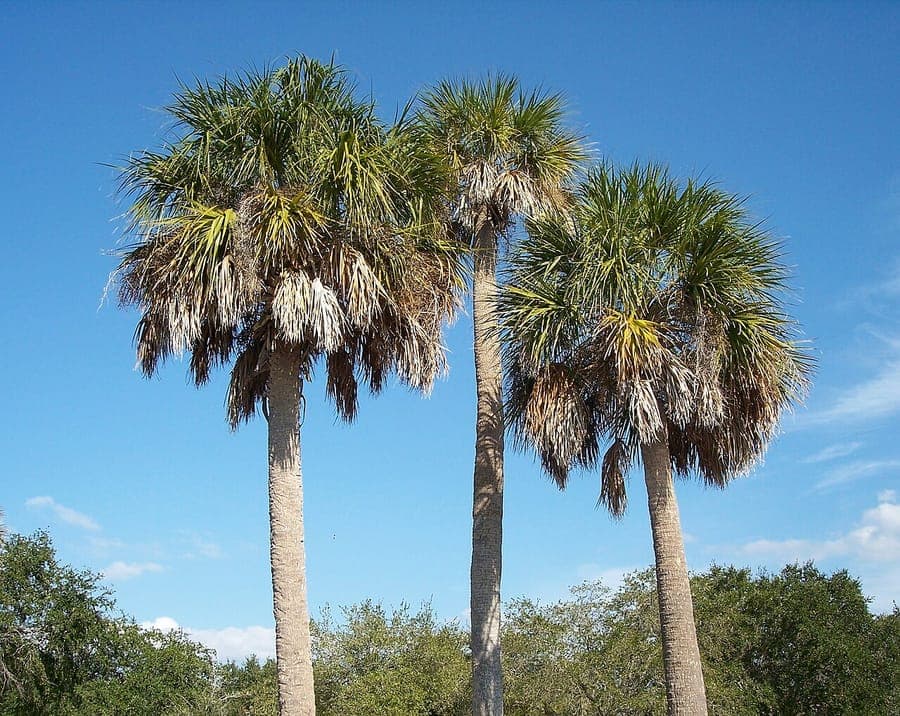
Mmcknight4 / Public domain, via Wikimedia Commons
Sabal palmetto: complete guide
Sabal palmetto
Want to see Sabal palmetto: complete guide in your garden?
1 minute, no credit card
Overview
Sabal palmetto, also known as the Blue Palmetto or Cabbage Palm, is one of North America's most iconic palms. This majestic palm is native to the southeastern United States, from Florida to South Carolina, and has also naturalised in areas from the Bahamas to Cuba. With its elegant fan-shaped leaves and stiff yet graceful form, it is a perfect choice for gardeners who want to create an authentic American-southern or Mediterranean front garden.
The Blue Palmetto is especially valuable because it is remarkably cold-hardy for a palm from tropical and subtropical regions. This makes it suitable for temperate climates in Western Europe, although it will need protection during harsh winters.
Appearance and bloom
Sabal palmetto forms a single-trunked palm that can reach 6-10 metres at maturity (often smaller in temperate climates). The trunk is grey and rough, covered with remnants of old leaf stalks that give a characteristic texture.
The leaves are large, fan-shaped, and green to blue-grey in colour (hence the name Blue Palmetto). Each leaf can reach 1.5 metres wide and hangs elegantly along the trunk. In young plants, leaves are often more green; as the plant matures, they become more grey.
Blooming occurs in late spring to early summer (May to July) and consists of long flower spikes carrying thousands of small, yellow-white flowers. These are pleasantly fragrant and attract bees. Following blooming, small black fruits develop that ripen in autumn.
Ideal location
Sabal palmetto grows best in abundant sunlight. Provide at least six hours of direct sun daily. The plant can tolerate some shade, but will grow more compact and healthy with more light.
Position this palm where it has protection from extreme strong wind. Although sturdy, hurricanes and severe storms can damage palm fronds. A location near a wall or in semi-sheltered areas is recommended.
Gardenworld.app advises placing Sabal palmetto centrally in gardens as a sculptural accent, surrounded by lower plants. Its upright form and elegant leaves create beautiful visual contrast against many low-growing garden plants.
Soil
Sabal palmetto is not fussy about soil type, but grows best in well-draining medium. It can tolerate sandy, loamy, and even clay-like soils, as long as these are not permanently waterlogged.
The plant can grow reasonably well in poor, nutrient-poor soil. Add compost or organic matter when planting, but over-fertilising is unnecessary. The palm grows slowly enough that regular feeding is not essential.
The pH should be between 5.1 and 7.8. This broad range means the plant can grow in both slightly acidic and neutral soils. Good drainage is more important than nutrient richness.
Free design
Want to see Sabal palmetto: complete guide in your garden? Make a free design now.
Watering
During the growing season (spring and summer), water Sabal palmetto regularly, especially during dry periods. The soil should be moist, but not soggy. A deep watering once per week, rather than daily light misting, is better.
In autumn and winter, gradually reduce watering. Established plants are reasonably drought-tolerant and can withstand long dry periods once rooted.
New plants (first 1-2 years) need more regular watering. Ensure roots establish well before stress occurs.
In regions with adequate rainfall, you can rely primarily on natural precipitation once the plant is established.
Pruning
Sabal palmetto requires minimal pruning. The natural form is already attractive and does not need drastic adjustment.
Remove only dead, yellow, or damaged leaves as soon as noticed. This prevents diseases from developing. Cut leaves at the point where they emerge from the trunk.
Late winter (February-March) is ideal for pruning. Remove all winter damage and dead material. Avoid pruning during the growing season, which can damage young vulnerable fronds.
Leave seed-bearing flower spikes unless you wish to prevent self-seeding. The fruits attract birds and give the plant a natural look.
Maintenance calendar
January-February: Check for frost and winter damage. Remove dead fronds. Prune heavy branches.
March-April: Gradually increase watering as temperatures rise. Check for new growth.
May-July: Regular watering. Blooming occurs. Add light feeding (optional). Monitor for insects.
August-October: Continue hydration. Fruits ripen. Winter preparation begins. Add mulch.
November-December: Reduce watering. Apply frost protection in cold areas. Prepare for dormancy.
Winter hardiness
Sabal palmetto is remarkably cold-hardy for a palm. In temperate climates, it can survive temperatures to -10 to -15 degrees Celsius, although young plants are more sensitive.
In extremely harsh winters (below -20 degrees), the palm may die back to ground level. Fortunately, young plants typically recover from the root system.
In areas with regular frost, young plants must be protected with burlap sacks or evergreen boughs in winter. Mature specimens are tougher.
Avoid placement in windy, exposed locations where winter wind increases the risk of damage.
Companion plants
Sabal palmetto pairs wonderfully with many Mediterranean and subtropical garden plants:
- Other American palms: Trachycarpus or Serenoa form beautiful clusters
- Lavender and other Mediterranean herbs: Soft texture against palm fronds
- Grasses: Movement and contrast
- Spreading ground covers: Jasmine, ivy, low plants
- Shrubs: Holly, pittosporum, euonymus
Gardenworld.app recommends combining 2-3 Sabal palms in clusters for more dramatic effect, with under-planting of lower shrubs.
Closing
Sabal palmetto is a classic choice for gardeners wanting something tropical without excessive fuss. This American palm brings southern elegance and authentic charm to your front garden. With winter protection in cold years, it will provide decades of growth and beauty. Available from many plant shops and tree nurseries, this palmetto allows you to create a piece of America in your own front garden.
Want to see Sabal palmetto: complete guide in your garden? Make a free design now.
Upload a photo, pick a style, and get a photorealistic design with plant list in under a minute.
No credit card required


Similar plants
Needle palm: complete guide
Rhapidophyllum hystrix
Everything about the needle palm: the world's hardiest palm, suitable for gardens in temperate climates down to USDA zone 7b.
Saw palmetto: complete guide
Serenoa repens
A complete guide to saw palmetto (Serenoa repens), the iconic fan palm from Florida and the southeastern United States, prized for its toughness.
Puerto Rican hat palm: complete guide
Sabal causiarum
Grow Puerto Rican hat palm successfully. A majestic fan palm with tropical presence suited to sheltered Mediterranean-style gardens.