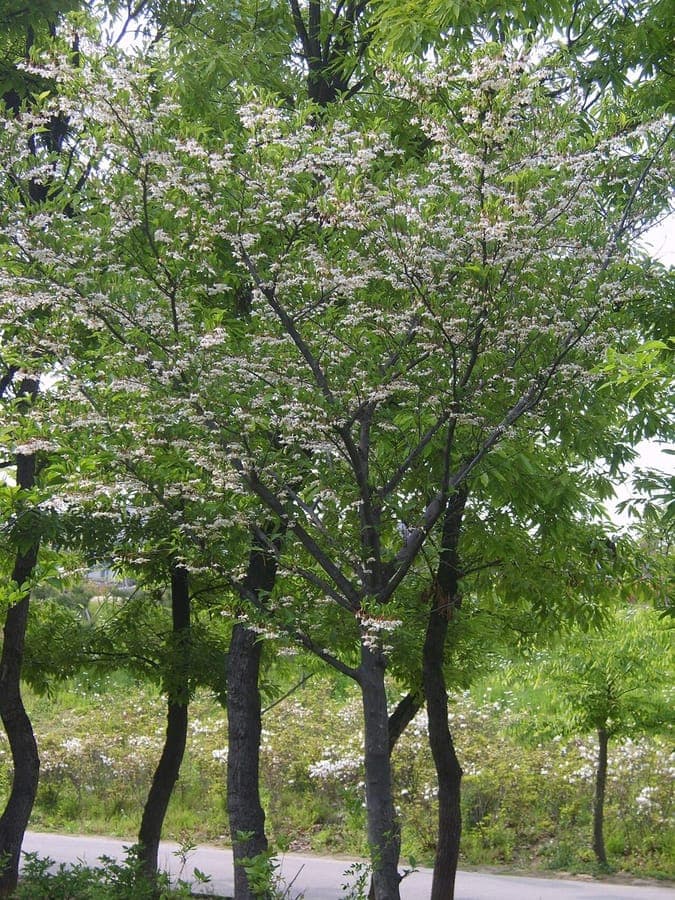
Dalgial / CC BY-SA 3.0, via Wikimedia Commons
Japanese snowbell: caring for a small garden tree
Styrax japonicus
Want to see Japanese snowbell: caring for a small garden tree in your garden?
Full design in HD: €7.99
Look after your Japanese snowbell with the GardenWorld app
Identify plants with your camera and get a care calendar with reminders for this plant.


Overview
The Japanese snowbell (Styrax japonicus) is one of the loveliest small trees you can grow. It is native to Japan, Korea and China, where it grows along woodland edges and on mountain slopes. In June hundreds of white bells hang beneath the branches, so that when you stand underneath the tree it seems to be snowing. The species belongs to the Styracaceae, a small family whose members mostly grow in warmer regions.
In a British or northern European garden the Japanese snowbell stays modest in size. After twenty years it usually reaches 6 to 8 m tall and 5 to 7 m wide, with a broad, gently layered crown of almost horizontal branches. It is often grown as a multi-stemmed tree, which makes it even more graceful. That makes it a good choice for smaller gardens, next to a terrace or as a focal point in a lawn. If you are unsure where it would work best, you can have a garden design made on gardenworld.app that gives the tree the space it needs, together with suitable underplanting.
Well-known cultivars include 'Pink Chimes' with pale pink flowers, 'Fargesii' with larger leaves and stronger growth, 'Fragrant Fountain' with weeping branches and 'Evening Light' with dark purple foliage.
Appearance and flowering
The leaves are oval to elliptic, 4 to 9 cm long, a fresh glossy green and spaced along the branches. In autumn they turn yellow, sometimes flushed with red or orange. The bark is smooth and grey-brown, and the fine twigs give the tree an elegant outline in winter.
Flowering comes in late May and June, after the leaves have opened. The flowers are white and bell-shaped, 1.5 to 2 cm across, with five lobes and a cluster of yellow stamens. They hang in groups of two to six on long stalks beneath the branches and have a light, sweet scent. Bees and bumblebees visit them in large numbers. Because the flowers face downwards, they are best seen from below. Plant the tree where you can sit or walk beneath it, or on a bank above a seating area. The photo shows young trees in full bloom beside a path, their crowns a haze of white flowers.
After flowering, round to egg-shaped grey-green fruits about 1 cm long develop. They contain saponins and are not edible. In Japan they were once used to make soap and to stun fish. Do not eat them, and keep children and pets away from them, as they can cause vomiting and stomach upset.
Ideal position
The Japanese snowbell flowers most generously in sun or light shade. A spot with morning sun and some shade during the hottest part of the day is ideal. In deep shade it grows thin and hardly flowers.
Shelter from cold, drying winds matters. Young leaves and flower buds can be damaged by late frost or bitter easterly winds in spring. A sheltered position, for example in the lee of larger trees, a hedge or the house, prevents that. When planting, keep at least 3 m from buildings so the crown has room to spread.
Soil requirements
This tree likes humus-rich soil that holds moisture but drains well and is slightly acidic to neutral, with a pH between 5 and 7. On chalky soil it often develops yellow leaves with green veins, a sign of iron deficiency, so alkaline ground is best avoided.
Dig a generous planting hole, twice as wide as the root ball. Mix the excavated soil with leaf mould, and on sandy soil add some well-rotted manure as well. On heavy clay, improve drainage by working in coarse grit and compost. Do not plant the tree deeper than it sat in its pot. A mulch of 5 to 8 cm of leaf mould or wood chips, kept clear of the trunk, keeps the shallow roots cool and moist.
Free preview
Want to see Japanese snowbell: caring for a small garden tree in your garden? Make a free preview of your design.
Watering
The Japanese snowbell has shallow roots and dislikes drought. During the first two years after planting, give it a good soak of 15 to 20 litres every week in dry weather. Even an established tree benefits from a deep watering every fortnight during long, dry summers. Brown leaf edges and early leaf drop in August are signs of thirst.
It is better to water generously once than to give a little every day, so the water reaches deep into the soil. Rainwater is preferable to hard tap water. Avoid digging or hoeing in the root zone, as you can easily damage the fine surface roots.
Pruning
Prune the Japanese snowbell as little as possible. It grows naturally into an attractive shape, and hard pruning leads to lots of vigorous water shoots and fewer flowers. Formative pruning of young trees is best done in late winter, in February, while the tree is bare. Remove dead, damaged and crossing branches, and perhaps a branch that hangs too low.
If you want a tree with a clear trunk and a raised crown, remove the lowest branches gradually over several years. With a multi-stemmed tree, keep several stems and take out only weak ones or those growing too close together. The tree is slow to heal large wounds, so avoid sawing off thick branches unless it is really necessary.
Care calendar
February: Formative pruning of young trees; remove dead and crossing wood.
March: Spread a layer of leaf mould around the tree. Plant new trees while the ground is not frozen.
April: Leaves emerge. Protect young trees with fleece on frosty nights.
May–June: Flowering. Enjoy the bells and water during dry spells.
July–August: Keep the soil moist with a mulch and deep watering.
September–October: Fruits ripen and autumn colour arrives. A good time to plant new trees.
November–January: Dormancy. Top up the mulch around young trees.
For a month-by-month overview like this for all your plants, use the plant calendar on gardenworld.app.
Hardiness
Styrax japonicus is fully hardy across most of Britain and the Low Countries. Established trees tolerate frost down to about -20 °C. Young trees are more vulnerable, especially in wet soil, so protect them for their first few winters with a thick mulch around the base.
The biggest risk is late spring frost, which can damage the young leaves and flower buds. The tree usually regrows, but flowering that year will be disappointing. A sheltered position away from a frost pocket prevents most problems. In the long term it is not ideal for containers; if you do want to grow a young tree in a pot, choose one of at least 60 litres and move it against a wall in winter.
Companion plants
The Japanese snowbell enjoys the same acidic, humus-rich soil as rhododendrons, azaleas and Pieris japonica. Together they create a calm, woodland-style border with flowers from early spring into summer. The Japanese dogwood (Cornus kousa) flowers at about the same time and makes an ideal neighbour in size and character. A Japanese maple (Acer palmatum) adds red tones in autumn beside the yellow leaves of the snowbell.
Beneath the crown, ferns, hostas, barrenwort (Epimedium) and Japanese forest grass (Hakonechloa macra) all thrive. Bigleaf hydrangea (Hydrangea macrophylla) takes over the flowering in July, once the bells have faded. Avoid vigorous, deep-rooting ground cover right next to the trunk.
Final thoughts
The Japanese snowbell is a small tree with a big impact: a crown full of white bells in June, a layered shape and warm autumn colour. Give it a sheltered spot in sun or light shade, humus-rich and slightly acidic soil and enough water in dry summers, and it will stay beautiful for decades. Plant it beside a terrace or a bench, so you can admire the flowers from below.
Frequently asked questions about Japanese snowbell
Is Japanese snowbell winter hardy?
Styrax japonicus is fully hardy across most of Britain and the Low Countries. Established trees tolerate frost down to about -20 °C.
When and how do you prune Japanese snowbell?
Prune the Japanese snowbell as little as possible. It grows naturally into an attractive shape, and hard pruning leads to lots of vigorous water shoots and fewer flowers.
How much water does Japanese snowbell need?
The Japanese snowbell has shallow roots and dislikes drought. During the first two years after planting, give it a good soak of 15 to 20 litres every week in dry weather.
What soil does Japanese snowbell need?
This tree likes humus-rich soil that holds moisture but drains well and is slightly acidic to neutral, with a pH between 5 and 7. On chalky soil it often develops yellow leaves with green veins, a sign of iron deficiency, so alkaline ground is best avoided.

See it in your garden
See Japanese snowbell in your garden
One photo of your garden and a few questions. You see the result in about a minute.
Try it with a photoIdentify this plant in your own garden. Identify a plant
Similar plants
Japanese dogwood: complete guide
Cornus kousa
Everything about the Japanese dogwood (Cornus kousa): spectacular bracts, autumn colour, edible fruits and care. Expert tips for this elegant ornamental tree.
Japanese Maple: complete guide
Acer palmatum
Everything about Japanese Maple (Acer palmatum): planting, pruning, cultivars and autumn colour. Expert tips for a spectacular ornamental tree in your garden.
Rhododendron: complete guide
Rhododendron
Everything about Rhododendron: planting, care, pruning and the right soil. Practical tips for an abundant spring display.
