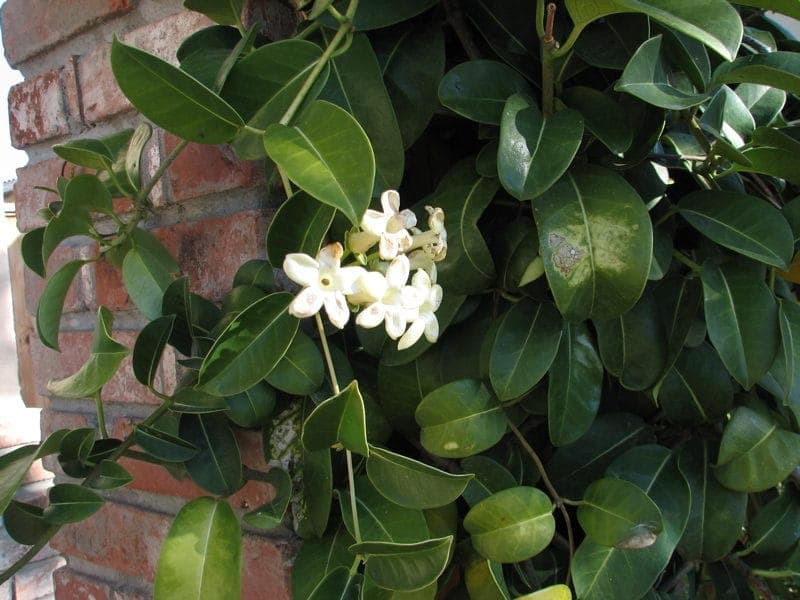
Lenore Edman from Sunnyvale, CA / CC BY 2.0, via Wikimedia Commons
Madagascar jasmine (Stephanotis floribunda): complete guide
Stephanotis floribunda
Want to see Madagascar jasmine (Stephanotis floribunda): complete guide in your garden?
Full design in HD: €7.99
Look after your Madagascar jasmine with the GardenWorld app
Identify plants with your camera and get a care calendar with reminders for this plant.


Overview
Madagascar jasmine (Stephanotis floribunda) is the waxy white flower that has graced bridal bouquets and buttonholes for well over a century. Its scent is sweet and heady, a little like true jasmine, and a single plant in bloom can perfume a whole room. It comes from Madagascar, where it grows as an evergreen twining climber, scrambling 5 m or more through shrubs and trees. It belongs to the Apocynaceae, the same family as oleander and mandevilla. Some botanists now place it in the genus Marsdenia, but Stephanotis floribunda remains the name used in the trade and in most reference books.
In northern Europe Madagascar jasmine is a houseplant, often sold trained around a wire hoop. Indoors, with regular training and a little pruning, it stays at 1 to 2 m of stem. In summer it can spend time on a sheltered, lightly shaded patio, but it needs to come back in early in autumn. On gardenworld.app you can have a design drawn up for your garden and patio, including a sheltered corner where houseplants such as Madagascar jasmine can enjoy the summer air.
Appearance and bloom cycle
The flowers are tubular, 3 to 5 cm long, opening into a star of five pointed lobes. They are pure white, thick and waxy, and appear in clusters of five to fifteen in the leaf axils. The photo shows one such cluster among glossy leaves against a brick wall. The main flowering season runs from May to September, and a well-grown plant may produce a few more blooms in autumn.
The leaves are opposite, oval, 5 to 10 cm long, leathery and a deep, glossy green. The stems start green and pliable and become woody with age. Very occasionally an older plant indoors will set a large, egg-shaped fruit of 8 to 10 cm, which takes months to ripen and then splits to release seeds carried on silky hairs. The fruit is not edible.
Position indoors
Madagascar jasmine wants plenty of light but not fierce midday sun through glass. An east- or west-facing window is ideal, or a spot a metre back from a south window with a sheer curtain in between. Too little light means few or no flowers; too much direct sun scorches the leaves.
During the growing season it is happiest at 18 to 24 °C, without big swings in temperature and away from draughts. One quirk is worth knowing: once buds are visible, do not move or turn the plant. A change in the direction of light often makes it drop its buds. Put it in its permanent spot in spring and leave it there until flowering is over.
Compost and repotting
Use a fertile, open houseplant compost with some extra perlite or fine clay granules for drainage. Slightly acidic to neutral compost suits it best, and a pot with a drainage hole is essential.
Repot young plants every March and older ones every two to three years. Move up only a few centimetres in size, because the plant flowers more freely when slightly pot-bound. For older specimens that are too large to repot, replace the top 3 to 5 cm of compost with fresh mix each spring. Add a hoop, small trellis or cane at the same time.
Watering and humidity
From April to September keep the compost lightly moist but never wet. Water when the top 2 cm feels dry and let the excess drain away. Use soft water at room temperature where possible, such as rainwater or filtered tap water, as cold or hard water turns the leaves yellow.
Madagascar jasmine likes humid air. Mist the leaves a few times a week in summer with tepid water, but avoid the flowers, which mark easily. Standing the pot on a tray of wet clay granules also helps. Feed every two weeks from April to August with a liquid fertiliser for flowering houseplants.
Free preview
Want to see Madagascar jasmine (Stephanotis floribunda): complete guide in your garden? Make a free preview of your design.
Pruning and training
Madagascar jasmine needs little pruning. Keep winding new stems around the hoop or trellis through spring and summer so the plant stays tidy. Stems that have grown too long can be cut back in early spring to just above a pair of leaves, and dead or weak growth removed at the same time.
Do not overdo it: flowers appear on last year's wood as well as on new shoots, so hard pruning costs you a season of bloom. A little white sap may ooze from the cuts; wear gloves if you have sensitive skin. Tip cuttings of 10 cm root in spring under a plastic cover at 22 to 25 °C.
Maintenance calendar
January and February: Cool rest at 12 to 15 °C. Little water and no feeding.
March: Light pruning and repotting if needed. Move the plant somewhere warmer and gradually increase watering.
April and May: Start feeding. Place the plant in its permanent spot as the first buds appear.
June to August: Main flowering. Water regularly and mist the leaves. From mid-June it can go out onto a sheltered, partly shaded patio if nights stay above 15 °C.
September: Back indoors. Stop feeding. Check for scale insects and mealybug.
October to December: Water less and move it to a cooler spot.
Overwintering
Stephanotis floribunda is a tropical plant that cannot take frost and suffers below 10 °C. Even so, it needs a cool winter rest to flower well the following year. From November to February give it a bright spot at 12 to 15 °C, such as a cool bedroom or an unheated but frost-free conservatory.
During this period water only when the compost is nearly dry and stop feeding altogether. In a warm living room at 20 °C or more the plant keeps growing, but it often forms fewer buds and becomes prone to scale, mealybug and red spider mite. Check stems and leaf undersides regularly in winter; small brown bumps or white fluff are signs of an infestation.
Toxicity for pets
Good news for cat and dog owners: the ASPCA lists Stephanotis floribunda as non-toxic to dogs, cats and horses. A pet that nibbles a leaf is therefore at no serious risk, although eating a lot of any plant material can cause a mild stomach upset.
Watch out for mix-ups, because the word jasmine is used for several unrelated plants. Carolina jasmine (Gelsemium sempervirens), for instance, is genuinely poisonous, so check the label. For people, the fruit is not edible and the sap may cause mild skin irritation in some individuals.
Companion plants
Indoors, Madagascar jasmine sits well alongside other fragrant or flowering climbers. Pink jasmine (Jasminum polyanthum) flowers earlier in the year and so extends the season. Wax plant (Hoya carnosa) has similar waxy flowers and needs much the same care. For greenery around the base of a large plant, choose peace lily (Spathiphyllum wallisii) or spider plant (Chlorophytum comosum), both of which enjoy the same bright position.
On a summer patio it looks good next to star jasmine (Trachelospermum jasminoides) and Chinese hibiscus (Hibiscus rosa-sinensis), provided the harshest midday sun is filtered.
Final thoughts
Madagascar jasmine is not a plant to shuffle around the house, but choose a bright, permanent spot, use soft water and give it a cool winter rest, and it will reward you every year with fragrant white stars. It is also one of the few flowering climbers that is safe around cats and dogs.
The plant calendar on gardenworld.app reminds you each month when it is time to prune, repot or move the plant somewhere cooler. Give your Madagascar jasmine a permanent home by a bright window this spring and enjoy the scent of Stephanotis floribunda all summer.
Frequently asked questions about Madagascar jasmine
When and how do you prune Madagascar jasmine?
Madagascar jasmine needs little pruning. Keep winding new stems around the hoop or trellis through spring and summer so the plant stays tidy.
How much water does Madagascar jasmine need?
From April to September keep the compost lightly moist but never wet. Water when the top 2 cm feels dry and let the excess drain away.

See it in your garden
See Madagascar jasmine in your garden
One photo of your garden and a few questions. You see the result in about a minute.
Try it with a photoIdentify this plant in your own garden. Identify a plant
Similar plants
Jasminum polyanthum: complete guide
Jasminum polyanthum
Discover Pink jasmine - a sweetly scented climber with white and pink flowers. Perfect for trellises with strong fragrance in winter and spring.
Star jasmine: complete guide
Trachelospermum jasminoides
Everything about Star Jasmine (Trachelospermum jasminoides): planting, care, pruning and winter protection. Expert tips for a fragrant evergreen climber.
Peace lily: complete guide
Spathiphyllum wallisii
How to grow a peace lily (Spathiphyllum wallisii): light, watering, repotting, getting it to flower again, and why it is toxic to cats and dogs.
