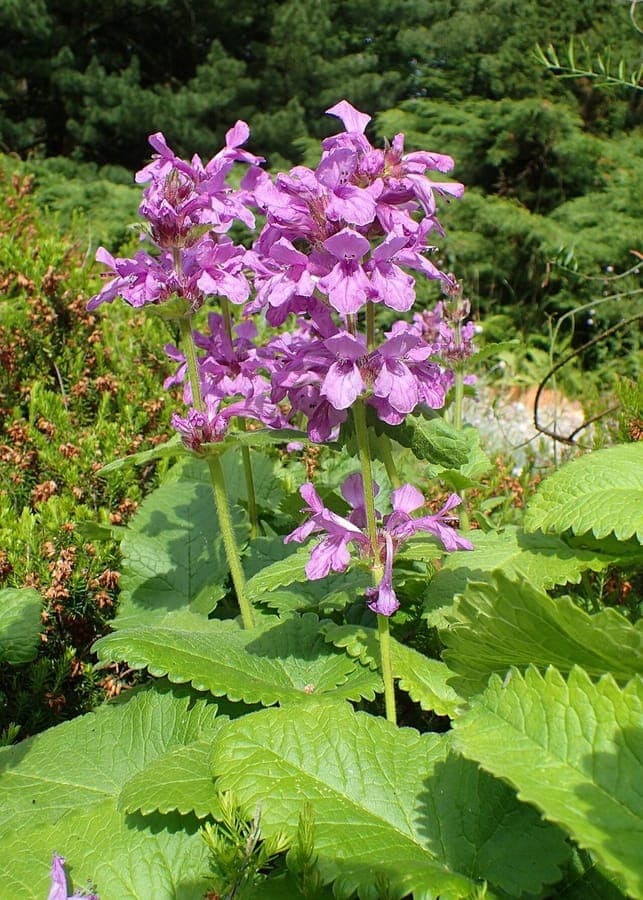
Krzysztof Ziarnek, Kenraiz / CC BY-SA 4.0, via Wikimedia Commons
Big betony (Stachys macrantha): complete guide
Stachys macrantha
Want to see Big betony (Stachys macrantha): complete guide in your garden?
Full design in HD: €7.99
Look after your Big betony with the GardenWorld app
Identify plants with your camera and get a care calendar with reminders for this plant.


Overview
Big betony (Stachys macrantha) is one of the loveliest betonies for the border, and one of the easiest too. It forms a low rosette of large, scalloped leaves, from which sturdy stems rise in early summer carrying whorls of purplish-pink hooded flowers. The species name macrantha simply means large-flowered, and rightly so: the blooms are far bigger than those of our native wood betony. Botanists now place it in the genus Betonica, as Betonica macrantha, but nurseries and garden centres almost always still sell it as Stachys macrantha.
The species comes from the Caucasus, north-eastern Turkey and north-western Iran, where it grows in mountain meadows and woodland clearings. It is therefore used to cold winters and moderately warm summers, which makes it an excellent fit for gardens in Britain and north-west Europe. You can have a garden design made on gardenworld.app in which big betony fills the front of the border from June into July as a dependable edging plant.
In flower it reaches 40 to 60 cm tall and spreads 30 to 45 cm. The best-known cultivar is 'Superba', with deep purplish-pink flowers; together with 'Robusta', which is a little taller and pinker, and the violet 'Violacea', it holds the Royal Horticultural Society's Award of Garden Merit. White ('Alba') and soft pink ('Rosea') forms are also available.
Appearance and bloom cycle
For half the year the foliage is the main attraction. The leaves sit in a dense rosette on long stalks and are broadly oval to heart-shaped, 5 to 12 cm long and deeply scalloped along the edges. The surface is wrinkled by sunken veins and feels slightly hairy. The colour ranges from fresh to dark green. In mild winters part of the rosette stays green, so the plant never vanishes completely in the cold season.
From late May or June the flower stems appear. They are square, hairy and carry only a few small leaves. At the top the flowers are packed in dense, stacked whorls. Each bloom is 3 to 3.5 cm long, with a hooded upper lip and a broad, spreading lower lip, in a warm purplish pink. The photo shows exactly this: dense clusters of purplish-pink hooded flowers on hairy stems above large, scalloped leaves.
The main flush comes in June and July. If you remove spent stems promptly, a smaller second flush often follows in August. Bumblebees, honeybees and solitary bees love it, as the large, open flowers are easy to reach and rich in nectar. It also lasts several days as a cut flower.
Ideal location
Big betony is not fussy. It flowers most freely in full sun but also does well in light shade, for example in a spot with morning sun or beneath tall trees with a thin canopy. In deep shade flowering becomes sparse.
In very hot, dry gardens it appreciates some protection from the fiercest afternoon sun, as the large leaves can wilt. It is ideal for the front of a border, as ground cover between roses or shrubs, in a cottage garden or along a path, where the rosettes make a neat edge. Space plants 30 to 40 cm apart, in groups of three to seven for the best effect.
Soil requirements
The best soil is ordinary, moderately fertile garden soil that holds moisture yet drains well. Loam, sandy loam and humus-rich sandy soil are ideal. Heavy clay is fine too, provided water does not stand on it in winter: the plant dislikes wet feet while dormant.
pH does not matter much; anything from slightly acidic to chalky will do. Work some compost into the soil when planting. After that, little extra feeding is needed. Soil that is too rich produces lots of leaves and floppy stems, so a handful of compost in spring is plenty. On poor, dry sandy soil add more organic matter so the ground stays moister in summer.
Free preview
Want to see Big betony (Stachys macrantha): complete guide in your garden? Make a free preview of your design.
Watering
Water regularly for the first few weeks after planting until the plant has rooted in well. After that Stachys macrantha copes on its own in most summers. During prolonged drought, especially in June when the flower stems are developing, give a thorough soaking once a week so the water reaches deep into the soil.
The leaves sometimes droop in the heat but usually recover by evening. If they are still limp in the evening, it is time to water. No watering is needed in winter. Plants in containers need more attention: check every couple of days in summer and make sure the pot has a good drainage hole.
Pruning
Pruning is simple. After the main flush, usually in mid-July, cut the spent flower stems back to the leafy rosette. This keeps the plant tidy and often encourages a second, smaller round of flowers. If you want seed for birds or for sowing, leave a few stems standing.
In autumn you can remove damaged or yellowing leaves, but leave the rosette itself: it protects the heart of the plant over winter. Tidy away old foliage in March, just before new growth starts. After three to four years the centre of a clump sometimes becomes bare. Lift and divide the plant in spring or early autumn and replant the young outer pieces. That also gives you new plants for elsewhere in the garden.
Maintenance calendar
March: Remove old and damaged leaves. Work a handful of compost in around the plant.
April: New rosettes develop. A good month for planting or dividing large clumps.
May: Flower stems appear. Water in dry spells. Watch for slugs on young plants.
June to July: Main flowering. Pick stems for the vase if you like. Water during long dry spells.
July to August: Cut spent stems back to the foliage for a second flush.
September to October: Dividing and moving is still possible. Clear yellow leaves.
November to February: Dormant period. Leave the rosette alone.
The planting calendar on gardenworld.app lets you keep track of these tasks month by month, so you never miss the right moment for cutting back or dividing.
Winter hardiness
Big betony is fully hardy. The Royal Horticultural Society places it in its highest category, H7, which means it survives severe winters with temperatures well below -20 °C. Anywhere in Britain and the Low Countries it needs no winter protection at all.
The only thing to watch is standing water around the roots in winter. On free-draining soil the plant is very long-lived. In containers the rootball can freeze during prolonged frost, but even then the plant usually survives; to be safe, stand the pot against a wall.
Toxicity: Stachys macrantha is not known to be toxic to people or pets. Rabbits and deer usually leave the hairy leaves alone. As with any ornamental plant, it is still sensible not to eat it.
Companion plants
Big betony is an ideal linking plant in the border. Balkan clary (Salvia nemorosa) flowers at the same time, its blue-purple spikes making a fine colour contrast. Lady's mantle (Alchemilla mollis) adds a fresh foreground with lime-green flowers and soft leaves, while bloody cranesbill (Geranium sanguineum) fills the gaps between the rosettes with magenta.
Masterwort (Astrantia major) and catmint (Nepeta racemosa) suit it well in a romantic cottage border. Roses, grasses such as Sesleria or a low Calamagrostis, and early summer flowers like lupins and aquilegias also combine beautifully with the purplish-pink whorls. Avoid vigorous spreaders that could smother the rosettes.
Final thoughts
Stachys macrantha asks for little and gives a great deal: handsome foliage from spring to autumn, an abundance of large purplish-pink flowers in early summer and a feast for bees and bumblebees. It is hardy, robust and fits almost any border.
Plant it in groups at the front of a sunny or lightly shaded border and enjoy its faithful flowering year after year.
Frequently asked questions about Big betony
Is Big betony winter hardy?
Big betony is fully hardy. The Royal Horticultural Society places it in its highest category, H7, which means it survives severe winters with temperatures well below -20 °C.
When and how do you prune Big betony?
Pruning is simple. After the main flush, usually in mid-July, cut the spent flower stems back to the leafy rosette.
How much water does Big betony need?
Water regularly for the first few weeks after planting until the plant has rooted in well. After that Stachys macrantha copes on its own in most summers.
Where does Big betony grow best?
Big betony is not fussy. It flowers most freely in full sun but also does well in light shade, for example in a spot with morning sun or beneath tall trees with a thin canopy.
What soil does Big betony need?
The best soil is ordinary, moderately fertile garden soil that holds moisture yet drains well. Loam, sandy loam and humus-rich sandy soil are ideal.

See it in your garden
See Big betony in your garden
One photo of your garden and a few questions. You see the result in about a minute.
Try it with a photoIdentify this plant in your own garden. Identify a plant
Similar plants
Woodland sage: complete guide
Salvia nemorosa
Everything about Woodland Sage (Salvia nemorosa): planting, care, pruning and combinations. Expert tips for months of blue-violet flower spikes.
Garden lady's-mantle: complete guide
Alchemilla mollis
Alchemilla mollis, or garden lady's-mantle, is a graceful perennial perfect for borders, shade gardens, and low-maintenance landscapes. Grows 15–30 cm tall, blooms June–August.
Bloody cranesbill: complete guide
Geranium sanguineum
Bloody cranesbill offers intense magenta-pink flowers and fall color. This hardy plant blooms tirelessly from May through October.
