
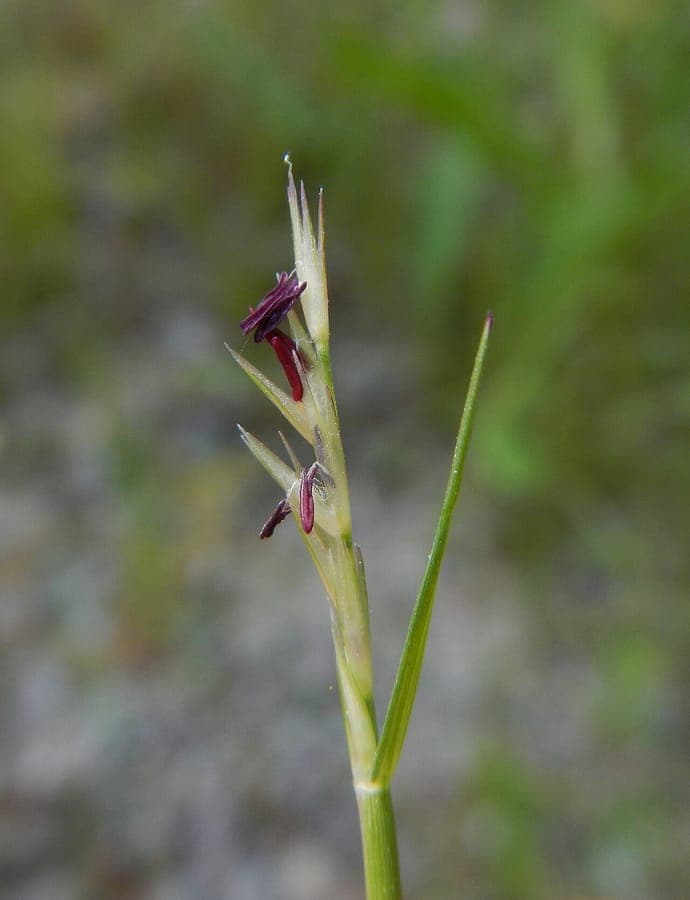
CJChapm / CC BY-SA 4.0, via Wikimedia Commons
Sporobolus vaginiflorus: complete guide
Sporobolus vaginiflorus
Want to see Sporobolus vaginiflorus: complete guide in your garden?
1 minute, no credit card
Overview
Sporobolus vaginiflorus - known in English as poverty dropseed or sheathed dropseed - is an annual to short-lived perennial grass belonging to the Poaceae family, native across a remarkably wide swath of North America, from Canada south to Texas and Florida. The common name 'poverty dropseed' alludes to its preference for poor, lean soils where few other plants can compete. 'Sheathed dropseed' refers to the clasping leaf sheaths that partially enclose the slender flower spikes - reflected in the scientific name vaginiflorus (sheath-flowered).
This is not a plant you will find at mainstream garden centres, but it is of genuine interest to those designing naturalistic prairie-style plantings, gravel gardens, and low-input landscapes. It is also a useful reference point for understanding the broader Sporobolus genus, which includes the celebrated prairie dropseed (Sporobolus heterolepis) - an excellent, widely available ornamental grass that shares many of the same virtues but offers more reliable garden performance. On gardenworld.app you can explore how ornamental grasses and prairie plants combine to create naturalistic, year-round garden designs.
Appearance and bloom cycle
Sporobolus vaginiflorus is a slender, upright-to-arching clump-former reaching 30-60 cm in height. The leaves are narrow, almost thread-like, and grey-green to light green. In dry conditions, the leaf blades fold inward along their midrib - a neat adaptation that reduces water loss. The stems are wiry but flexible, bending gracefully in wind rather than snapping.
The inflorescence is a narrow, spike-like panicle, 5-15 cm long, partly concealed within the uppermost leaf sheath. Flowering occurs in August and September; seeds ripen in September and October. The seeds are smooth and glossy, typical of the genus Sporobolus - a name derived from the Greek for 'seed-thrower', referring to the way the seeds are expelled from their thin-walled husks at maturity. After seed set, the plant gradually dries to warm straw-gold tones that provide late-season and winter interest in a naturalistic border.
As an annual or short-lived perennial, S. vaginiflorus reproduces primarily by seed, self-sowing onto open mineral ground in suitable conditions.
Ideal location
Full sun is non-negotiable for this species. It grows on open, disturbed, dry ground in the wild: roadsides, field margins, limestone ledges, sandy flats and railway embankments. In garden settings, it fits best into gravel gardens, prairie-style plantings, or any area with lean, open soil where competition from more vigorous plants is limited.
This is a species that thrives on neglect and struggles in fertile, regularly irrigated borders where larger plants would quickly overwhelm it. For designers working with naturalistic, low-maintenance planting schemes, it functions as an ecological connector and as an informal ground cover on bare, sunny patches. It is particularly interesting in combination with other pioneer species on disturbed or restored ground.
Soil
Sporobolus vaginiflorus demands well-drained, low-fertility soil. Sandy, gravelly and stony soils are ideal. Heavy, wet or nutrient-rich soils favour competing plants and disadvantage this delicate species. A soil pH of 5.5-7.5 is suitable - the plant tolerates a wide range. Good drainage is more important than any other soil factor. No raised beds or drainage pipes are needed if the underlying soil is naturally free-draining.
In restored prairie plantings or gravel gardens, S. vaginiflorus can be used as a pioneer on mineral soil surfaces that other plants have not yet colonised. It helps bind loose soil and provides early habitat structure for invertebrates before other species establish.
Free design
Want to see Sporobolus vaginiflorus: complete guide in your garden? Make a free design now.
Watering
Once established, poverty dropseed is extremely drought-tolerant and needs virtually no supplemental watering. In dry summers it maintains itself without intervention. Excessive watering is counterproductive: it stimulates the growth of competing species and makes the plant more susceptible to fungal issues at the base.
When sowing or transplanting into a new location, some moisture management in the first few weeks can help germination and establishment. After that, the plant is self-sufficient. In conventional irrigated borders it tends to be outcompeted. The strength of this species lies precisely in its capacity to thrive where water is scarce and soil is poor.
Pruning
For annual specimens, no pruning is required: the plant dies after seed set and can be removed or left in place for self-sowing. For short-lived perennial individuals, no special cutting back is needed. Leaving the dried clumps in place through winter provides subtle movement and texture in the garden, and the seeds feed small birds. In spring, as new growth begins in perennial plants, pull or cut away the previous year's dried stems at the base to allow fresh growth to emerge.
A firm tug at the base is the typical approach for clump-forming grasses at the end of winter. No tools are usually needed for this slim, lightweight species.
Maintenance calendar
January - February: plant is dormant (or dead if annual). Leave dried stems for winter interest and birds.
March - April: for perennial plants, remove dried stems as the ground thaws. Sow fresh seed onto open, sunny, bare mineral soil.
May - June: vegetative growth begins. Minimal maintenance required.
July - August: full vegetative growth; flower spike formation.
September - October: flowering and seed ripening. Seeds ready when they fall freely at a touch.
November - December: plant dries to gold. Leave for winter texture or remove, as preferred.
Winter hardiness
As an annual, Sporobolus vaginiflorus does not overwinter as a plant - its seeds overwinter in the soil and germinate the following spring. In its short-lived perennial forms, it is rated to USDA zone 5, corresponding to minimum temperatures around -28 degrees Celsius. In most of north-western Europe this presents no challenge at all. Seeds retain their viability through hard frost. In suitable spots, the species self-sows reliably year after year, maintaining a colony without any gardener intervention. Visit gardenworld.app for more inspiration on building plant communities that self-sustain through the seasons.
Companion plants
Sporobolus vaginiflorus fits best into naturalistic, low-input plantings on lean soils. It combines well with other dryland species: Bouteloua curtipendula (sideoats grama), Schizachyrium scoparium (little bluestem), and Andropogon gerardii (big bluestem). In a gravel prairie, pair it with low-growing flowering species such as Erigeron compositus, Penstemon hirsutus, and Asclepias tuberosa for a diverse, colourful tapestry.
In European gardens, the closely related Sporobolus heterolepis (prairie dropseed) is the recommended choice for a more ornamental, readily available clump-forming grass. Both share fine foliage, elegant movement and warm autumn colour. For larger naturalistic scenes, combine Sporobolus species with Sorghastrum nutans or Nassella tenuissima for an airy, meadow-like effect.
Closing
Sporobolus vaginiflorus is not a mainstream garden plant, but a fascinating species with an important ecological niche. For gardeners interested in North American prairie planting, gravel gardens or low-input naturalistic landscapes, it offers valuable insight into how plants adapt to adversity. Its close relative Sporobolus heterolepis is available from specialist perennial nurseries and quality garden centres, and brings all the visual elegance of the genus in a reliable, garden-worthy form.
Want to see Sporobolus vaginiflorus: complete guide in your garden? Make a free design now.
Upload a photo, pick a style, and get a photorealistic design with plant list in under a minute.
10,000+ gardens designed already
No credit card required


Similar plants
Prairie Dropseed: complete guide
Sporobolus heterolepis
Everything about Sporobolus heterolepis, the elegant prairie dropseed from North America. Location, soil, care and garden design inspiration.
Bouteloua curtipendula: complete guide
Bouteloua curtipendula
Discover sideoats grama, a native American grass with unique hanging flowers. Learn how to grow this ornamental grass in dry front-yard designs.
Switchgrass: complete guide
Panicum virgatum
Discover Panicum virgatum, an American ornamental grass with delicate foliage and stunning autumn color change. Perfect for modern gardens and prairie designs.