Wikimedia Commons / Public domain, via Wikimedia Commons
Bouteloua curtipendula: complete guide
Bouteloua curtipendula
Want to see Bouteloua curtipendula: complete guide in your garden?
Full design in HD: €7.99
Look after your Bouteloua curtipendula with the GardenWorld app
Identify plants with your camera and get a care calendar with reminders for this plant.


Overview
Bouteloua curtipendula, better known as sideoats grama or tall grama grass, is a fascinating native American grass from the Poaceae family. This grass grows naturally from North America to northern Argentina and forms important forage for grazers on the Great Plains.
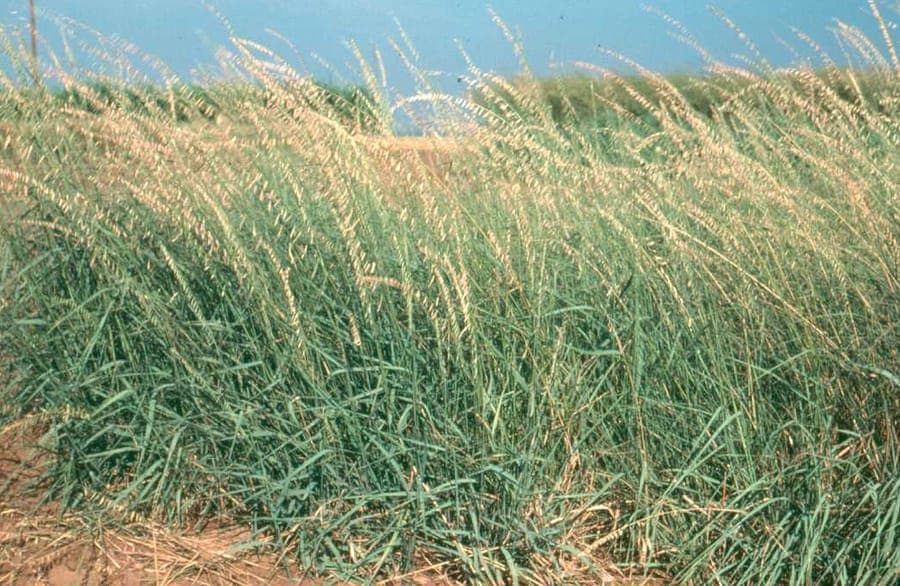
In modern garden designs, it's beloved for its unique flower arrangement. The grass reaches 60-90 cm in height and forms dense clumps with highly characteristic flowers that hang diagonally downward.
Appearance and Bloom
Bouteloua curtipendula forms green to silvery-green leafy clumps. The foliage is fine and linear, as typical for grasses. During the growing season, foliage remains green, but in autumn it can develop beautiful reddish-brown tones.
The blooming is the most characteristic feature. The flower arrangement consists of a central axis with small flower heads hanging at angles - hence the name "sideoats." These flower heads are first green-purple, later reddish-brown to golden-brown.
The entire structure is very light and elegant, with flowers hanging like tiny flags from the central stem. This gives the grass a very original, almost sculptural appearance.
Ideal Location
Bouteloua curtipendula thrives best in full sun on warm locations. This grass is born for dry, sunny positions. It loves south or west-facing spots where heat is no problem.
This grass works fantastically in prairie-style borders, dry borders, and steppe garden designs. It's also ideal for wildflower mixes and bird gardens where the seed is important food.
Ensure good air circulation - this grass hates humidity.
Soil
Bouteloua curtipendula grows in poor to moderately fertile soils. The plant prefers neutral to slightly acidic (pH 5.5-7.8). It's very adaptable and grows in sand, loam, and even clay.
The plant is renowned for its drought tolerance. It grows with minimal water and tolerates dry periods without dying.
Good drainage is beneficial but not essential. The grass can grow in heavier soils as well.
Free preview
Want to see Bouteloua curtipendula: complete guide in your garden? Make a free preview of your design.
Watering
Bouteloua curtipendula is extremely drought-tolerant. Young plants need some water their first growing season, but once established you can virtually forget the plant.
Even in extreme drought, this grass grows without extra water. This makes it ideal for water-conscious gardens in warm regions.
In very wet periods, excessive water could harm it, so avoid waterlogging.
Pruning
Bouteloua curtipendula requires minimal pruning. Leave the flowers and seed through autumn and winter. These are highly decorative and provide birds with food.
In March you can remove all dead culms before the next growing season. Cut the grass close to the ground.
Maintenance Calendar
March: Remove dead culms from previous season. Plant begins regrowing.
April-May: Growth accelerates. Plant prepares for blooming.
June-August: Flowering period. Characteristic hanging flowers appear.
August-October: Flowers ripen and turn golden-brown. Plant self-seeds.
October-November: Flower stalks remain decorative. Birds pick at seed.
November-February: Winter dormancy. Stalks can remain until March.
Winter Hardiness
Bouteloua curtipendula is winter-hardy to USDA zone 4 (-30 to -40 degrees Celsius). In the Netherlands and Belgium, it's completely hardy. These are warm-season grasses that die back annually above ground.
The plant survives winters as a rhizome structure and breaks dormancy again in spring.
Companion Plants
Bouteloua curtipendula combines beautifully with:
- Solidago (Goldenrod): Yellow flowers against green culms
- Rudbeckia (Black-eyed Susan): Orange-yellow flowers alongside grama
- Liatris (Blazing Star): Purple flowers vertically for contrast
- Achillea (Yarrow): Red tones against golden grama
- Other prairie grasses: Andropogon, Panicum for understory
Closing Thoughts
Bouteloua curtipendula is indispensable for modern prairie and dry garden designs. With its unique, hanging flowers, extreme drought tolerance, and easy care, it's a true winner for water-conscious gardeners.
Available from American natives and grass specialists. Check GardenWorld for more prairie plant combinations.
Frequently asked questions about Bouteloua curtipendula
Is Bouteloua curtipendula winter hardy?
Bouteloua curtipendula is winter-hardy to USDA zone 4 (-30 to -40 degrees Celsius). In the Netherlands and Belgium, it's completely hardy.
When and how do you prune Bouteloua curtipendula?
Bouteloua curtipendula requires minimal pruning. Leave the flowers and seed through autumn and winter.
How much water does Bouteloua curtipendula need?
Bouteloua curtipendula is extremely drought-tolerant. Young plants need some water their first growing season, but once established you can virtually forget the plant.
Where does Bouteloua curtipendula grow best?
Bouteloua curtipendula thrives best in full sun on warm locations. This grass is born for dry, sunny positions.
What soil does Bouteloua curtipendula need?
Bouteloua curtipendula grows in poor to moderately fertile soils. The plant prefers neutral to slightly acidic (pH 5.5-7.8).

See it in your garden
See Bouteloua curtipendula in your garden
One photo of your garden and a few questions. You see the result in about a minute.
Try it with a photoIdentify this plant in your own garden. Identify a plant
Similar plants
Pheasant's tail grass (Anemanthele lessoniana): a guide
Anemanthele lessoniana
Pheasant's tail grass (Anemanthele lessoniana) is an evergreen New Zealand grass with orange-streaked leaves and airy summer flower heads. Siting, soil, care and hardiness.
Korean feather reed grass (Calamagrostis brachytricha): guide
Calamagrostis brachytricha
Everything about Korean feather reed grass (Calamagrostis brachytricha): position, soil, cutting back and planting partners for its glistening autumn plumes.
Northern sea oats (Chasmanthium latifolium): growing guide
Chasmanthium latifolium
Northern sea oats (Chasmanthium latifolium) carries flat, dangling spikelets and thrives in part shade. Learn how to site, water, cut back and partner it.
